Showing posts with label Explorers of the World. Show all posts

Wednesday, March 26, 2014

Continuing and revising our mini-studies


We've been continuing our work on our mini-studies, as mentioned in a previous blog entry


Pencils, tagged and being tracked
Students were given three choices for the subject of their study last week, and we've spent the time since then collecting data and fine-tuning (or radically redesigning) our data collection instruments. 


The original assignment 
After spending time working on these studies individually, we gathered today in small groups to reflect: 

This project has been an interesting challenge for us. What is the best way to collect data? What information is important? What's superfluous? What might be valuable later? What if you want to use your data to attempt to answer any of the following questions?: 


Collecting data in an organized, methodical way allows you to analyze it in different ways, some of which you might not anticipate at the beginning of a study. What patterns can be observed? What correlations might be drawn? What questions can be answered, and what further questions are inspired? Students worked in small groups today to share and compare their successes and their struggles, then revise their studies accordingly. 


Lee and Keira, comparing notes on their pencil tracking spreadsheets

It's challenging work, and it's being noticed! Some of the 7/8s became curious about all the oddly-marked pencils and inquired about what was going on. We then learned that a couple of industrious middle schoolers had been collecting all stray pencils that they had been left out all year and stashing them away. This partially solved a long-standing Summers-Knoll mystery this year: where do all of the pencils keep going?? When these enterprising young people realized that those pencils would better serve the community by being returned to circulation, they deposited dozens of them in our communal supply areas, solving our longstanding pencil shortage, while wreaking havoc on some of our studies. Science! 

Also exciting, our studies apparently made the S-K News


Monday, March 17, 2014

Designing a study

We're back to a project involving observational science this week, as students are tasked with creating individual studies to document the fluctuations of temperature in the middle school, the flow of traffic on Platt Road, or the mysterious travels taken by pencils in the S-K middle school. 


Pencils with odd markings are showing up all over the middle school. Each one is from the study of a different student, attempting to track its movements through Summers-Knoll. 
The inspiration for the pencil banding.

Each student is designing their own study, developing a data collection instrument, and attempting to gather data in a useful, meaningful way. By the end of the week, we should be able to draw some conclusions based on the information that we've collected.

Monday, November 11, 2013

Friday County Farm Project time


Last Friday, we spent most of the afternoon in County Farm Park collecting data for our projects. Jules, one of our advisors from the University of Michigan joined us to help out. 


In the field, exploring Fox Prairie. 


Jules, talking with Emma and Margaret. 
Grayson, examining a stone in Britton Woods. What can this rock tell us about glacial activity in Southeast Michigan?
Lee, pictured with what might be evidence of deer chewing on bark. Matthew and I saw a large buck strolling through the woods about twenty minutes later.  
The deer are elusive and difficult to photograph, but these guys are plentiful, scurrying about and preparing for Winter. 


Keira, documenting the edible -and poisonous- berries of County Farm Park. Kaeli continues her tree census behind her. 


Back at school, one of the walls in the Middle School Commons is slowly being covered with detailed satellite images, gridded out into specific sections for standardized data collection. Also visible here, an ariel photograph of the park from 1960, at which point most of the park is clearly cultivated farmland. 

We'll continue to visit the park to gather data for our projects in the weeks ahead, and some students will be collecting data throughout the school year as sustained projects. 


Monday, November 4, 2013

County Farm Park projects with City of Ann Arbor Naturalists

We spent this afternoon tromping through Britton Woods in County Farm Park with two guest speakers from the City of Ann Arbor. 

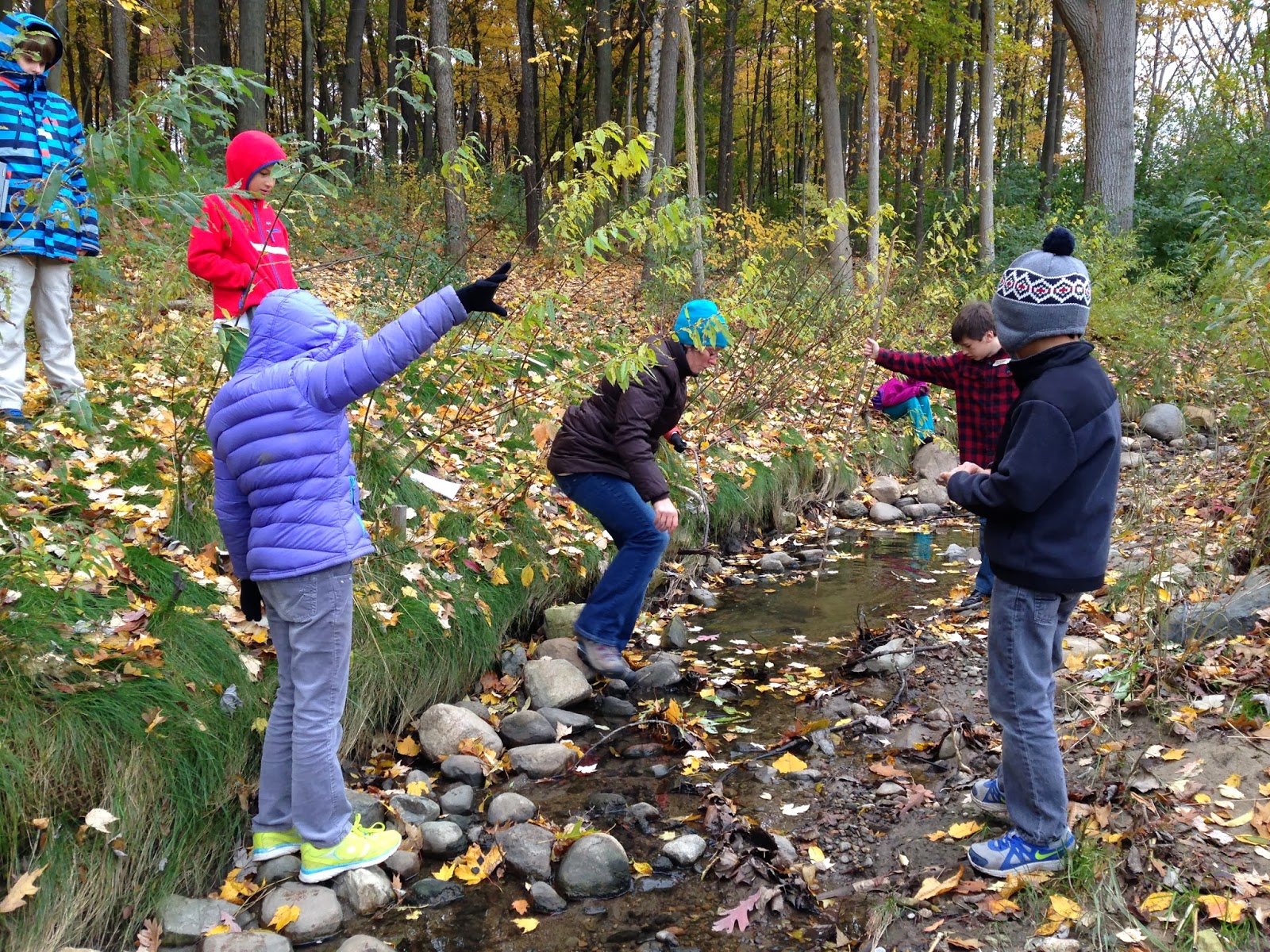
The kids explained their various projects to our guest speakers, then set off to data collection and discussion with our experts. Questions were asked and advice was sought. Some students were able to refine their studies a bit, setting the stage for a full afternoon in the park this Friday afternoon. 


Malletts Creek


Friday, November 1, 2013

County Farm Park project research


We spent part of the afternoon in County Farm Park again, planning our projects. Today's focus was on trying out some of our data collection ideas, and preparing questions for our naturalist guest experts on Monday afternoon.

Tuesday, October 22, 2013

Classroom guest! Tree identification with Jules


We had a guest speaker today! This morning, Jules came in to talk to us about plant identification. We took a walking tour of the Summers-Knoll campus, examining them and using a dichotomous key to identify the specific species of trees found around our school.

Here, Jules points out the features of the Norway Maple in front of the school. We also examined a large Silver Maple in our courtyard, a Scotch Pine (sometimes referred to as a "volcano tree"), a Black Pine, and some Common Buckthorn.

 Jules will be helping us shape our County Farm Park projects in the days ahead.

Sunday, October 20, 2013

Art class in County Farm Park

We had a special, extended Art class with Monica on Wednesday. We spent it doing close observation drawings of various plants in County Farm Park. Here we see kids observing and admiring the results. These drawings are the first step toward learning how to make block prints later this year. (And they'll likely be included in our County Farm Park class project.)