Showing posts with label Math. Show all posts

Friday, April 28, 2017

Week 30 -- Choose your own adventure


This week has been a whirlwind of collaboration. On Monday, we began working on an all-class choose-your-own-adventure story. We began by composing the first portion together as a whole-group activity, projecting the story on the big class TV. We took turns offering ideas for plot points and dialogue, finding our way to the first big branching point. We continued on and wrote the first parts of each branch as a group. At that point, we had four stories to continue, so we broke into smaller groups. Those groups continued autonomously, each coming up with their own subsequent branching points and splitting into smaller and smaller groups as the stories progressed. Eventually, everyone will be writing endings individually (and contributing to other storylines as they develop). It’s all being recorded in a crazy shared Google document. It's been a delight to see how the kids have taken the stories in radically different directions. You can sneak a peek of it here, with the caveat that it has not been completed or edited yet.


Thursday was a day that was particularly full of excitement, as we had two dramatic arrivals in our classroom. First of all, sturdy new tables arrived to replace the rickety ones that we had been working with. The class reacted passionately against them. (They sometimes fear change.) Eventually, an elite tiger team of go-getters took it upon themselves to start cleaning the tables off and getting them integrated into our space. Then, at the very end of the day, the very first sets of professionally printed cards from our Into the Biome game project arrived. They look great, which was a powerful motivator for the other three groups to get theirs completed and ordered as well. (Everyone is getting very close!)
Rachel works with the combined 5/6 grades every Thursday for library and technology. Here, they are discussing an article on the appropriation and alteration of Michelle Obama's image for a mural. 


An assortment of other things filled in the rest of the week, including a visit from Violet and Abe (complete with age appropriate read alouds), some background on how caves form, and a decidedly odd writing prompt about a unicorn head mask. Responses varied, as you would imagine.
A pick-up game of soccer with the 1/2s. 


In Math group, we spent Monday and part of Tuesday going through A Parable of Polygons, which is a fascinating interactive blog post written by Vi Hart and Nicky Case that creates a model society that values diversity, yet harbors a small bit of inherent bias (sound familiar?). By reading through and interacting with it, you start to see some interesting patterns emerging. It’s a thought-provoking post for young and old, and I heartily recommend exploring it on your own. We also read another chapter of The Number Devil, and devoted a couple of days to Singapore work time.

Friday, April 14, 2017

Week 28 -- Place Out of Time banquet 2017


Monday was the much anticipated Place Out of Time banquet, which finds the entire Summers-Knoll middle school traveling to the University of Michigan to meet face to face with many of the other students who have been participating in the POOT simulation. It’s always a fun trip, and we prepped for it by traveling into the S-K attic to find accents and costumes for the event. Once there, the students discussed and debated different aspects of the case with their peers in break-out groups, as well as in large, whole-group conversations. Afterward, our class was able to stay a little longer, allowing us to have an impromptu reflection conversation with the professors and college student mentors who orchestrate the whole experience. It was a highlight of an already exciting day.


Our journal prompt was student-submitted this week: What is your favorite board game and why? As always, it was interesting to read the range of responses. Some people preferred cooperative games, while others preferred competitive. Some preferred games with large groups of people, others preferred the opposite. One person noted that they liked games that required thought and set up before the game even began. This exercise led nicely into Thursday afternoon, which featured a class boardgame session. Our other writing prompt was a story starter involving a mysterious cloud island. These stories are still in the process of being developed, but the glimpses I’ve seen are promising!


In Math group, we read the first two chapters of The Number Devil, by Hans Magnus Enzensberger. It’s a fun and strange book in which a young student’s dreams are plagued by an odd creature who shows him some interesting curiosities in mathematics. Take, for example, the pattern formed when you multiply 11x11, and compare it to 111x111, and 1111x1111, and so on. (Try it yourself.) We also dipped into the Roman numeral system, which we will be continuing with next week.

Friday, March 17, 2017

Week 25 -- Pi, pi, shoplifting, and justice

Recording our gravity car trials in science 

The Place Out of Time trial has begun in earnest, and we spent part of this week unpacking the opening arguments of the plaintiff and the defense. As mentioned previously, our case involves the true story of the Italian Supreme Court of Cassation overturning the conviction of a homeless man who shoplifted approximately $4.70 worth of food because he was in “a state of need.” It’s a very interesting story, and it’s well worth reading a little about it. It captures a lot of what’s in the political climate of our country at the moment, while being far enough removed to allow some perspective.

Our trial in the Place Out of Time courtroom is a fictional extension of the story. The plaintiff in our case is the shopkeeper whose merchandise was stolen in the first place. She asserts that human need and dignity are obviously important matters for a society to address, but the fact remains that it was her store and property that were affected. A law was broken, and she was directly impacted. Doesn’t this ruling send a message that anyone can come in and take her property? She makes a compelling argument, and the defense has the job of convincing us that the court’s ruling should stand. Everyone is wrestling with this issue, both in-character and as themselves.


Winter came back for a bit this week:


Henry pits readers against each other. 
Meanwhile, a conversation that began during our weekly library time with Rachel led to this week’s journal prompt: “Novels versus Graphic Novels!” Students were encouraged to explore the pros and cons of each as a storytelling medium, and to write about how they interact with each. It was a unique prompt, in that kids were given the option of responding in prose, text, or some hybrid of both. Some kids who enthusiastically leapt to respond in a comic format realized that it can take a lot longer to write and draw a story than they realized. Many of the responses were playful and clever. Ask your child how they responded!
Joey had the books themselves fight it out. 

In math group, we spent some time working in our Singapore books, but as with every March 14, pi was front and center. On Tuesday, 3/14 (Pi Day), we watched some videos about pi, including one of Vi Hart’s infamous anti-pi rants.

One of the points of her video led us down a bit of a rabbit hole, as we started talking about scales of magnitude and the spaces in between things. This was vividly illustrated by playing with the very illuminating internet tool/toy The Scale of the Universe. Please do yourself a favor and spend several minutes playing with it right now. We also watched the classic Eames film Powers of Ten.


Of course, we are essentially obligated to bring in some sort of actual pie as part of all of this, a task that Sam dutifully took on as our school’s foremost expert on pi, pie, and homophones.


Friday, December 16, 2016

Week 15 -- The Nutcracker and fiascos


It’s difficult to top the excitement of an unexpected snow day, but we did our best with the rest of our week. On Tuesday, we began reading When You Reach Me, by Rebecca Stead. It’s a difficult book to talk about without giving away its secrets, so suffice to say that it begins in the late 1970s in New York City, and a mystery quickly develops. We also continued group peer review sessions of our Summers-Knoll myths, practicing active listening and giving constructive feedback to one another.


On Wednesday, we entered into a fun new phase of our Into the Biome project, which was born in science class. Kids are working in teams to create their own versions of a game we enjoyed called Into the Forest, and we began creating the artwork for the games. Our room is quickly filling with renderings of wolverines, blue jays, raspberries, sea cucumbers, and more.  


On Thursday, we traveled to the Power Center in Ann Arbor to see a production of The Nutcracker (and to cheer on our classmate Rebecca, who was one of the sugar plums!). Between that and our work on the school play last week, theatrical productions have loomed large in our minds, so when we returned to school, we listened to act 1 of the Fiasco episode of This American Life while working on artwork for our games. It’s a very entertaining story that certainly puts some of the minor mistakes that we may have made in our own performances into stark perspective.

Math group was quite abbreviated this week, as we missed two sessions (one from the snow day, the other to go see The Nutcracker). The remaining two days were spent working in our Singapore books, and doing a self-audit of progress. I had each student make note of what page they were on in their books, then told them what page they had been on at the beginning of the school year. Some students were pleasantly surprised by how much progress they had made in 15 weeks of school, while others have a renewed sense of purpose in making good use of their time and energy in class. On Friday, our work period was punctuated by a fun visit from Mrs. Carpenter’s math students, who came and performed some math magic for the group.

Friday, December 9, 2016

Week 14 -- Peer review, myth, and multiplication

Scenes from the Stratford workshop
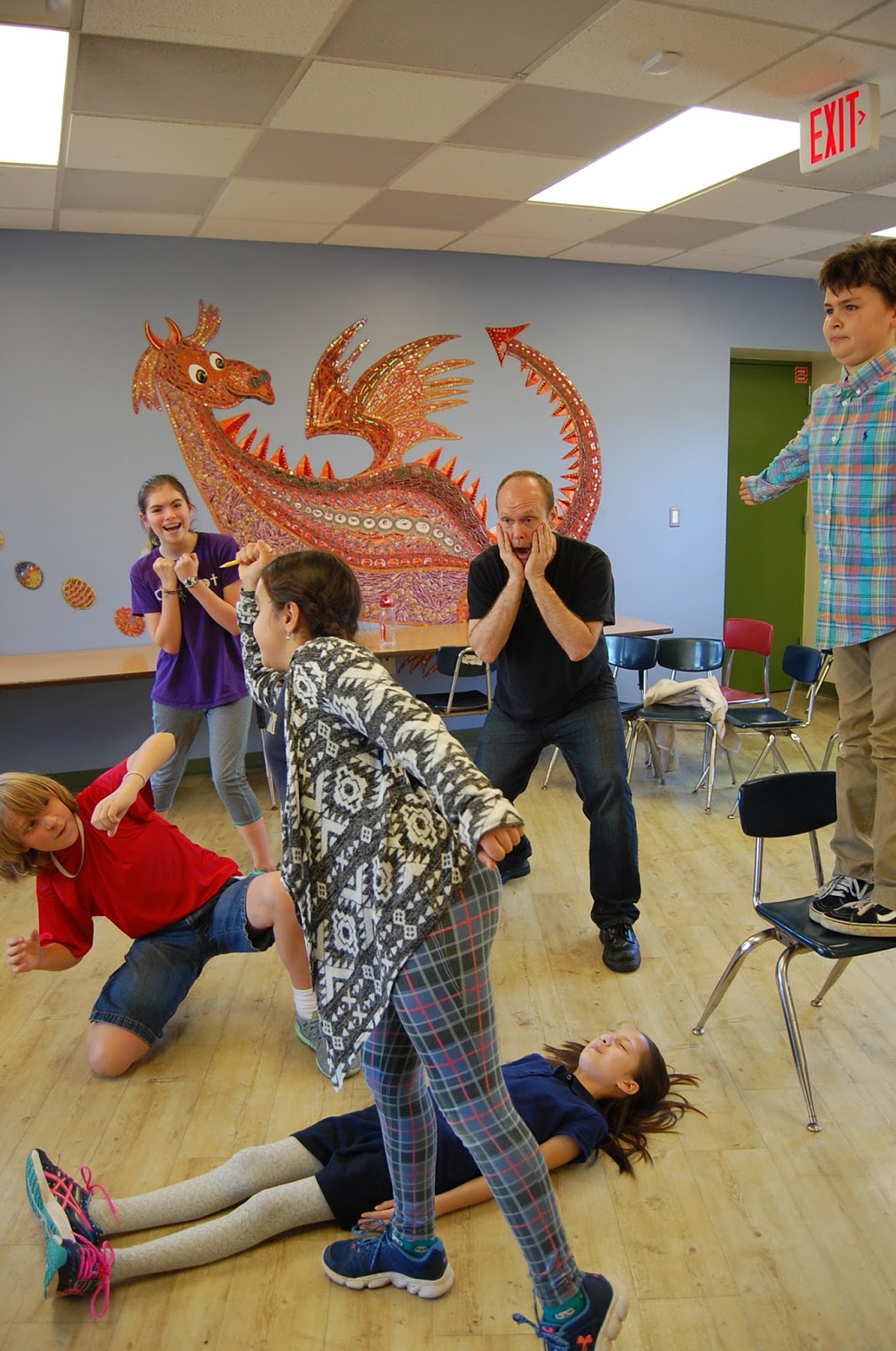
The week of the school play is almost always wholly consumed by rehearsal and prep, and this year is no different. We’ve spent much of our homeroom time running our lines, practicing the staging, and trying to hone our performances to make sure that we put on a good show. Meanwhile, the students who don’t have roles in the play have been working to design and construct the props needed for the show. We hope to see you at one of the performances of the show!
Scenes from the Stratford workshop
When not working on the play, we’ve been doing group peer review of our Summers-Knoll myths. Our protocol for this is as follows: First, each student reads a piece of writing to the group twice. Both times, students are actively listening for things that they find interesting and enjoyable, as well as making note of where they were confused, or where the author might want to go into more detail on something. After reading their work, the author takes control of the room and calls on volunteers. For the first few minutes, we ask only for positive thoughts. Kids might point out something that they thought was clever, an interesting turn of phrase, or praise a plot twist. Then, we switch into constructive criticism. The audience shares what they were confused by, where the author might go into more detail, etc. The author’s role during this time is exclusively to listen to their audience. Questions about the work are deliberately not answered, and points are not argued. The point is that the author knows that their audience had those thoughts while hearing the work. The author then processes and considers the feedback, and uses it as they see fit during the revision process later.


For example, an author may have intended for a particular character to be somewhat mysterious in their story. However, if they get feedback from their peers that the character came across as merely underdeveloped, they can then take that information and work to clarify their intent during the revision process.
Scenes from the Stratford workshop

This method of review requires a community of writers who are all taking the exercise in good faith, and who are actively working to support each other during what can be a somewhat harrowing process. It can be challenging and scary to receive feedback on your writing, and I am happy to report that the conversations have been kind, productive, and supportive.

In math group, we have concluded our survey of multiplication methods, culminating with the standard algorithm, which is the method that most of us were taught during our own schooling. We learned and practiced seven different methods of multiplication, On Thursday, we began an assessment to see how well we could perform each of them, while also evaluating their effectiveness. Which methods are the quickest? What are the strengths and weaknesses of each? Perhaps most importantly, which methods are the most efficient for each individual? Surveying these varied methods has drawn a fine point on the idea that there isn’t one “correct” way to perform this operation, and by examining each method and comparing them to each other, we have developed a deeper understanding of what is actually happening when you multiply.
Henry performs at the Music Cafe


Friday, November 18, 2016

Week 11 -- Myth, music, and math


There was a big focus on performance this week. The most public example of that was a substantial amount of preparation for the Friday night’s Music Cafe. Keyboards, drum sets, music stands, and the occasional harp were dragged to and fro as kids found places to practice their pieces for the show. We also received our parts for the school play, and we began our first proper run throughs of the script. We also began reciting our Summers-Knoll myths to each other. You may recall that we’ve been writing stories that convey some aspect of the culture of Summers-Knoll. Now, we’re telling them to each other and seeing what aspects resonate with people and survive later retellings. In addition to being audiences for each other, we were able to spend part of Wednesday morning attending the poetry exhibitions of the 7/8s to see what they’ve been studying. Finally, some we were visited by some actors from the Stratford Festival, who engaged the entire middle school in some acting exercises. 

Our journal writing prompt this week was, “A ship in harbor is safe, but that is not what ships are built for.” It’s a thought that speaks to the spirit of risk-taking and courage that emboldens these kids to stand up in front of each other and our community to tell stories, sing songs, and share themselves so openly and publicly with the world.


In math, some students took a risk of another sort by participating in the AMC-8 math competition on Tuesday. Math competitions aren’t exactly a common occurrence at Summers-Knoll, but they are certainly an interesting thing to opt into for a unique experience. Meanwhile, our class began investigating the concept of multiplication, discovering that there are actually dozens of ways to perform this seemingly mundane mathematical operation. It’s an investigation that we’ll be continuing in the weeks ahead, learning different methods and then evaluating them for precision and speed.


There was some time after Science class for some fall fun on Friday:


Friday, October 14, 2016

Week 6 -- Milkweed hunt, rising tigers, and graphing caterpillars


Scenes from a milkweed scouting mission


We finished reading The Tiger Rising this week, analyzing its rich figurative language (we’ve been focusing on metaphor and personification), as well as the author’s use of parallels and imagery. We’ve discussed the book extensively as a group throughout our reading, and now students are reflecting on it individually through a series of questions. We also had opportunity to sample some novels individually this week. I gave very brief introductions to about a dozen novels that the class was unfamiliar with, then they each picked one and read it for about thirty minutes. Afterwards, they wrote a quick review of their thoughts on it, indicating if they might like to continue reading it, or move along to something else next time. (Ask your child what they sampled and how they felt about it!)


Our journal writing prompt this week is “do you enjoy sharing your writing with other people?” As you might imagine, opinions vary. Another writing prompt this week was “describe a day in class from the teacher’s point of view,” which has given them all a chance at expressing some empathy for their teacher. Through it, I’ve learned that they have some strange ideas about what I actually think from moment to moment.

We also returned to reading Napoleon Chagnon’s Yanomamo: The Fierce People, which always leads to rich discussions about how complicated it is to examine a culture that is very different from your own. The class delighted in hearing how the Yanomami subverted Chagnon’s attempt to create detailed genealogies of the villages he visited. Ask your child why they didn’t want to help, and how they tricked him. It’s a pretty good story.


In math, our group has merged with Sam’s to do some graphing work on the data that the 5th and 6th graders have been collecting about their monarchs. We worked in groups to accurately graph the growth rates and pupation point of several of our caterpillars, then began discussing how we can draw conclusions from those graphs when viewing them.