Showing posts with label Scenes from S-K. Show all posts

Friday, December 4, 2015

Weeks 9 - 13: Miscellany


I take a lot of photos over the course of a week. Here's a smattering of odds and ends from recent weeks. 


Juna is camera shy. 

Her classmates are not.


Henry!


Guest artist Leslie Sobel came to share her work with us several weeks ago. The middle school recently visited an exhibition of her work at the Village Theater in Canton. Monica has an entry up on her Middle School Art Blog as well.


Touring the theater


Nick!


We've been studying body systems in Science. Here are some photos of our class constructing a device to simulate the lung. 


And here we see kids puzzling through the muscular-skeletal system. They are attempting to construct a "muscle" that mimics the hinge joint of the human elbow.


Silent reading time:


Each Monday morning, the whole school gathers for an assembly. Here, the student government representatives articulate and demonstrate the rights and responsibilities that they have come up with.


Using the windows as a giant light box for tracing.


Bora!


As part of our exploration of the various body systems, we've been constructing paper models of ourselves with each system taped inside. It's yielded some odd photo opportunities.


We led the school assembly on Monday, November 23rd. We opted to talk about our three class values, demonstrated by brief skits.


Grandfriends Day!


Here we are playing 'Jenkins Says' with our Grandfriends. (Ask your kids/Grandfriends about the rules. It's fun!)


Giving the Grandfriends a tour of the school. "The Cove" is always a popular stop. 


Preparing scenery for the school play:


Winter is coming. 


Saturday, October 31, 2015

Hodge Podge: Week 8 in review


This was an excellent year for Eco-Fair/Homemade Halloween costumes! 

It is impossible to adequately convey everything that happens each week, which is why a lot of blog posts lately have focused on one aspect of our work. This week, I decided to try to capture a smattering of what happens from day-to-day.


The first thing we do each Monday is attend an all-school assembly. Each week, a different homeroom is responsible for sharing something with the entire school. This helps keep our community connected with all of the interesting and exciting things that are happening around the school. This week, Spencer's group talked about projects that they're working on. The morning assemblies are only about fifteen minutes, so if you have time to spare at drop-off on a Monday, come join us! (Our class is up to lead on Monday, November 23rd.) 


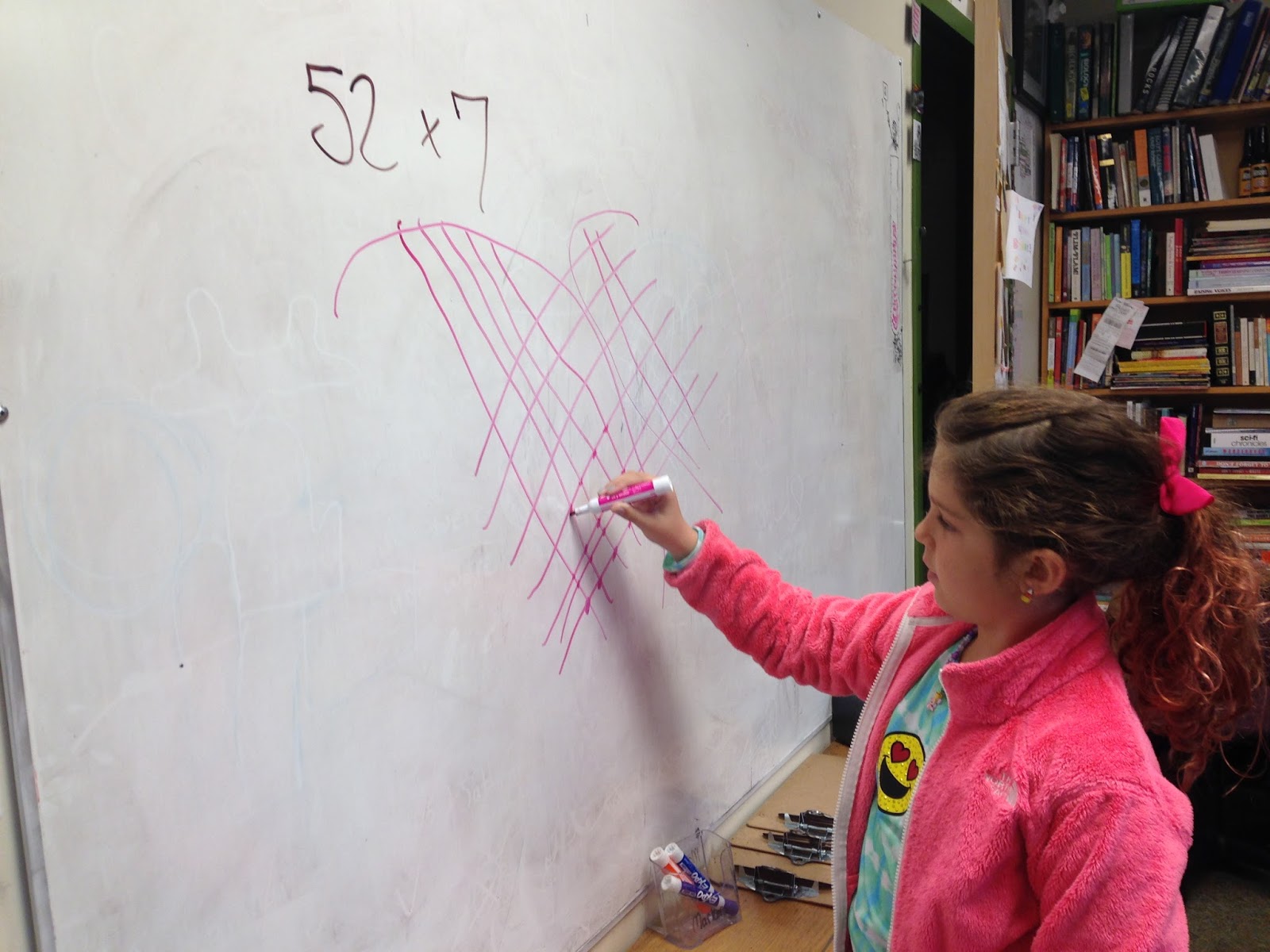
In my Math group, we spent much of the week discussing the concept of multiplication. Many of us learned the "standard algorithm," but not necessarily how or why it worked. Some of us might not have even understood that there are, in fact, many different ways to multiply numbers. 
The "standard algorithm"
Our group spent the week learning and evaluating other methods of multiplication (and also firmed up our understanding of the standard algorithm). 

The Lattice method is one that is also frequently taught. It's fairly similar to the standard algorithm, but it breaks it down into slightly smaller steps. Take a look: 


Reviews were mixed at first on this method, but once mastered, it was generally appreciated. 


Compare that with this method, which is very cool and enticing:


Everyone was instantly captivated by this one. The video above is silent (a reminder: embedded videos sometimes don't show up in the email version of this blog. Check the web version of this blog if you don't see a fascinating video of someone drawing lines to multiply above), below are two videos with verbal explanations: 


This method received high marks at first for smaller numbers, but the grouping aspect of it quickly became unwieldy for many of us with larger numbers. Many found the counting aspect of it to be laborious with larger numbers. 


Finally, here's a really cool method with many names, including Egyptian multiplicationEthiopian multiplicationRussian multiplication, or peasant multiplication.


Back in homeroom, we began a read aloud called Esperanza Risingby Pam Muñoz Ryan. The book is historical fiction, beginning in Mexico in 1926, and moving to the United States during the 1930s. In the first few days of reading, we've had conversations about social class, the Mexican Revolution, the customs and laws of inheritance ("wait, why can't Esperanza's mother inherit the land!?"), which lead all the way back to the Magna Carta. 

We'll be getting into migrant and immigration issues, the notion of organized labor, discrimination, and more. 


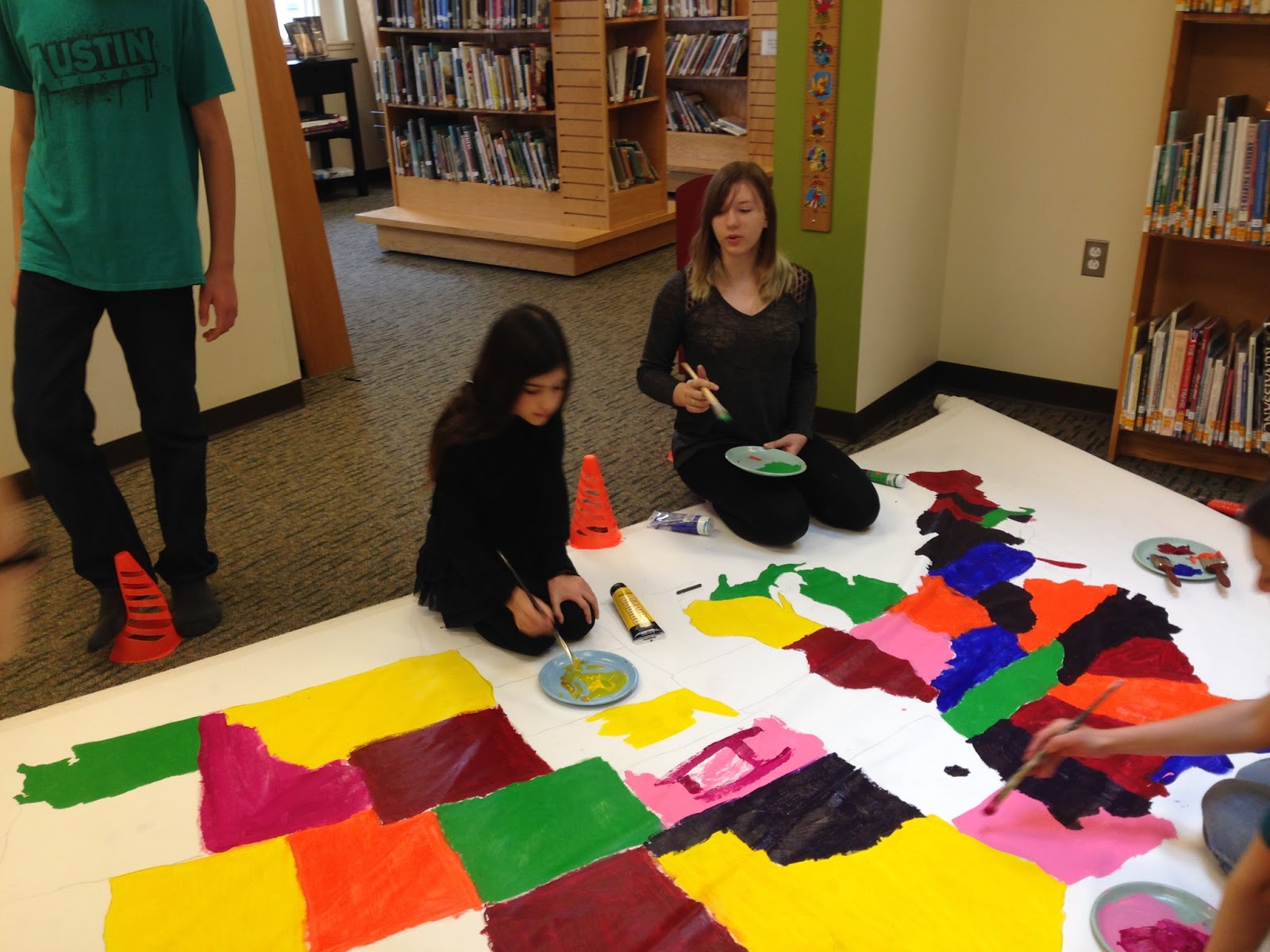
The book benefits from a decent grasp of North American geography, and after a brief pre-assessment, we decided as a group that we desperately needed some work on this front. 


Ella and Bora work to label their US maps. 
Completely unrelated, but I think it's funny, so here's Bora confronting Zombie Ella. 

Of course, the highlight of the week for many was Eco-Fair/Homemade Halloween. There was a strong showing of costumes this year, both in our class and across the school! 


We also did some writing, learned about simile and metaphor, worked with Scholastic News, made progress in our electives, had a rehearsal for the upcoming play, made Mason jar heart pump models in Science, worked on Music Cafe songs, and plenty of other stuff. A busy week! 


Tuesday, September 15, 2015

Science: "Enigma Cylinders" (and banana phones)


As you may know, Lisa Johnson (famous and beloved for bringing Fish Lab to Summers-Knoll) has joined our faculty as a science teacher. We'll be co-teaching science this year, and we ran a fantastic activity on class on Monday. I'll tell you all about it, just as soon as Bora finishes this phone call. 


Bora blatantly violating our "no phones during the school day" rule


We wanted the kids to get the kids "doing science" early and often this year, but many people have differing ideas about what that actually means. To get us all thinking about what science really is, we introduced the class to some mysterious objects that we call "Enigma Cylinders." 


As an educator, this activity was incredibly easy to run: We simply passed out a few of the cylinders to the kids. Before we had a chance to bore them with directions, they all instantly snapped into the mindset of scientists. They furrowed their brows, tugged at strings, and started talking. 


First they made observations, then they started offering possible explanations for what they were seeing. Before long, they were sketching. By the time Lisa and I actually told them that they'd be attempting to make their own models of this contraption, most of them were already well on their way to sketching potential designs. All of this was pure inquiry. It required so little direction from us that I was able to film them in action. Check out the following video, which picks up immediately after handing kids the cylinders. None of what you hear them saying is in response to questions that we've posed to them. If you've ever wanted to be a fly on the wall during a Summers-Knoll class, this is the video for you:


As mentioned in the video, all three groups eventually constructed models that seemed to be reasonable facsimiles of the cylinders that they examined. However, Lisa and I have vowed to never reveal the inner workings of our actual cylinders, as that's part of true science! There are many things in this universe that we will never truly know. 


Lisa gave a great example: We will never know for certain what caused the extinction of the dinosaurs. Never! We do, however, have a very good hypothesis or two about what happened to them. And as we collectively learn more about the world, we can revise our hypothesis (or throw it out entirely if compelling evidence demands it). In many ways, science demands failure and revision. We will encourage both over the course of this school year (and beyond)!


But enough about Science. Let's check in with Bora. How's that phone call going, Bora? 


See? This is why we make kids keep them in their backpacks.