Showing posts with label water. Show all posts

Wednesday, December 17, 2014

Separating iron, salt, and sand


As part of an ongoing study of water, filtration, compounds, and mixtures, students are currently working in small groups to design a procedure to separate this:


A mixture of sand, salt, and iron

Into this: 
Separated samples of iron, salt, and sand

It requires a deepening understanding of many of the concepts we've been working with this year, including filtration, mixtures, and evaporation. It also requires brainstorming a plan with their partners, as well as crafting a detailed procedure to follow. 

Checking out the magnified structures of iron, salt, and sand 


Wednesday, December 10, 2014

Our class lately. . .


It's been difficult to adequately sum up what's been happening at school lately, as we've been very busy! 


First and foremost, our upcoming school play looms over everything. Rehearsals for Alice have taken over this week, and things have been coming together nicely! 
A full dress rehearsal underway in the atrium
Meanwhile, the students who aren't in the play are working on a variety of other projects. 
Gabe and David are working on a tessellation presentation. Marcellin and Keira are working on creating a fraction game. 
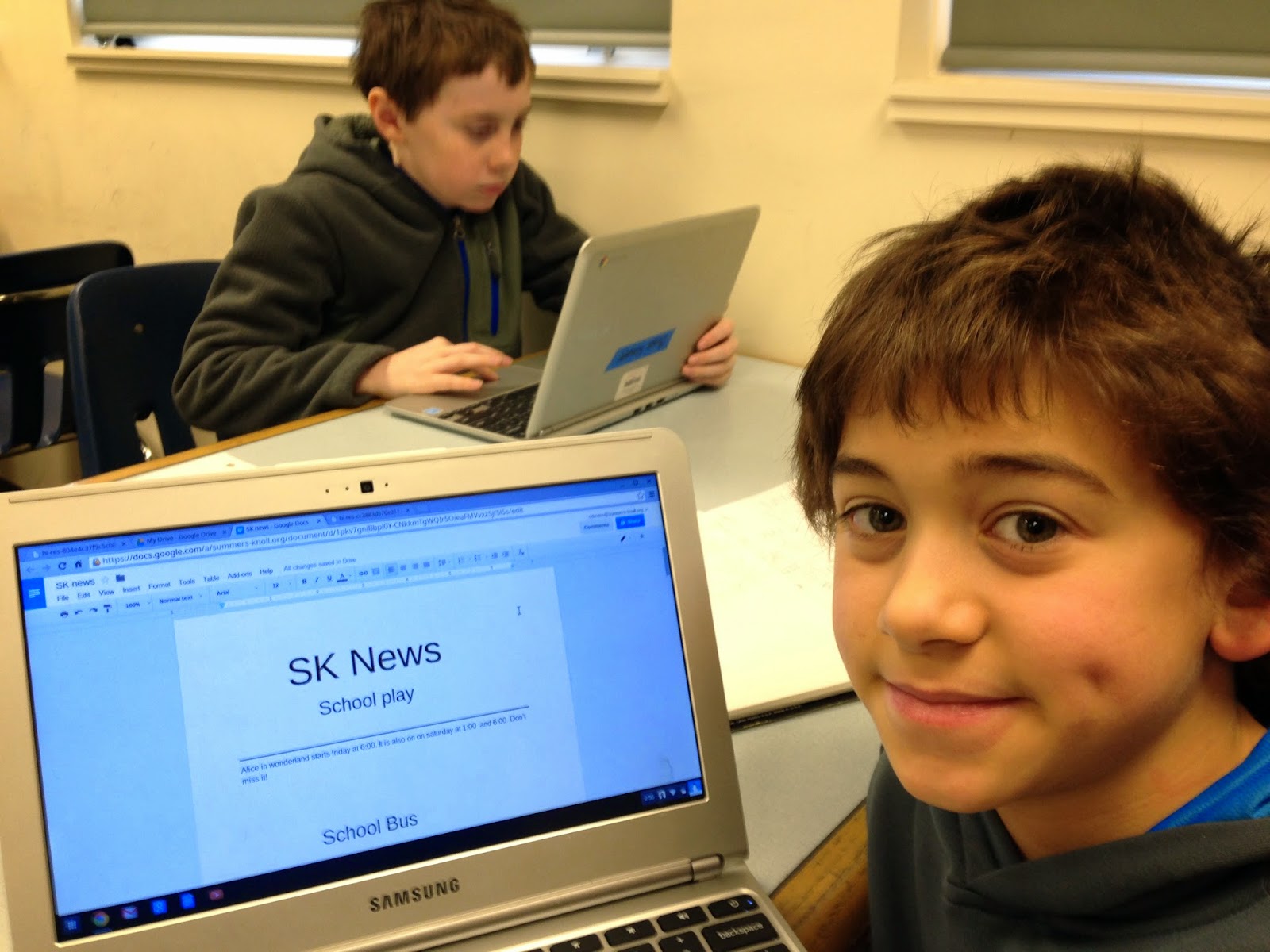
Owen began working on an S-K themed newspaper, and Oliver has started contributing as well. 

Meanwhile, our entire class continues our investigation into water, water purity, and filtration. Here, Sam uses a student-built filter to see if it can remove green food coloring from a cup of water. (It can't! Why not?)

Nick shows off a jar of water that has been driving a lot of our investigations. It was pulled from the standing water just behind the S-K playground. We've been watching as it settles and changes, and learning about the processes that cause the jar to re-pressurize every time we open it and re-seal it. 

We've also been conducting an experiment in evaporation. We placed the same amount of water into differently shaped containers. At what rate will each evaporate? (If they're different rates, why might that be?) Not only is it an exercise in surface area, evaporation, and filtration, but also one involving experimental design and good data collection. (Students are also writing a set of procedures that are precise enough that someone else could replicate the experiment.) 


On top of this, we're also continuing with our book groups. Some groups are finished with their books and have moved onto preparing presentations to share with the rest of the class. It's a busy time! 


Tuesday, November 11, 2014

Science: Filtration investigation

Various filter designs

As part of our ongoing study of water, watersheds, and water quality, we began a discussion today about water filtration.


We began with a reading to build some background knowledge, making note of (and discussing) terms that were unfamiliar to the class.

Then, students were tasked with creating two different designs for potential water filters, given a list of materials and their costs. Their budget was $8.00 per filter.


The groups set to work, brainstorming ideas and crafting designs.


The next step will be to present their designs to the class to get feedback.


Thursday, October 16, 2014