Showing posts with label Music Cafe. Show all posts

Friday, May 12, 2017

Week 32 -- Reflections and running


We began the week with a warm-up created by Evie, which tasked kids to design an umbrella, then write about a day in its life. One story has the umbrella married to a broom, who has been put out of work by the fancy new vacuum. A few had the umbrellas lamenting the amount of time they spend whiling away their days unused and hanging on hooks. At least a couple incorporated Seattle. We also spent some time listening to an assortment of each other’s work as I read it aloud from their files. We do a wide variety of writing in our class, and I often collect it and hold onto it for long periods of time. Then, I occasionally read samples of work anonymously. The class generally loves hearing each other’s work, trying to guess who wrote what, and delighting in hearing work with fresh ears. It also gives them a periodic reminder of just how much they’ve produced this year, and how good much of it is.
Some of the cards from Into the Great Barrier Reef

Because we’re so deep into the school year, some aspect of these weekly summaries will frequently be different versions of this: We also continued work on our ongoing projects. This week, we had two more milestones in our biome game groups. One group figured out an efficient and good looking way to correct the mistakes in their game decks, and they’re well on their way to the finish line. We were also very excited to officially place the order for the Into the Siberian Taiga group! We’ll likely receive them in the next week or so.


Two other big events kept everyone occupied this week. Reflections Night preparation always dominates the week of a performance, and everyone seemed to have a great time at the event. We capped the week off with the long-postponed Fun Run around the building, followed by the more intense S-K 5K.


In math group, we’re trying to finish the year with strong showings in our Singapore work, so we’ve been focusing a lot of time in class making progress. We also had one of our beloved game days this week to break up the routine.

Friday, March 3, 2017

Week 23 -- Filling in the gaps, fear is a LIAR.


In science, we're continuing to work with our gravity-powered cars. 
After a relaxing week off, we got right to work with an extension to our Place Out of Time timelines project. By now, almost everyone has a detailed timeline of the life of their character posted in the appropriate spot on our giant timeline in the middle school commons. However, most of our characters are clustered in the twentieth century. This week, we have spent some time populating the gaps in our huge timeline to provide more context for the scope of human history. For example, before this week, there were no events recorded in the entire 1400s. Now, there are notes about the world-changing voyage of Christopher Columbus in 1492, and another noting that the game of chess was in its modern form by 1475. Each student has been tasked with putting up at least five cards on the timeline this week, with more to come in the weeks ahead. Also POOT-related, Sam led the entire 5-6 group in a discussion about dignity, which is a concept that is the heart of the issue framing Place Out of Time this year.

Calculating averages for each of our trials


We also concluded our read aloud on Monday afternoon. The climax of When You Reach Me is mind-bending and unexpected, revealing the fact that many tiny details along the way were actually clues, laid out like breadcrumbs for the reader to discover. It’s a lovely book that tightly-plotted and bittersweet. Ask your child about “the Laughing Man” and see what they’ll reveal about the story.


Our journal prompt this week was “fear is a liar.” Kids were asked to respond to the idea, considering what it might mean, evaluating the validity of the statement, and coming up with examples that might argue the point either way. Students wrote about how fear was both useful (it keeps you from harm), but also occasionally counterproductive (roller coasters are fun, planes are useful).

Of course, the impending Music Cafe tends to take over the week, so focus quickly shifted toward that by the end of the week.


In math group, we celebrated a couple of kids completing assessments and moving into new books, worked collaboratively on some problems (ask about Danielle, her pet crocodile, the parrot, and the monkey), and had an always-popular math game day.

Friday, December 9, 2016

Week 14 -- Peer review, myth, and multiplication

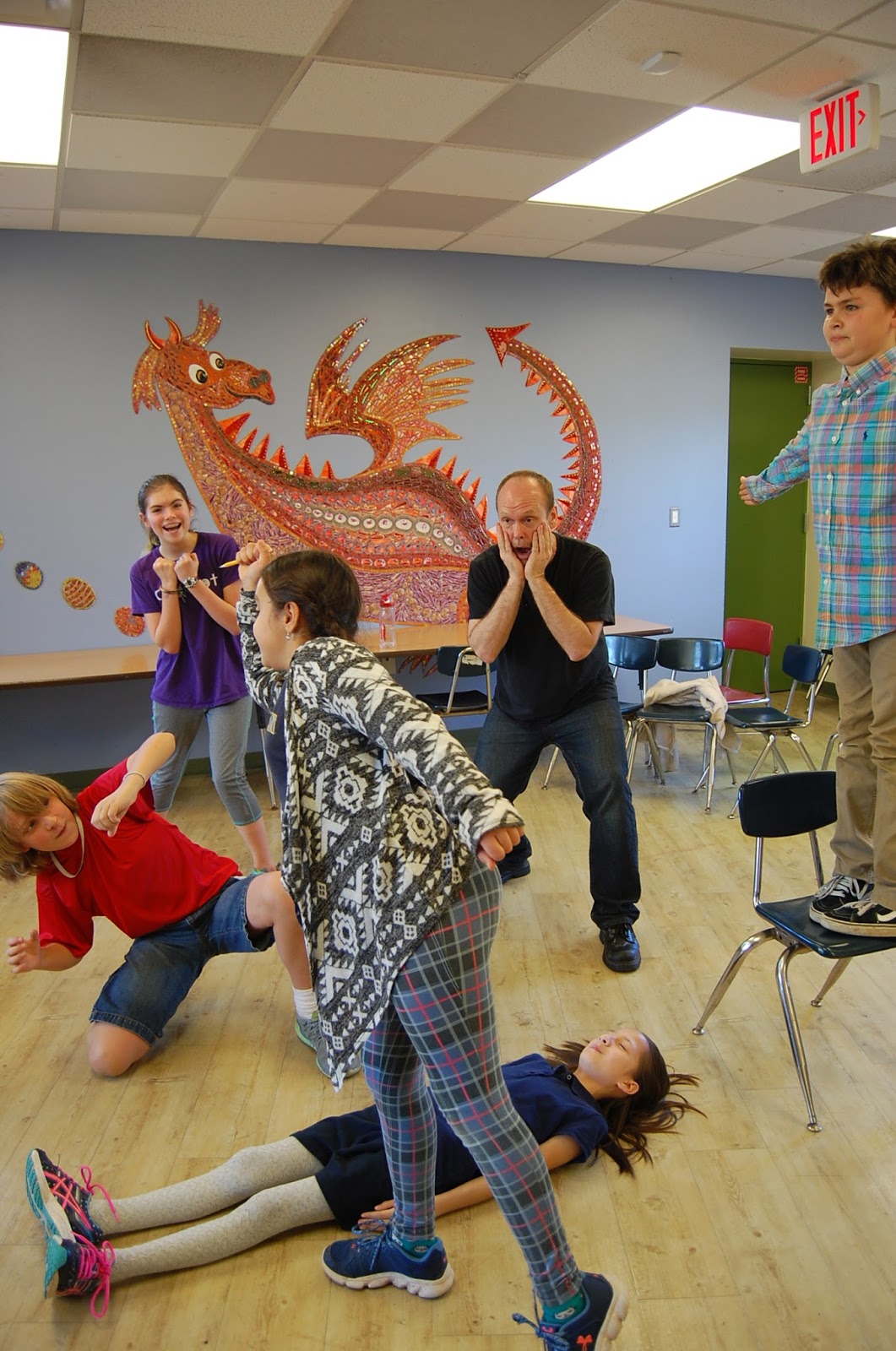
Scenes from the Stratford workshop
The week of the school play is almost always wholly consumed by rehearsal and prep, and this year is no different. We’ve spent much of our homeroom time running our lines, practicing the staging, and trying to hone our performances to make sure that we put on a good show. Meanwhile, the students who don’t have roles in the play have been working to design and construct the props needed for the show. We hope to see you at one of the performances of the show!
Scenes from the Stratford workshop
When not working on the play, we’ve been doing group peer review of our Summers-Knoll myths. Our protocol for this is as follows: First, each student reads a piece of writing to the group twice. Both times, students are actively listening for things that they find interesting and enjoyable, as well as making note of where they were confused, or where the author might want to go into more detail on something. After reading their work, the author takes control of the room and calls on volunteers. For the first few minutes, we ask only for positive thoughts. Kids might point out something that they thought was clever, an interesting turn of phrase, or praise a plot twist. Then, we switch into constructive criticism. The audience shares what they were confused by, where the author might go into more detail, etc. The author’s role during this time is exclusively to listen to their audience. Questions about the work are deliberately not answered, and points are not argued. The point is that the author knows that their audience had those thoughts while hearing the work. The author then processes and considers the feedback, and uses it as they see fit during the revision process later.


For example, an author may have intended for a particular character to be somewhat mysterious in their story. However, if they get feedback from their peers that the character came across as merely underdeveloped, they can then take that information and work to clarify their intent during the revision process.
Scenes from the Stratford workshop

This method of review requires a community of writers who are all taking the exercise in good faith, and who are actively working to support each other during what can be a somewhat harrowing process. It can be challenging and scary to receive feedback on your writing, and I am happy to report that the conversations have been kind, productive, and supportive.

In math group, we have concluded our survey of multiplication methods, culminating with the standard algorithm, which is the method that most of us were taught during our own schooling. We learned and practiced seven different methods of multiplication, On Thursday, we began an assessment to see how well we could perform each of them, while also evaluating their effectiveness. Which methods are the quickest? What are the strengths and weaknesses of each? Perhaps most importantly, which methods are the most efficient for each individual? Surveying these varied methods has drawn a fine point on the idea that there isn’t one “correct” way to perform this operation, and by examining each method and comparing them to each other, we have developed a deeper understanding of what is actually happening when you multiply.
Henry performs at the Music Cafe


Friday, November 18, 2016

Week 11 -- Myth, music, and math


There was a big focus on performance this week. The most public example of that was a substantial amount of preparation for the Friday night’s Music Cafe. Keyboards, drum sets, music stands, and the occasional harp were dragged to and fro as kids found places to practice their pieces for the show. We also received our parts for the school play, and we began our first proper run throughs of the script. We also began reciting our Summers-Knoll myths to each other. You may recall that we’ve been writing stories that convey some aspect of the culture of Summers-Knoll. Now, we’re telling them to each other and seeing what aspects resonate with people and survive later retellings. In addition to being audiences for each other, we were able to spend part of Wednesday morning attending the poetry exhibitions of the 7/8s to see what they’ve been studying. Finally, some we were visited by some actors from the Stratford Festival, who engaged the entire middle school in some acting exercises. 

Our journal writing prompt this week was, “A ship in harbor is safe, but that is not what ships are built for.” It’s a thought that speaks to the spirit of risk-taking and courage that emboldens these kids to stand up in front of each other and our community to tell stories, sing songs, and share themselves so openly and publicly with the world.


In math, some students took a risk of another sort by participating in the AMC-8 math competition on Tuesday. Math competitions aren’t exactly a common occurrence at Summers-Knoll, but they are certainly an interesting thing to opt into for a unique experience. Meanwhile, our class began investigating the concept of multiplication, discovering that there are actually dozens of ways to perform this seemingly mundane mathematical operation. It’s an investigation that we’ll be continuing in the weeks ahead, learning different methods and then evaluating them for precision and speed.


There was some time after Science class for some fall fun on Friday: