|
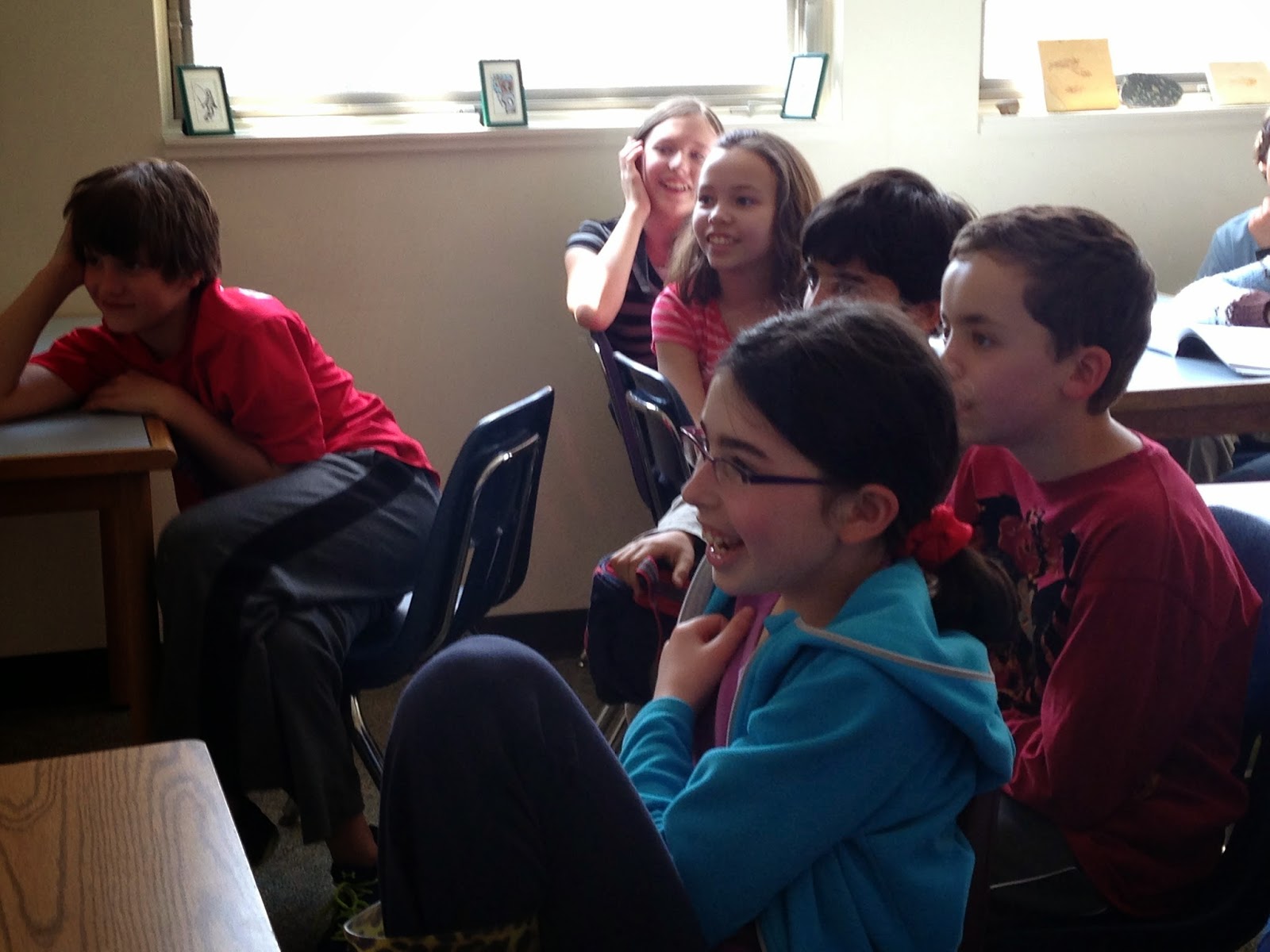
| But first, say hello to the mysterious, affable, two-headed creature that we call Junella. |
Identity Theme - Communities
Our first theme for the school year is Identity. One of the ways that we'll be exploring this topic is by taking a closer look at our own identities. There are many ways to think about who we are as individuals, and one particularly useful one is to think about what communities we are members of. After some discussion, we filled out charts listing (some of) our various communities, along with the benefits we receive for being a part of them, and the responsibilities that we have to them.

For example, everyone listed their immediate families as one such community. The benefits they receive are food, shelter, love, safety, etc. Each person had different responsibilities to their family, such as doing chores, going to school, being kind, and so on.
Other examples of communities were sports teams, the city of Ypsilanti, the city of Ann Arbor, the Summers-Knoll School community, our classroom community, the State of Michigan, the United States. Some kids thought even more broadly: We are a one species, and we are all citizens of the world.
Everyone was able to think of several communities, as well as list some benefits that come along with being a part of that community. On one level, this got us all thinking a little more pointedly about the privileges and advantages that we are afforded in our lives. (And our upcoming field trip to Howell Nature Center will reinforce and expand this concept!)
By also thinking about our responsibilities to these communities, it made us a little more conscious about what we're doing to serve and support them, and perhaps how we might be able to be even more mindful about them. (So feel free to use this weekend to try and encourage your child to pick up a few more household chores.)
Technology at Summers-Knoll -- Crafting our technology guidelines
Each member of our class will soon be issued a Chromebook laptop for school use. These marvelous machines are remarkably useful tools, and we'll have them out regularly. However, learning to use them properly is fraught with peril. First of all, we all have to agree what "properly" means! Each year, we work with students to help them craft their own set of guidelines for safe, productive use of technology at Summers-Knoll.

We began with a group brainstorming session with Jason's Class and Sam's Class working together to get our ideas going. What are some things that we shouldn't do with our computers? What are some things that we should do with them? Students then broke off into small groups to come up with guidelines that they felt were reasonable. ("Don't have food or liquid near your computer." "Do good work." "Don't get out your computer unless you've asked or been told to get it." "Use appropriate search terms." "Make sure your computer is plugged in at the end of the day.")

Then we came back together and shared our drafts of items for our technology agreement. Once we've drafted it (and made sure that we didn't miss anything important), students will read through the rules that they created (and that we approved) and sign an agreement to abide by the guidelines.

Giving the students an active role in the creation of these guidelines instills a sense of ownership in them that is far more powerful than simply being handed a list of rules to follow. It also gets them thinking about the challenges and issues that they will face over the years as they venture online more frequently.
Stepping up and helping out
As recess was wrapping up on Thursday, we had an impromptu opportunity to help our our community. Shan had the Kindergarteners out on the playground as part of a science scavenger hunt, and one of her students got cut. As Shan tended to the (very minor, but bleeding and potentially disturbing image for our littlest students) wound, each of the 5th/6th graders quickly paired off and teamed up with a Kindergartener and proceeded to help them out with their task, while Shan took time to clean and bandage the cut.
 |
| Ella takes a photo of her Kindergartener's find. |
One of the best ways to bring out the best in older kids is to have them work with their younger schoolmates. It was lovely to see in action.


Identity Theme: What is an American?
As another way to explore the concept of identity, we began a study of American history. There are many possible points to begin this story, and I've chosen the epic tale of Cabeza de Vaca.
If you don't know his story, it's worth looking into. Cabeza de Vaca was part of a doomed conquistador expedition to the mainland of North America. Things went... poorly, and eventually only four explorers were left to struggle their way across this new (to them) continent. Along the way, they were attacked, befriended, enslaved, and borderline worshipped, depending on the disposition of the local population. Operating without the benefit of European technology (armor, weapons, horses), the stranded explorers were forced to deal with North America on its own terms, as opposed to acting like conquerors.
It is for this reason that I've chosen to use this story as our entrance point to American history. It provides context for the strong European heritage of the United States, while still acknowledging the fact that the Americas were first populated by large numbers of complex and distinct societies. Cabeza de Vaca's experiences give us a unique glimpse into these cultures (albeit viewed through a European lens).
They were eventually "rescued" eight years later, and Cabeza de Vaca prepared a lengthy and surprisingly accurate report for Spain, particularly given the fact that he did it all from memory. He had no way of recording information during this journey. In addition to describing the people and customs of the societies that they encountered, Cabeza de Vaca advocated for more peaceful and humane interactions between the Native Americans and the Spanish, a position that was rejected.
We're using two books for this part of our studies. One is a translation of the report authored by Cabeza de Vaca himself (vocabulary term: Primary source!), and the other is a book that tells the tale as we understand it today (vocabulary term: Secondary source!).

These were but a few of the happenings this week. We also visited all of our specialist classes (Math, Latin, French, Mandarin, PE, Music, Art, and Science. Science was particularly cool, and I'll add some photos to the blog soon!
Thank you to everyone for a wonderful first week!