Showing posts with label Mythology theme. Show all posts

Tuesday, May 30, 2017

Spring Trip -- Day 1 -- photos galore


Our little class is on a big trip! Here's an assortment of photos to give you a sense of what we've been up to. These cover day one, which found us departing from S-K, heading to the Creation Museum in Kentucky, and then finishing up the day in Cave City. 
(For even more photos, visit our Twitter page. You don't need to be a Twitter user to see it. Just click this link: https://twitter.com/JasonsClassTrip )


The moment of departure.


Rest stop


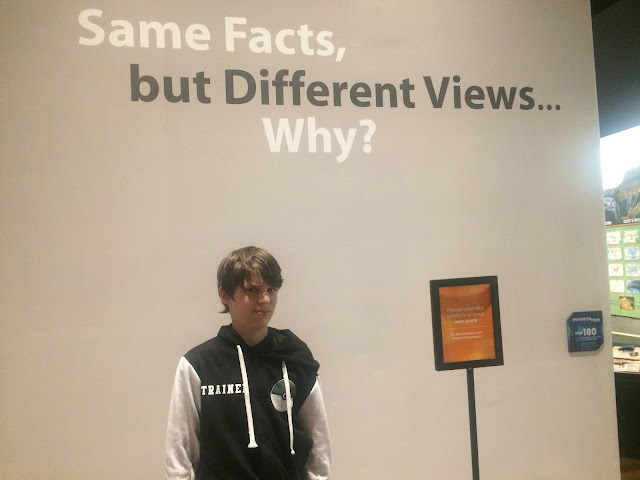
The grounds of the Creation Museum. We had our sack lunches next to a tranquil pond. They have quite a lovely garden. As we prepared to go in, we discussed the following (mangled and misattributed, but still useful) quote:

"It is the sign of an educated mind to be able to consider an idea without accepting it."

We parsed the meaning together, essentially coming up with a directive for how to tour the exhibits in the museum: Don't scoff at them and don't dismiss them out of hand. Instead, think about what they are trying to say. Consider what arguments they're trying to use. You don't have to agree with the argument, but you should try to understand the point of view being expressed, and where it comes from.

After that brief, but useful conversation, we went in. It's among the weirdest places I've ever been, and the photos don't really do it justice.  


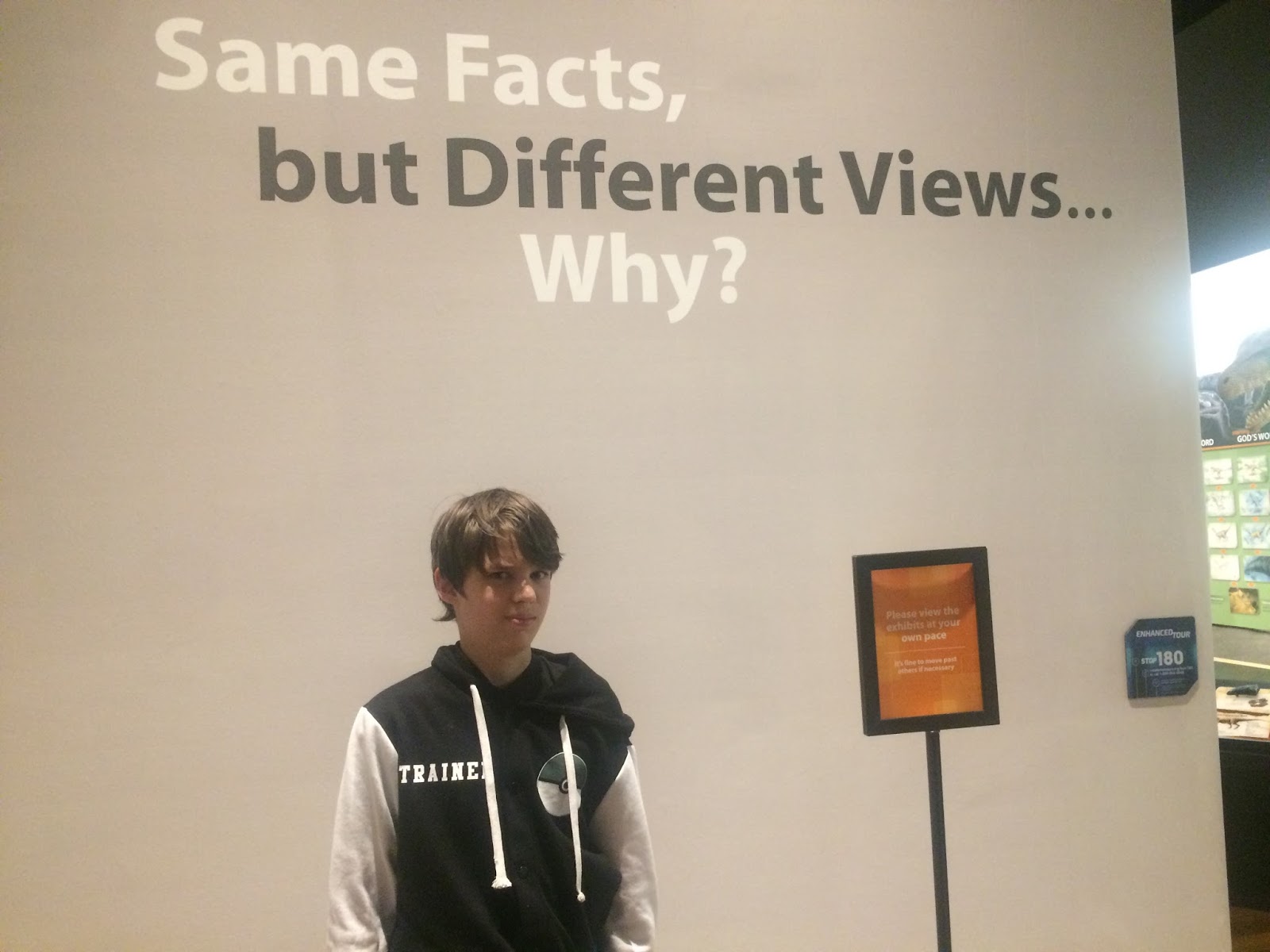
Henry considers.


The entire museum is a large, elaborate persuasive essay. The thesis is that one can interpret the Christian Bible to be literally true, and that the bulk of scientific understanding can be interpreted to prove this worldview. 

The museum is divided into many rooms with different purposes. One early room has a bunch of displays that compare and contrast "Man's Word" and "God's Word." 


Here, for example, is "Man's Word" on the timeline of the universe. We've been learning about this timeline in school recently. The museum rejects this version of events, and puts forth one that says that the Earth is only about 6000 years old. 


There are a lot of displays with animatronics. Here is a depiction of the Garden of Eden, complete with man, penguins, and (just out of frame) dinosaurs.


There is a big section on the story of Noah's ark. In class, we have discussed the prevalence of flood myths around the world, including the epic of Gilgamesh, which was the subject of a school play a few years back. That flood story also involves a boat created to save living things

The dioramas in this section are amazing. 


Life on the ark. 


There are a lot of dinosaurs at the Creation Museum. Fossils, pictures, animatronic, and stuffed ones in the gift shop. Back at school, we've been learning about fossil formation in science with Lisa. 
We've talked a lot about religion and mythology this year, and the roles that they play in cultures. This stop was a fascinating exploration of one example of that. We'll surely be unpacking what we saw next week back in school. 


Back to the bus: 


DInner and dancing in Cave City, Kentucky:


Our home for the next couple nights. 


Friday, January 20, 2017

Week 18 -- Move-up day, leading assembly

Demonstrating "Mystery Person."

This was an unusual week in a few ways. First of all, between the holiday and the ice day, it was quite brief. Second, Thursday was our annual “Move-Up Day,” during which everyone is temporarily promoted to the next grade level and spends the day in the appropriate classroom. Our sixth graders all became seventh graders and joined Karl and Rachel upstairs. In their places, we welcomed visitors from Chris and Spencer’s classes and made them honorary fifth graders. It was a novel way to spend the day, and everyone got a glimpse of what next year might look like for them.


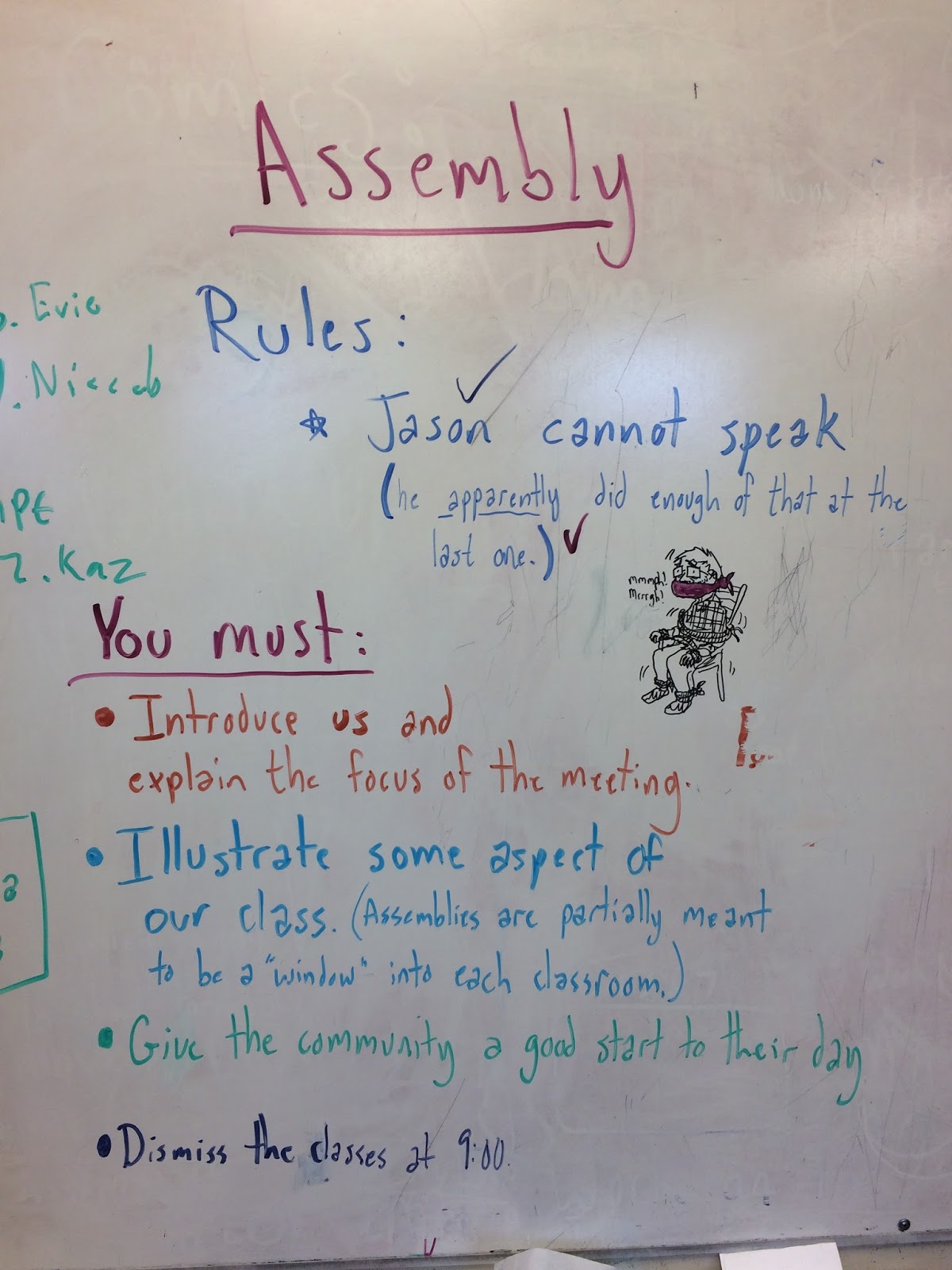
Finally, our class led the weekly all-school assembly on Friday, and planning it took most of the small chunk of homeroom time that we have on Wednesday. For this assembly, it was decided that the kids would organize and run everything, and that I would be completely, 100% silent for the proceedings. (Apparently, I spoke a little too much at the last assembly we were in charge of. Ahem.) Assemblies are partially intended to give a view into the happenings of each classroom, and our class decided to spotlight two things. The first was Sana’s S-K myth (accompanied by an interpretive play), and the second was “Mystery Person,” which is a brief, collaborative game that we regularly play at the end of the school day.

Meanwhile, our math group met twice this week. On Thursday, we combined with Sam’s math class to play math games with our guest students, and Friday was devoted to work in our Singapore books.


Friday, December 9, 2016

Week 14 -- Peer review, myth, and multiplication

Scenes from the Stratford workshop
The week of the school play is almost always wholly consumed by rehearsal and prep, and this year is no different. We’ve spent much of our homeroom time running our lines, practicing the staging, and trying to hone our performances to make sure that we put on a good show. Meanwhile, the students who don’t have roles in the play have been working to design and construct the props needed for the show. We hope to see you at one of the performances of the show!
Scenes from the Stratford workshop
When not working on the play, we’ve been doing group peer review of our Summers-Knoll myths. Our protocol for this is as follows: First, each student reads a piece of writing to the group twice. Both times, students are actively listening for things that they find interesting and enjoyable, as well as making note of where they were confused, or where the author might want to go into more detail on something. After reading their work, the author takes control of the room and calls on volunteers. For the first few minutes, we ask only for positive thoughts. Kids might point out something that they thought was clever, an interesting turn of phrase, or praise a plot twist. Then, we switch into constructive criticism. The audience shares what they were confused by, where the author might go into more detail, etc. The author’s role during this time is exclusively to listen to their audience. Questions about the work are deliberately not answered, and points are not argued. The point is that the author knows that their audience had those thoughts while hearing the work. The author then processes and considers the feedback, and uses it as they see fit during the revision process later.


For example, an author may have intended for a particular character to be somewhat mysterious in their story. However, if they get feedback from their peers that the character came across as merely underdeveloped, they can then take that information and work to clarify their intent during the revision process.
Scenes from the Stratford workshop

This method of review requires a community of writers who are all taking the exercise in good faith, and who are actively working to support each other during what can be a somewhat harrowing process. It can be challenging and scary to receive feedback on your writing, and I am happy to report that the conversations have been kind, productive, and supportive.

In math group, we have concluded our survey of multiplication methods, culminating with the standard algorithm, which is the method that most of us were taught during our own schooling. We learned and practiced seven different methods of multiplication, On Thursday, we began an assessment to see how well we could perform each of them, while also evaluating their effectiveness. Which methods are the quickest? What are the strengths and weaknesses of each? Perhaps most importantly, which methods are the most efficient for each individual? Surveying these varied methods has drawn a fine point on the idea that there isn’t one “correct” way to perform this operation, and by examining each method and comparing them to each other, we have developed a deeper understanding of what is actually happening when you multiply.
Henry performs at the Music Cafe


Friday, November 18, 2016

Week 11 -- Myth, music, and math


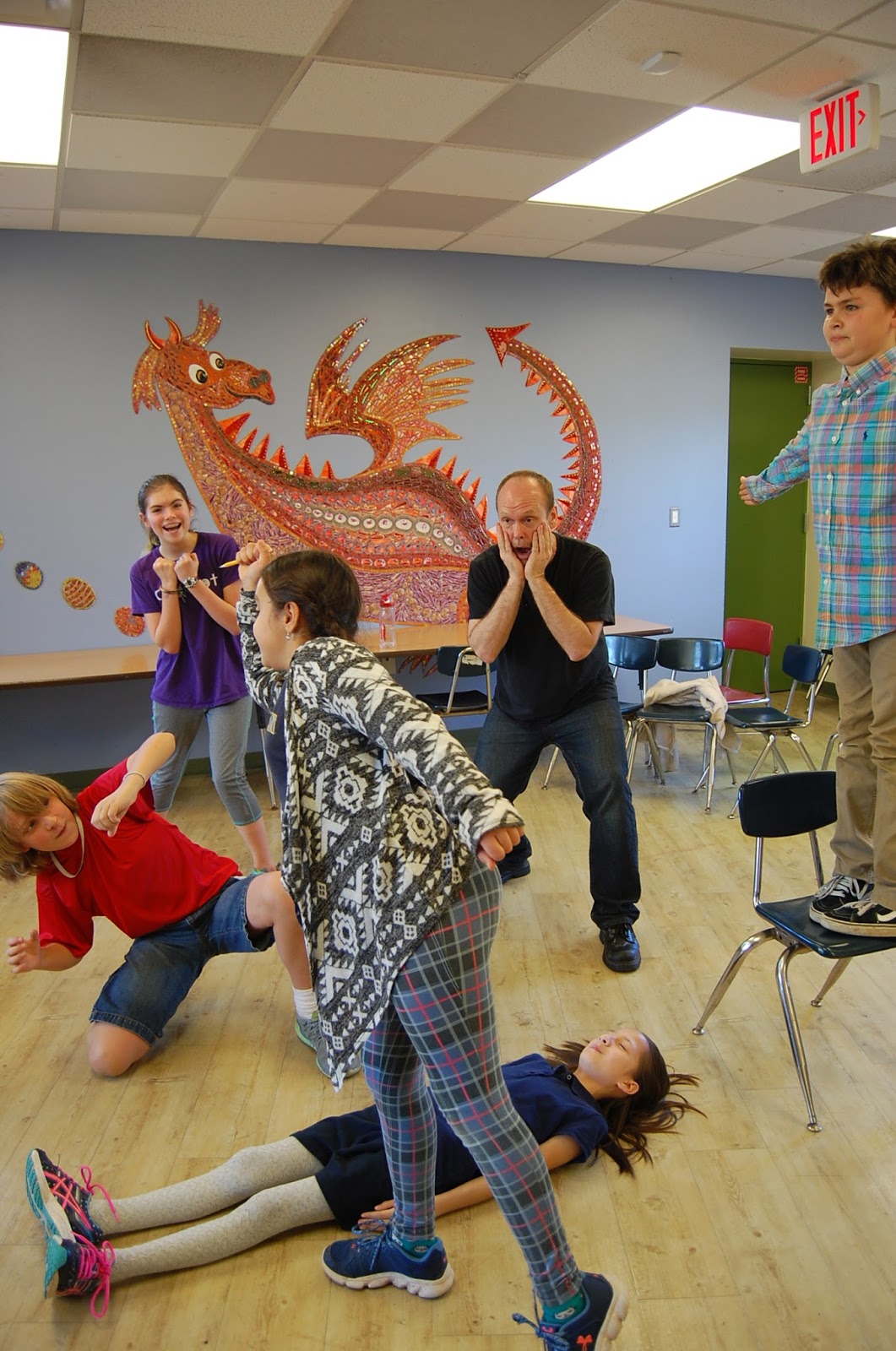
There was a big focus on performance this week. The most public example of that was a substantial amount of preparation for the Friday night’s Music Cafe. Keyboards, drum sets, music stands, and the occasional harp were dragged to and fro as kids found places to practice their pieces for the show. We also received our parts for the school play, and we began our first proper run throughs of the script. We also began reciting our Summers-Knoll myths to each other. You may recall that we’ve been writing stories that convey some aspect of the culture of Summers-Knoll. Now, we’re telling them to each other and seeing what aspects resonate with people and survive later retellings. In addition to being audiences for each other, we were able to spend part of Wednesday morning attending the poetry exhibitions of the 7/8s to see what they’ve been studying. Finally, some we were visited by some actors from the Stratford Festival, who engaged the entire middle school in some acting exercises. 

Our journal writing prompt this week was, “A ship in harbor is safe, but that is not what ships are built for.” It’s a thought that speaks to the spirit of risk-taking and courage that emboldens these kids to stand up in front of each other and our community to tell stories, sing songs, and share themselves so openly and publicly with the world.


In math, some students took a risk of another sort by participating in the AMC-8 math competition on Tuesday. Math competitions aren’t exactly a common occurrence at Summers-Knoll, but they are certainly an interesting thing to opt into for a unique experience. Meanwhile, our class began investigating the concept of multiplication, discovering that there are actually dozens of ways to perform this seemingly mundane mathematical operation. It’s an investigation that we’ll be continuing in the weeks ahead, learning different methods and then evaluating them for precision and speed.


There was some time after Science class for some fall fun on Friday: