Showing posts with label literature. Show all posts

Friday, October 14, 2016

Week 6 -- Milkweed hunt, rising tigers, and graphing caterpillars


Scenes from a milkweed scouting mission


We finished reading The Tiger Rising this week, analyzing its rich figurative language (we’ve been focusing on metaphor and personification), as well as the author’s use of parallels and imagery. We’ve discussed the book extensively as a group throughout our reading, and now students are reflecting on it individually through a series of questions. We also had opportunity to sample some novels individually this week. I gave very brief introductions to about a dozen novels that the class was unfamiliar with, then they each picked one and read it for about thirty minutes. Afterwards, they wrote a quick review of their thoughts on it, indicating if they might like to continue reading it, or move along to something else next time. (Ask your child what they sampled and how they felt about it!)


Our journal writing prompt this week is “do you enjoy sharing your writing with other people?” As you might imagine, opinions vary. Another writing prompt this week was “describe a day in class from the teacher’s point of view,” which has given them all a chance at expressing some empathy for their teacher. Through it, I’ve learned that they have some strange ideas about what I actually think from moment to moment.

We also returned to reading Napoleon Chagnon’s Yanomamo: The Fierce People, which always leads to rich discussions about how complicated it is to examine a culture that is very different from your own. The class delighted in hearing how the Yanomami subverted Chagnon’s attempt to create detailed genealogies of the villages he visited. Ask your child why they didn’t want to help, and how they tricked him. It’s a pretty good story.


In math, our group has merged with Sam’s to do some graphing work on the data that the 5th and 6th graders have been collecting about their monarchs. We worked in groups to accurately graph the growth rates and pupation point of several of our caterpillars, then began discussing how we can draw conclusions from those graphs when viewing them.


Friday, September 23, 2016

Week Three -- Tigers, monarchs, ethnography, and Farkle

A monarch emerges during Math class. 


Our third week of school has been regularly punctuated by excited cries as caterpillars began pupating (ask your child), and later as butterflies emerged. With Lisa’s guidance, we’ve begun tagging our monarchs with tracking stickers, then releasing them back into the wild. If all goes well, we should be releasing several more in the next week or two. We also began reading a book together as a class called The Tiger Rising by Kate DiCamillo. We’re doing a close read of this novel, taking time to think and talk about the craft of the writing and the intent of the author. We’ve also continued learning about the Yanomami tribe of South America, and got to have a lively conversation with an actual ethnographer who came to speak to the entire 5/6 about her work. In our writing journals, we explored the question, "What is the best way to talk to someone with different political beliefs?” It’s a question that I’m sure we’ll be coming back to regularly in the weeks leading up to Election Day.

Chatting with the ethnographer


Henry leads us through a "Perplexor," one the logic puzzles we do in class. 
Tagging a monarch for release 


Monarchs emerging 

Taking measurements of very hungry caterpillars 


Picture day was also this week! 

Behind the scenes


In our math group, Monday was devoted to practicing the strategy of making a table to organize information when solving certain types of problems. We did one as a group, then another individually. Tuesday was spent working in our Singapore math books, and Thursday and Friday were an introduction to the basics of probability, as experienced through the dice game ‘Farkle.’


Friday, September 25, 2015

Equality, Justice, Harrison Bergeron, and the Global Village

Nick and Eva spy a visitor to the Howell Nature Center Global Village.

We began our week in the spotlight, as it was the job of the 5/6s to lead our Monday morning assembly. Each Monday morning, all of the students, staff, and faculty (and occasional parents, grandparents, and other family members!) gather in the atrium for a community gathering. A different homeroom leads the meeting each week, often taking the opportunity to share something that's been going on in our classes. 


We chose to spotlight our trip to the Howell Nature Center Global Village, and we adapted the skits that they wrote and performed there for the Summers-Knoll community. While writing them, the kids were very thoughtful about how to best convey what we had learned to the wide age range of our audience. The Global Village trip is a fun and exciting experience, but the underlying message is quite serious. The fifth and sixth graders felt enlightened about the severity of inequity in the world, but they didn't want to disturb, for example, their Kindergarten compatriots while sharing what they had learned. We opted to share our direct experiences, and only briefly touch on the larger issues. It allowed us to introduce some ideas, and hopefully generate some conversation and thought. 

As I narrated, the entire group of fifth and sixth graders acted out brief skits about the challenges and triumphs of the trip: Learning to communicate with each other, bartering for resources, starting a cooking fire, trying to cook with limited ingredients, and eventually trying to fall asleep in cramped and primitive quarters. It was a fun and breezy presentation, that will hopefully generate further conversations.


And since we're talking about equality... 


This image always gets people talking. I'll come back to it in a moment. 


As part of a beginning-of-the-year writing exercise, I was asking the kids about the basic elements of a story. They quickly rattled off "characters, plot, and setting," but when someone said "theme," many had a hard time explaining what it meant. As a result, I did a read aloud of a Harrison Bergeron by Kurt Vonnegut, Jr. Have you read it? If not, you can do so here. Go on! It's a very quick read. I'll wait....

While you do that, here's a photo of Henry, Niko, Kaz, and Eva celebrating their success at keeping their Global Village balloon baby alive through the night. 

Well, what did you think? Vonnegut really yanks the rug out from under you at the end there, doesn't he? 

Harrison Bergeron is a great story to read with 5th and 6th graders. It's funny, brief, and features a big idea that's played out to an almost cartoonish degree. The idea of mandatory equality appeals to them, just as much as the implementation of concept in the story appalls them. (And I've found that the concept of the ear piece broadcasting thought-scattering noises every twenty seconds is a great thing to reference during the times in the year when interrupting each other becomes an issue. Blurting things out when we're having a group conversation causes everyone to have to mentally reset over and over.) (If you haven't read Harrison Bergeron, and you just skimmed past that link earlier, this sentence made no sense to you. For shame.) 

Kids like to talk about the different handicaps mentioned in the story, which gets us into talk about why the characters in the story would willfully submit to them (and why other characters would attempt to subvert them). The discussion eventually turns to the idea of equality not necessarily being an inherently good thing, as exemplified by the Equality Versus Justice cartoon above. 

Of course, Vonnegut's story is satirical, and being very bright kids, they realized that the society represented in the story didn't match either side of the Equality Versus Justice image. In fact, the equality in Harrison Bergeron was best represented by this image:  

Equal!


One can interpret Vonnegut's story a number of ways (and people have! Not always to Vonnegut's satisfaction...), which is another great reason to read it with kids who are expanding their understanding of social justice, while also developing a sense of the power of writing. 

Thursday, January 15, 2015

January So Far...

January is off to a rollicking good start in the 5/6. (Snow Days excluded, or perhaps enjoyed.) Here's a long, rambling recap of some of the things we've done with these first eight days of January.
A quiet work period in the middle of a very busy two weeks. 


Evan explains the ideas supporting the exploration of Near Earth Asteroids (NEAs).

This month has a strong science and social studies focus. Our new school theme is Journeys, and we're exploring that by beginning a unit on manned exploration of space.

Last week, the students split up into small groups to learn about a possible destination for a human habitat outside of the atmosphere. The groups each read an article about the logistics of putting people in one of the following places: Low-Earth Orbit, Near-Earth Asteroids,  Luna (Earth's moon), Venus, or Mars. (Ask your student about the destination that they researched!)

Marcellin and a guest student explain a proposed mission to Venus. 

Prior to presenting, each student had a specific role in their group: The Data Specialist was responsible for making notes on the key points in the document. The Mission Commander was responsible for presenting the groups report to the whole class. The other students in the group were given mini-rubrics to help the Mission Commander prepare the short presentation, as well as being responsible for the initial reporting.
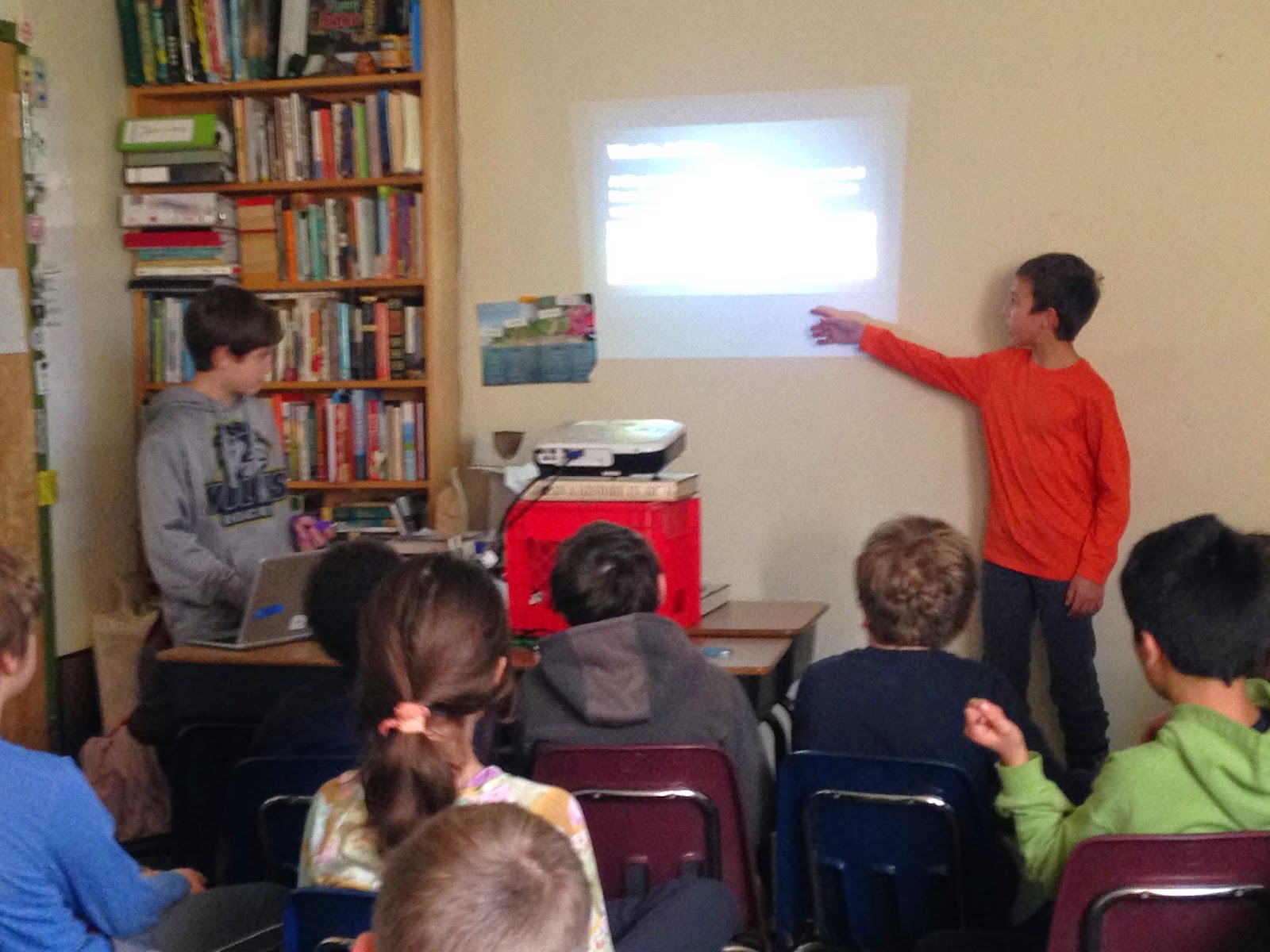
Each group then presented a summary of what they learned to the rest of the class.

This week, science has been focused on the wide variety of technologies that have been developed or enhanced as a result of Space Exploration (Insulin pumps! Whale tracking technology! Helmet padding!) . Each student is investigating two specific NASA created (or developed) technologies.


In math, we are doing a small project on data collection, display, and analysis. So far the students have crafted questions suitable for analysis ("What month were you born in?" "How tall are you in inches?").

Today we talked about how to collect and organize the data as it's being collected, and then moved on to actual data collection. A few students have begun to transfer their data to a Google Sheet (the spreadsheet program in Google Drive). Next week, we'll be working on analyzing and presenting the data and making conclusions.

Owen collects data about student's favorite sport to play.

We've also wrapped up our book group presentations. As mentioned in a previous post, we've been reading novels in small groups. Each group has completed their book and prepared a presentation for the rest of the class to share about the book and their experiences. Some groups spoke in the first person as characters from the book, some read excerpts, and everyone gave enticing summaries about what was valuable and interesting about each book that they read.
Eleanor, Emma, and Adri talk about Out of My Mind

Jonah, Evan, Gabe, Ben, and Oliver discuss First Light

Niko reads a selection from A Wizard of Earthsea, as Marcellin, Luke, David, and Owen await their turns to share. 

We've also been having some group discussions about the media, society, and how we interact with each other. On Monday, we wanted to gauge how kids were processing anything that they may have heard in the news about various terrorist acts. Students' awareness of the news stories varied widely, which lead to a productive discussion about how we consume media, and why certain stories stick out in our minds. For example, of all the current events that were mentioned, the only one that almost every student had heard of was the semi truck full of fireworks that was involved in an accident on I-94. We talked a little about why that story has stuck out in their minds. ("It's sort of scary." "It's exciting.") We eventually hit on the idea of personal relevance and/proximity: Something happened that feels close to you. Car accidents on I-94 feel much more relevant than car accidents in Nevada.


We eventually also talked a little bit about the incidents in France recently, trying parse through the rationale for such a senseless act. We talked about the concept of satire, fundamentalism, freedom of the press, and the challenges (and strengths) of living in blended, multicultural societies.

Finally, we had a long sprawling conversation yesterday about our personal interactions at school. We frequently have these kinds of discussions on a small scale, sometimes in response to a specific conversation, and other times preemptively, but yesterday's chat was particularly in depth.

We talked a lot about how to navigate the constantly shifting power dynamics of the middle school world. We talked about "being your best self" as often as possible, with the understanding that no one can always achieve that. However, if one of us happens to fall short on a given day or in a particular moment, as long as the rest of us hold ourselves together, things will be okay. We also talked about how to prevent situations from spiraling out control, not carrying the grudges of other people, and strategies to help things run smoothly during these occasionally turbulent pre-teen years.


This is a spotty snapshot of some of the things that were discussed. We'll be revisiting this conversation regularly in the weeks and months ahead.


Oh, one more item worthy of note:

In writing last week, we went over the rules of using quotation marks when writing dialogue in stories. As practice in this, kids were required to write a dialogue between three or four characters using proper punctuation. The dialogue did not have to be a self-contained story, but it did have to give some sense of what the larger plot was, where the setting was, and a bit about the personalities of the characters involved. They are still trickling in, as they're not formally due until tomorrow (Friday), but on the whole, they've been both excellent and hilarious. Since the assignment only asked for a scene, many kids seemed content to come up with some bizarre and creative ideas. Nearly everyone of them is a cliffhanger begging for the larger context of the unwritten story. They're great.

On a whim, we staged a few of them as impromptu mini-plays in class the other day, much to the delight of everyone.


Tuesday, December 16, 2014

Scenes from the final week of 2014


Now that the energy and excitement of the play has crested, we have a week left before a well-earned break. The final week in December can often be a tricky one, as people are starting to burst at the seams, but we're still getting a lot done! 


On Monday, the first of our book groups presented to the class, telling us a bit about the characters and themes of Mockingbird, the book they had read. 


Later in the day, Gabe and David gave a presentation teaching us about tiling and tessellation, which included a group activity designed to illustrate what shapes are able to tessellate. (It's difficult to photograph a slideshow in low light, so please know that David is actually pointing out a detail of a tiling, as opposed to just a blob of white light.) 


In Math today, what was meant as a warm-up exercise wound up taking over much of the morning, as kids worked together (using manipulatives, drawings, paper, and white boards) to solve a logic puzzle involving checkers on a board. 

Today was also one of our days for PE, so after working through the morning, they were ready to run off some energy in the afternoon. 


Tuesday, November 11, 2014

Book groups

Joanna talks about A Wizard of Earthsea by Ursula LaGuin.

Starting next Monday, we'll begin our new book groups. Each group of four-to-five students will be reading one of five different books:

Not pictured: Stargirl by Jerry Spinelli. (Our copies are on order...)

Rachel Goldberg, our resident librarian, came in and gave inspiring book talks about each novel on Monday. We then asked each student to rank them in the order of greatest-to-least interest. We'll be announcing the groups soon, but everyone seems likely to get their first or second choice.

Each group will be led by an adult, who will be reading the novel along with the students and guiding discussions. Everyone seems very excited about it!


Tuesday, October 14, 2014

Magic Realism: 'Loser' by Aimee Bender


There are many facets to all of our themes, and Magic is no exception. Yesterday, we spent some time learning about the literary genre magic realism, in which magical or unreal elements accent stories that are otherwise grounded in reality (as opposed to books like the Harry Potter series, which are straight fantasy.) 

We read a short story by Aimee Bender, in which a young boy develops the peculiar power to sense the location of misplaced objects; car keys, hairbrushes, and... other things. 

The full text of Bender's story is below, along with a link to an episode of the radio program This American Life, where it was once read aloud in an episode. 

It's a short story that yielded some very insightful conversations: 
- Why is it called Loser?
- Who is the young man talking to at the end? 
- What would it be like to have this power? 
- What do people think of him? 
- What does he think of himself? 
- Is he a happy character? 


Listen:
'Loser' by Aimee Bender on This American Life


Loser 
by Aimee Bender
(This story is collected in her book The Girl in the Flammable Skirt, an excellent collection of short stories, most of which I would not recommend the kids read until they're a little older.)

Once there was an orphan who had a knack for finding lost things. Both his parents had been killed when he was eight years old. They were swimming in the ocean when it turned wild with waves, and each had tried to save the other from drowning. The boy woke up from a nap on the sand, alone.
After the tragedy, the community adopted and raised him, and a few years after the death of his parents, he began to have a sense of objects even when they weren't visible. This ability continued growing in power through these teens. And by his 20s, he was able to actually sniff out lost sunglasses, keys, contact lenses, and sweaters. The neighbors discovered his talent accidentally.
He was over at Jenny Sugar's house one evening, picking her up for a date, when Jenny's mother misplaced her hairbrush and was walking around complaining about this. The young man's nose twitched. And he turned slightly towards the kitchen and pointed to the drawer where the spoons and knives were kept. His date burst into laughter. "Now, that would be quite a silly place to put the brush," she said, "among all that silverware." And she opened the drawer to make her point, to wave with a knife or brush her hair with a spoon. But when she did-- boom-- there was the hairbrush, matted with gray curls, sitting on top of the fork pile.
Jenny's mother kissed the young man on the cheek, but Jenny herself looked at him suspiciously all night long. "You planned all that, didn't you?" she said over dinner. "You were trying to impress my mother. Well, you didn't impress me," she said. He tried to explain himself, but she would hear none of it. And when he drove his car up to her house, she fled before he could even finish saying he'd had a nice time, which was a lie, anyway. He went home to his tiny room and thought about the word lonely, and how it sounded and looked so lonely, with those two L's in it, each standing tall by itself.
As news spread around the neighborhood about the young man's skills, people reacted in two ways. There were the deeply appreciative and the skeptics. The appreciative ones called up the young man regularly. He'd stop by on his way to school, find their keys, and they'd give him a homemade muffin. The skeptics called him over, too, and watched him like a hawk. He'd still find their lost items, but they'd insist it was an elaborate scam and he was doing it all to get attention.
"Maybe," declared one woman, waving her index finger in the air, "maybe," she said, "he steals the thing so we think it's lost, moves the item, and then, comes over to save it. How do we know it was really lost in the first place? What is going on?"
The young man didn't know, himself. All he knew was the feeling of a tug, light but insistent, like a child at his sleeve. And that tug would turn him in the right direction and show him where to look. Each object had its own way of inhabiting space, and therefore, messaging its location. The young man could sense, could smell an object's presence. He did not need to see it to feel where it put its gravity down. As would be expected, items that turned out to be miles away took much harder concentration that the ones that were two feet to the left.
When Mrs. Allen's little boy didn't come home one afternoon, that was the most difficult of all. Leonard Allen was eight years old and usually arrived home from school at 3:05. He had allergies and needed a pill before he went back out to play. That day by 3:45, alone, Mrs. Allen was a wreck. Her boy rarely got lost. Only once had that happened in the supermarket. But he'd been found quite easily under the produce tables, crying. The walk home from school was a straight line. And Leonard was not the wandering kind.
Mrs. Allen was just a regular neighbor, except for one extraordinary fact. Through an inheritance, she was the owner of a gargantuan emerald she called the Green Star. It sat, glass-cased in her kitchen where everyone could see it because she insisted that it be seen. Sometimes, as a party trick, she'd even cut steak with its beveled edge.
On this day, she took the Green Star out of its case and stuck her palms on it. "Where is my boy?" she cried. The Green Star was cold and flat. She ran, weeping, to her neighbor, who calmly walked her back home. Together they gave the house a thorough search. And then, the neighbor, a believer, recommended calling the young man.
Although Mrs. Allen was a skeptic, she thought anything was a worthwhile idea. And when the phone answered, she said in a trembling voice, "You must find my boy." The young man had been just about to go play basketball with his friends. He'd located the basketball in the bathtub. "You lost him?" said the young man. Mrs. Allen began to explain, and then her phone clicked. "One moment, please," she said. And the young man held on.
When her voice returned, it was shaking with rage. "He's been kidnapped," she said. "They want the Green Star." The young man realized, then, that it was Mrs. Allen he was talking to, and nodded. "Oh," he said, "I see." Everyone in town was familiar with Mrs. Allen's Green Star. "I'll be right over," he said. The woman's voice was too run with tears to respond.
In his basketball shorts and shirt, the young man jogged over to Mrs. Allen's house. He was amazed at how the Green Star was all exactly the same shade of green. He had a desire to lick it. By then, Mrs. Allen was in hysterics. "They didn't tell me what to do," she sobbed. "Where do I bring my emerald? How do I get my boy back?"
The young man tried to feel the scent of the boy. He asked for a photograph and stared at it. A brown haired kid at his kindergarten graduation. But the young man had only found objects before, and lost objects at that. He'd never found anything or anybody stolen. He wasn't a policeman.
Mrs. Allen called the police, and one officer showed up at the door. "Oh, it's the finding guy," the officer said. The young man dipped his head modestly. He turned to his right, to his left, north, south. He got a glimmer of a feeling towards the north and walked out the back door, through the backyard. Night approached, and the sky seemed to grow and deepen in the darkness.
"What's his name again?" he called back to Mrs. Allen. "Leonard," she said. He heard the policeman pull out a pad and begin to ask basic questions. He couldn't quite feel him. He felt the air, and he felt the tug inside the Green Star, an object displaced from its original home in Asia. He felt the tug of a tree in the front yard, which had been uprooted from Virginia to be replanted here. And he felt the tug of his own watch, which was from his uncle. In an attempt to be fatherly, his uncle had insisted he take it. But they both knew the gesture was false. Maybe the boy was too far away by now.
He heard the policemen ask, "What is he wearing?" Mrs. Allen described a blue shirt, and the young man focused in on the blue shirt. He turned off his distractions, and the blue shirt came calling from the northwest, like a distant radio station. The young man went walking, and walking. And about 14 houses down, he felt the blue shirt shrieking at him.
And he walked right into the backyard, right through the back door. And sure enough, there were four people watching TV, including the tear-stained boy with a runny nose, eating a candy bar. The young man scooped up the boy while the others watched, so surprised, they did nothing. And one even muttered, "Sorry, man."
For 14 houses back, the young men held Leonard in his arms like a bride. Leonard stopped sneezing and looked up the stars. And the young man smelled Leonard's hair, rich with the memory of peanut butter. He hoped Leonard would ask him a question, any question. But Leonard was quiet. The young man answered in his head. "Son," he said to himself. And the word rolled around, a marble on a marble floor. "Son," he wanted to say.
When he reached Mrs. Allen's door, which was wide open, he walked in with quiet Leonard, and Mrs. Allen promptly burst into tears. And the policeman slunked out the door. She thanked the young man a thousand times, even offered him the Green Star, but he refused it.
Leonard turned on the TV and curled up on the sofa. The young man walked over and asked him about the program he was watching, but Leonard stuck his thumb in his mouth and didn't respond. "Feel better," he said softly.
Tucking the basketball beneath his arm, the young man walked home, shoulders low. In his tiny room, he undressed and lay in bed. Had it been a naked child with nothing on-- no shoes, no necklace, no hair bow, no watch-- he could not have found it.
He lay in bed that night with the trees from other places rustling, and he could feel their confusion. No snow here. Not a lot of rain. Where am I? What is wrong with this dirt? Crossing his hands in front of him, he held onto his shoulders. Concentrate hard, he thought. Where are you? Everything felt blank and quiet. He couldn't feel a tug.
He squeezed his eyes shut and let the question bubble up. Where did you go? Come find me. I'm over here. Come find me. If he listened hard enough, he thought he could hear the waves hitting.