Showing posts with label simulations. Show all posts

Tuesday, May 5, 2015

Trials, Bias, Prejudice, Baltimore, and Polygons


Some social issues that we've been exploring in class recently have given some context for the recent events in Baltimore. 


A couple of weeks ago, we watched the 1957 film 12 Angry Men. It's a classic that remains captivating nearly 60 years later. It's a film that builds slowly (the story essentially unfolds in real time), and the bulk of it takes place in one room. 


I was interested in screening it for the class because offers a number of ways to begin talking about the basics of our legal system, but it's also a great film to watch when teaching writing. The story is built methodically, and the characters are efficiently, but vividly drawn. All twelve characters are distinct and recognizable (if not particularly well fleshed out). 


If you've seen it, you know that film addresses bias and prejudice, particularly the type that most people profess not to have. This idea alone inspired quite a bit of discussion. 

The film is a good introduction to aspects of our legal system. The right to a fair trial is one of them (though how fair the trial actually was is part of the story). The concept of being judged by a jury of peers is another, and we talked about what that meant for the defendant: He was a kid from the slums, and the jury of his "peers" was a group of older, mostly middle or upper class white males. This reflects the time of the film, but jury selection remains an important part of the process. What would a true jury of one's peers look like, and why is that important? 


We've also talked about the concept of unearned privilege and unconscious bias. This is a giant issue, but this video provides a good point of entry for such a complicated conversation: 


We've talked a lot about bias, prejudice, stereotypes, and privilege, particularly terms of race, economic status, gender identity, and other ways in which we tend to view people. The conversations have been open, engaging, and lively. 


Seemingly unrelated, we also spent some time going through this thought-provoking activity: Parable of the Polygons. It involves these little guys: 


The entire post is well worth reading , but here's the gist: All of the shapes are slightly shapist. They don't dislike each other, but they also don't want to be the only one of their kind living in a neighborhood. Here's a breakdown of their rules for happiness: 


While the shapes don't want to be a strong minority in their neighborhoods, they're actually happiest in a diverse situation, as shown in the middle. As you can see on the right, they're actually a little less happy in a completely homogenous environment. 


So each of these little shapes values diversity, but has a small bias. The game allows you to move a shape only when they're unhappy. Under this rule set, it's amazing how quickly the "neighborhoods" becomes segregated: 


Again, reading through the entire post is really worthwhile. Everyone in class was able to work with the site for a while, changing variables and making observations. The big lesson was that small, seemingly inconsequential biases can lead to a larger, systemwide bias. 


All of this eventually led to a discussion of the events in Baltimore, Ferguson, and beyond. We talked about what we had heard about the story (and there were a lot of misconceptions about the basics of those situations), and made some connections about why these issues might be occurring. Why might some communities be so segregated? Why might there be a disconnect between a community and the police department that serves it? What role does bias play in these interactions, and our understanding of them? 

Of course, these questions don't have easy answers, but we've found much of value in the conversation. 

Sunday, March 1, 2015

Mars Out of Time (or "MOOT.")

Belgian cartoonist HergĂ© has recently joined our class. 


Over the next several weeks, you'll be hearing a lot about the planet Mars, and something we call "MOOT." 


"MOOT" stands for Mars Out of Time, which is a new spin on one of our favorite annual projects. For many years, Summers-Knoll students have had the opportunity to participate in Place Out of Time (or "POOT"), a simulation run by the University of Michigan. The idea behind Place Out of Time is brilliant: What if we could bring the great (and lesser) minds of history to ponder a contemporary issue? 


In order to accomplish this, students select a notable character and learn as much about them as possible. They study primary and secondary sources (and learn what "primary" and "secondary" sources are in the process). They comb through books, magazines, websites, documentaries, and beyond in an attempt to learn as much as possible about their character, as well as the time in which they lived. 

Then, each student "becomes" their character, portraying them in the first person in classroom discussions and activities, and also on a web-based messageboard. 

The discussions cover a wide variety of topics, but they always eventually lead to one large, overarching issue. For example, two years ago, students were asked to explore and debate the French law that bans the wearing of conspicuous religious symbols in public. Last year, we debated the morality and legality of the Italian scientists who were held criminally liable for failing to accurately predict a 2009 earthquake

The project requires that students not only examine the intricacies of a contemporary issue, but that they do it from someone else's perspective, which is often radically different from their own. They learn and practice substantial research skills along the way, and by interacting with their classmates, they learn a lot about characters and times other than the ones that they're studying. It's a fantastic project. 

Dame Julie Andrews has also been recently spotted in the halls of Summers-Knoll!  


The University of Michigan masterminds behind the Place Out of Time program have opted to run a simulation about the Italian earthquake trial again this year. Since so many of our students have already examined this case (most of the current 6th graders, and almost all of the 7th and 8th grade class), we have opted to strike out on our own this semester. We'll still be collaborating with the U of M Place Out of Time crew, but our issue this time will be one that ties into our own recent studies: We will be planning and conducting a manned expedition to Mars. 

Kids have already selected their characters, and we've begun the research phase of the project. On Thursday, we took a field trip to the Ann Arbor District Library, where we were given a tour of their collection, with a specific focus on materials that pertain to each student's character. 


A selection of research materials for our cast of characters from a recent trip to the Ann Arbor District Library. 


Place Out of Time/Mars Out of Time is always a fun, highly-rated experience. Excitement runs high!


Wednesday, April 23, 2014

Cryptozoology: pondering Big Foot

Our current theme is Mythology, and we've spent much of this week studying the (pseudo)science of cryptozoology, focused largely on the myth of Big Foot. 

We kicked off the week by viewing some infamous footage:


We've read a few different historic accounts of Big Foot (also known by several other names), including The Story of Jacko, 1884. Students spent some time breaking down what each article actually says, writing answers to the following questions: 

1. Who reported the incident? (And to whom?)
2. What was observed? (Give a precise description, including quotations from witnesses.) 
3. What was the time and date of the incident?
4. Where is the exact location that this incident occurred?
5. What information do we have about the witnesses? (What were their jobs, ages, etc?)

We applied these questions to a few written accounts. Under close scrutiny, we found that many of these questions were impossible to answer, even though they were reports published in presumably reputable periodicals. 

Big Foot has also crept into other areas of our studies, inspiring this fascinating range of portraits from Art class: 


Later in the week, we'll be investigating other pieces of evidence that are often cited when discussing Big Foot, including studying the foot size and stride length of humans. 

Wednesday, April 16, 2014

Place Out of Time: The importance of reflections


Our Place Out of Time experience is nearing its conclusion, and the middle school gathered this morning to begin talking about the value of reflection. We opened with a few quotes. The first two come from John Dewey.


  • “We do not learn so much from experience as we do from reflecting on our experience.”


  • “Perhaps the greatest of all pedagogical fallacies is the notion that a person learns only the particular thing he is studying at the time.” 

  • – John Dewey

(New vocabulary words for most of the group: "pedagogical" and "fallacies.")

The third came from a source a little more familiar to many of us: 


  • Harry stared at the stone basin. The contents had returned to their original, silvery white state, swirling and rippling beneath his gaze.
  • “ What is it?” Harry asked shakily.
  • “This? It is called a Pensieve,” said Dumbledore. “ I sometimes find, and I am sure you
  • know the feeling, that I simply have too many thoughts and memories crammed into my
  • mind.”
  • “Err,” said Harry who couldn’t truthfully say that he had ever felt anything of the sort.
  • “At these times” said Dumbledore, indicating the stone basin, “ I use the Penseive. One simply siphons the excess thoughts from one’s mind, pours them into a basin, and examines them at one’s leisure. It becomes easier to spot patterns and links, you
  • understand, when they are in this form.’ 

  • - Excerpt from Harry Potter and the Goblet of Fire, by J. K. Rowling


This lead to a good discussion about the value of externalizing an experience in order to really process it. By getting it out of your head and onto paper (or onto a screen), you can look at things from a new perspective. 

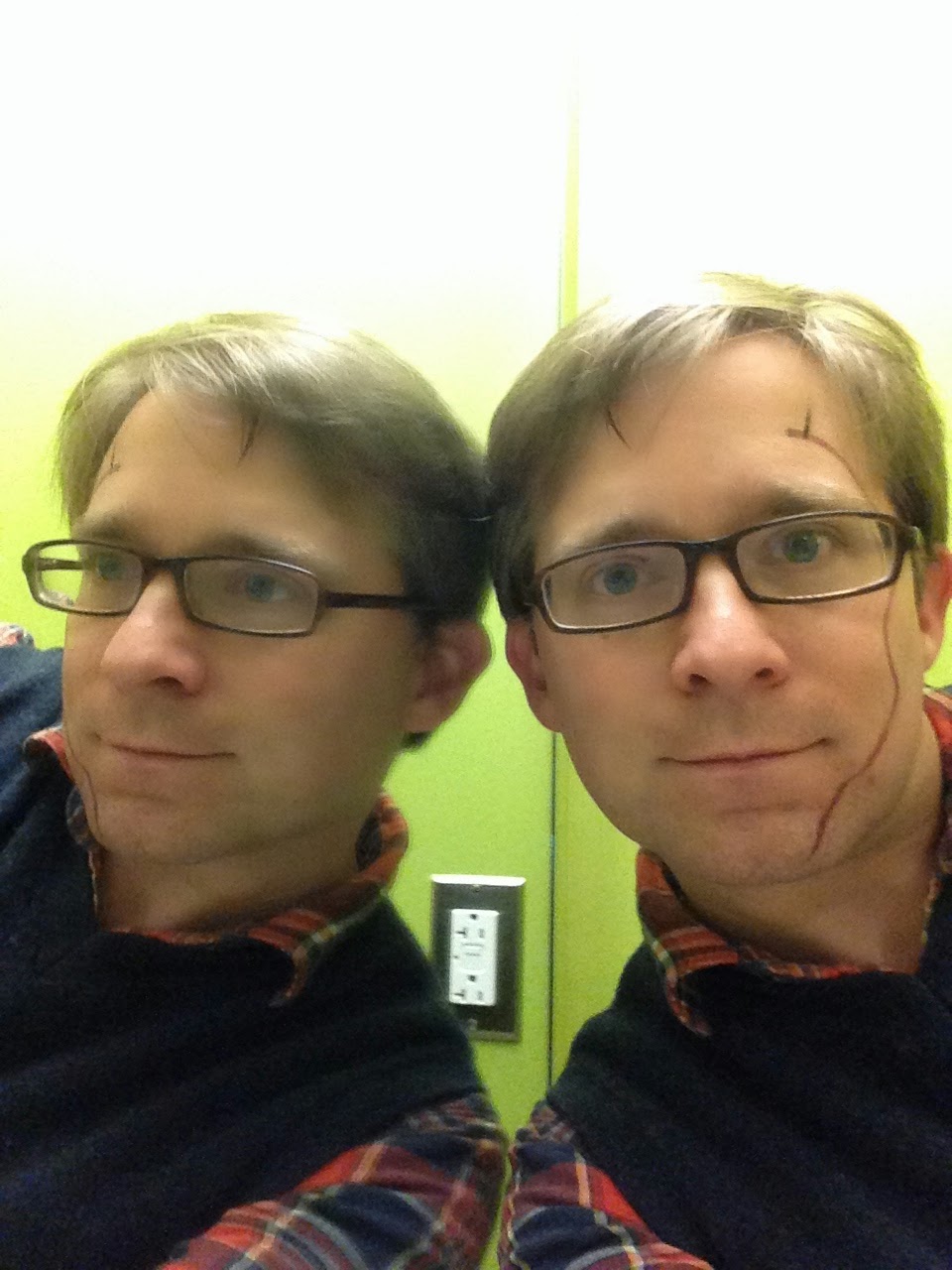
It is perhaps worth noting that I looked like this for the duration of this discussion: 
(If you look closely, you might notice a hint of dry erase marker on my face.)

I used myself as an example. As a teacher, you have to earn the respect of your students. Were I to get dressed each day, look myself up and down, and leave the house without looking in the mirror, my day might look a lot like this: 
For some reason, I am failing to command their respect.

A mirror provides an external reflection that gives one instantaneous feedback on aspects of your appearance that you would otherwise be unable to see. 

Dumbledore's Penseive serves a similar function. By getting his thoughts out of his head, he's able to parse through them from a different perspective. 

There are any number of ways to reflect on something, but we started with a simple format: 

1. What?
- What are you reflecting on? Be objective. Don't add commentary or emotion, simply describe what Place Out of Time is, as you might explain it to a new student or a parent. 

2. So what??
- Now that you've objectively articulated the basics of the project, begin writing about your own experiences. What was the value of the experience? What did you learn? What skills did you develop? What was particularly challenging? Where did you exceed your expectations? Where did you fall short? What did you like and dislike about the experience? 

3. Now what??? 
- After thinking and writing about your experience and performance, how can you learn from it? What were the causes of your struggles, and how can you address them? Where did you thrive, and what does that say about your interests and skills? 

After our discussion, we began writing our reflections (and I washed my face). We'll continue working on them the rest of the week. 

Tuesday, April 15, 2014

Place Out of Time banquet!


We kicked off the week by attending the annual Place Out of Time banquet on Monday! We'll be posting a more detailed write up soon. In the meantime, take a look at this amazing gathering of luminaries from throughout time: 


Our own Lady Gaga addresses the assembly.

Charles Taylor, Calvin Johnson, Michael Jackson, Harry Houdini, and Pope Francis engage in a spirited debate. 


Tuesday, January 21, 2014

Cities topics presentations - The early 1900s


Our theme for January and February is Cities, and one of the ways that we've been exploring the topic is by learning about the growth of Midwestern American cities over the course of the twentieth century. 

Last week, students paired up to research and prepare short presentations on a variety of topics relevant to cities at the turn of the century (that's 1900, not 2000). Topics included Henry Ford and the $5 Day, Women's Suffrage, The Great Migration, The Toledo War, and Life on a Farm in 1900. They spent the week working with their partners, then gave their presentations on Friday.  


Luke and Karenna talk about the history of the importance of the railroad in Michigan. 


Margaret and Sydney teach about Native American cultures of Southern Michigan. 

This week, students will go further with their projects. First, they'll be receiving feedback about their presentations, both in terms of content, and their public speaking. They'll incorporate that feedback into a "second draft" of their presentation, which will be delivered again on Friday, this time to the third and fourth graders of Chris and Joanna's classes. 

In addition to making improvements to their overall presentations, students will be given an additional component to incorporate: 


We've been using a small model city during our class discussions to help illustrate various points and concepts. Though not based on a specific location, it has been designed to be a reasonable facsimile of a typical small city, somewhere in Southeast Michigan. It's currently meant to represent circa 1910 or so, and the plan is for it to evolve and grow as we move through history. 

For their presentations, students will be tasked with explaining how their topic might play out or affect our fictional town. For example, Matthew and David might talk about how Henry Ford's Five Dollar Day played out in the factories in our city. Did other industrialists follow his lead? What were the ramifications? 

Next week, we'll repeat the process, with new partners and new topics, this time investigating events from the 1920s and 1930s. Eventually, students will have a much deeper understanding of how and why American cities have developed in different ways over the years; How has Chicago thrived? Why is Detroit in its current state? How is Cleveland different from Buffalo? Why have Ypsilanti and Ann Arbor had such different trajectories? It's a fascinating topic that we're excited to be studying! Along the way, we'll be developing and strengthening our research, collaboration, and presentation skills.