Showing posts with label reading. Show all posts

Friday, September 30, 2016

Week Four: POP X, magical items, masters and beginners, and hand feeding butterflies


This week we took an impromptu field trip this week, traveling to downtown Ann Arbor’s Liberty Plaza to visit POP X, an art installation. Students explored the exhibits in trios, making note of what intrigued them, then returned to school and designed their own exhibits in the spirit of what they saw.
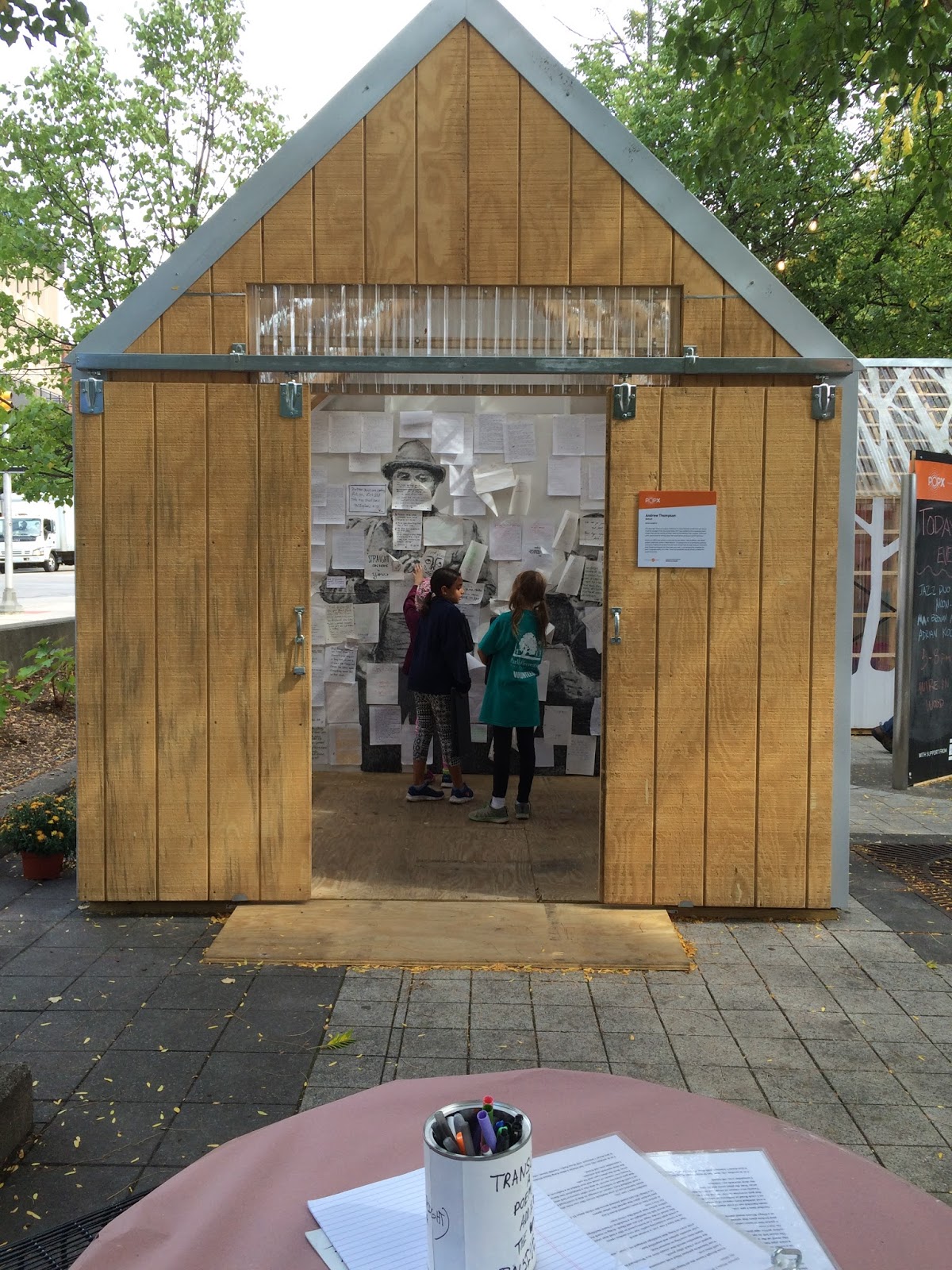


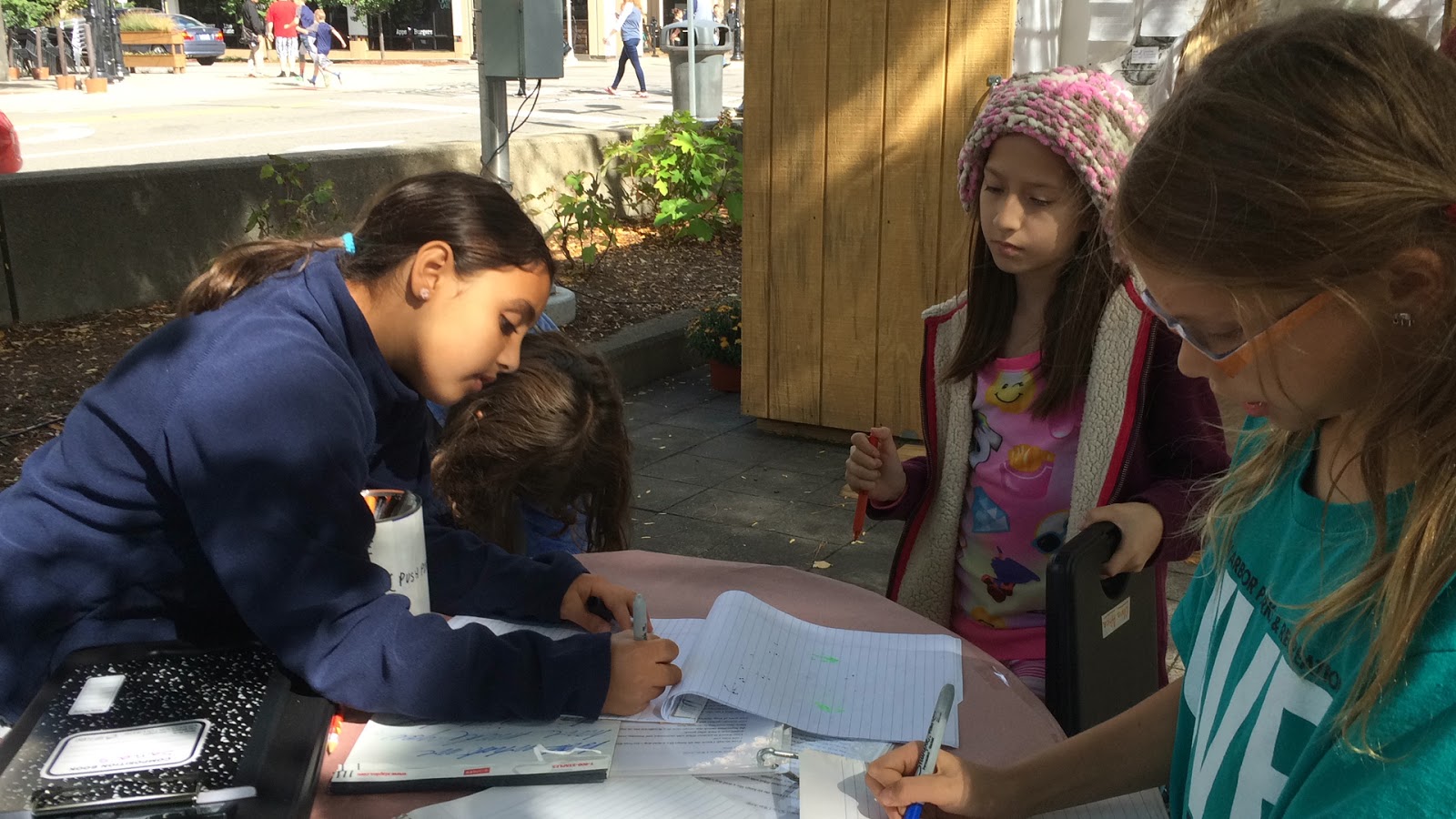


In homeroom, we discussed the elements of a story, focusing on what makes writing compelling. We then wrote a couple of lackluster stories together, then worked individually to make them more engaging. We also had a writing prompt about taking ordinary items (flashlights, paintbrushes, etc) and making them magical, and a journal prompt that asked students to consider the quote “the master has failed more times than the beginner has even tried.”


We also continued our close reading of The Tiger Rising as a group, analyzing the writing to discern the author’s intent.

On top of all of that, we also had a talk with Rachel about banned books, and toured a project gallery of a recent project by the 7/8 classroom.
We're committed to getting outside as often as possible, which sometimes makes for rainy recesses. 

The muddiest kick line ever 

In math group, we spent two days working in our Singapore books, and spent the other two days playing an assortment of math games, identifying what mathematical concepts were involved in each (pattern recognition, symmetry, arithmetic, etc.)


On Friday morning, we partnered with Sam's class to lead the all school assembly, where we talked about our ongoing work with Lisa and monarch butterflies. 

Lisa hand feeds one of our monarchs. 
Learning to wrangle monarch butterflies safely 


Friday, September 23, 2016

Week Three -- Tigers, monarchs, ethnography, and Farkle

A monarch emerges during Math class. 


Our third week of school has been regularly punctuated by excited cries as caterpillars began pupating (ask your child), and later as butterflies emerged. With Lisa’s guidance, we’ve begun tagging our monarchs with tracking stickers, then releasing them back into the wild. If all goes well, we should be releasing several more in the next week or two. We also began reading a book together as a class called The Tiger Rising by Kate DiCamillo. We’re doing a close read of this novel, taking time to think and talk about the craft of the writing and the intent of the author. We’ve also continued learning about the Yanomami tribe of South America, and got to have a lively conversation with an actual ethnographer who came to speak to the entire 5/6 about her work. In our writing journals, we explored the question, "What is the best way to talk to someone with different political beliefs?” It’s a question that I’m sure we’ll be coming back to regularly in the weeks leading up to Election Day.

Chatting with the ethnographer


Henry leads us through a "Perplexor," one the logic puzzles we do in class. 
Tagging a monarch for release 


Monarchs emerging 

Taking measurements of very hungry caterpillars 


Picture day was also this week! 

Behind the scenes


In our math group, Monday was devoted to practicing the strategy of making a table to organize information when solving certain types of problems. We did one as a group, then another individually. Tuesday was spent working in our Singapore math books, and Thursday and Friday were an introduction to the basics of probability, as experienced through the dice game ‘Farkle.’


Friday, November 20, 2015

Week 11: Fear itself


As with much of the rest of the world, Paris, Beirut, Syria, and the United States were on our minds this week. 


When we left school on Friday, the news from Paris was just starting to break, which meant that we hadn't discussed it at all at school. By Monday, almost everyone had already talked about the terrorist attacks with their families, which allowed us to talk about some of the fallout of these tragic events, as well as some historical context.  

An example of the fallout was the domino effect of United States governors declaring that Syrian refugees were unwelcome in their states. 

Article: More than half the nation's governors say Syrian refugees not welcome
Our kids have been raised to believe that being charitable and kind is a core value, so this development required some conversation to understand. We talked about why so many people might object to the arrival of these immigrants, and we eventually got to the idea of fear. What follows is a stream of images that we had conversations about: 

First, I introduced them to the following very famous quote: 


Everyone had heard the quote, but no one knew who had said it or why. When told that it was a quote from FDR's inaugural address, some people guessed that it might refer to World War II.  

In fact, it was in reference to the Great Depression. The economy had crashed, unemployment was up, and people were scared and desperate.  


Though there was some help available, it was far from enough, and people weren't always welcoming. Many Americans had to travel far and wide in search of food, shelter, and work. The images of Hoovervilles, breadlines, and groups of desperate people looked very similar to images that we're seeing in the news of late. 

Not long after, something happened that really stoked fears in the United States. 


When the Japanese attacked the United States base at Pearl Harbor, fear and suspicion reigned, with drastic consequences for many Americans. Though many Japanese Americans had lived as citizens of the United States for their entire lives, they were distrusted and ostracized. 

Despite their protestations, their allegiances were suspect to their countrymen. Xenophobia and fear led to Executive Order 9066 (signed by President Roosevelt, apparently giving in to the fear that he had earlier warned against), which laid the ground for the internment of over 100,000 Americans of Japanese descent. 


We talked about the internment of Japanese Americans during World War II. Again, the camps looked familiar. 


Every wave of immigrants has generated some degree of backlash. We're also seeing evidence of this in Esperanza Rising, our current read aloud novel. 


The kids who are in 5th and 6th grade today were born after 9/11. They are coming of age in a world where terrorism is a looming specter. Those of us who are older were raised with a different fear. 
The fear of nuclear war was a potent one for many who came of age from the 1950s through the 1980s. In addition to a cultural anxiety, it also inspired a wealth of literature. We delved deeper into the idea of metaphor by reading a short story called 'The Wheel' by John Wyndham. On the surface, the story seems to have nothing to do with nuclear annihilation. Upon reading it a little more closely, we found a portrait of a culture crippled by its own fears. We are finding that each generation is confronted with issues unique to its time. How will these young citizens react to the challenges of their time?