Showing posts with label endangered species. Show all posts

Friday, March 11, 2016

Fragmentation


In homeroom, we've continued looking into the complicated consequences of human beings affecting the fates of other species. This week, we looked at habitat fragmentation. 
Here's a snake in its preferred environment. It has a decent size range that allows it food and shelter. 


Then, humans move in.


The habitat changes over time. A road bisects part of its range, and a couple of subdivisions have been built. (You've probably realized that this is not to scale. That's not a gigantic snake.) 

A road may seem like a relatively harmless addition, but it means the snake is now forced to cross an unnatural border in order to access its full range. While on that road, it is more vulnerable to predators (and more likely to be run over). 

Even if the road poses little issue for the snake, it might have a dramatic effect on the environment that it had previously occupied. Roads make water drain differently. The vegetation along the roadway changes. The animals that the snake previously hunted may not be as common. These small changes can add up to make a habitat unlivable for animals that had previously thrived here. 

We talked in class about this example, then broke into groups to explore a similar scenario. 

Heere is Wood Thrush Creek. It's a secluded forested area with a stream running through it. It may not look like much on your screen, but it's lovely in person. 
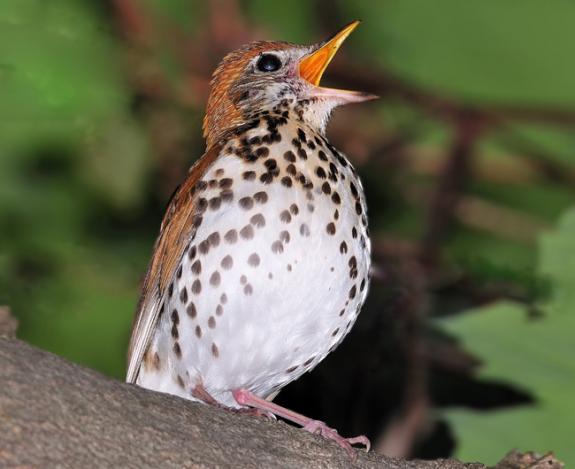
Each group of students was given a print out of this, along with a bunch of one-inch circles, which represent the nesting territories required for the wood thrush (the adorable bird pictured above) to successfully breed. 


The ranges can't overlap, so careful manipulation is required to see how many will fit in this unspoiled version of Wood Thrush Creek.

After seeing how many birds can fit in the area before development, some challenges are introduced:

In this scenario, the owner of the land quite reasonably decides to develop some of it. Over the course of ten years, a couple of roads are built, as well as some houses. The shaded box at the bottom represents an area that has been logged. 

In person, it still looks serene and beautiful, and now it's easier to get to, thanks to the roads. The houses are nestled back in the woods, and to the untrained eye, it looks much as it did before. 

Unfortunately, things look much different to the wood thrush. As far as it's concerned, the habitat has been drastically changed. Many birds are quite sensitive to manmade activity, and can't nest in areas that have structures or activity. Some animals simply won't tolerate it and move on. But others are subject to other factors, such as increased predation. (Imagine, a nesting wood thrush is startled by a lawn mower and flies from the nest. Meanwhile, another animal finds the eggs unguarded and has a filling meal.) 

Twenty years later, things are even busier, with the addition of more roads and houses, as well as a snow mobile/ATV trail. 

Keeping in mind that the Wood Thrush cannot successfully nest near these manmade creations, how many can fit in each area now? Students worked together to try to fit in as many nesting areas as possible in all of these scenarios. 


Finally, we talked about the reality of the situation. Not all land can be completely protected and left in an untouched state. Land (and other resources) have to be managed, ideally in ways that are sustainable to wildlife and humans. 

(We even took a brief detour into the relationship between shape and interior area. Both areas above have a perimeter of 40 miles, but the rectangle has an area of 75 squire miles, while the square has a full 100.)

Students were tasked with creating plans that included all of the features of the previous scenarios (including the trail, the same number of homes, and a logged area), but managed those changes in a less impactful way. 


Thursday, January 28, 2016

Week 19: Hodge Podge


We kicked off the week with some highly anticipated news: We received our Place Out of Time character assignments from our friends at the University of Michigan. In our class, we'll be spending the next couple of months getting to know Pelé, Millard Fillmore, Rachel Carson, Henry Clay Frick, Raina Telgemeier, Mustafa Kemal Atatürk, Elon Musk, Richard Nixon, and Manfred con Richthofen (also known as "the Red Baron"). 
We're just dipping our toes into the research phase of the project this week, but things will progress quickly moving forward. Everyone is using a fairly comprehensive research log to help guide their inquiry into the life and time of their character. To take a look at the template, click here. Each child has their own copy on Google Drive, so be sure to chat with your child about what they're learning. (They can share their actual research log with you, if you like!) We'll be doing online research at school, as well as attempting to find books at the library, but feel free to help your child seek out material outside of school as well! In addition to the learning about each character, we'll all be learning research skills and strategies, the difference between primary and secondary sources, and the importance of citing sources of information. 


We're also continuing with a much smaller scale research and presentation project this week. As mentioned in a previous blog entry, each student was tasked with researching and presenting on a species that is threatened or endangered in Michigan.
Eva presents on the Canadian Lynx. 

Ella presents on the Karner blue butterfly. 

Nick tells us about the plight of the Indiana bat. 

Bora lectures on the rufa red knot. 
This project has dovetailed with a project in science class, in which each student has been tasked with creating a new species, drawn from both their imaginations and a real-world understanding of body systems and ecosystems. (And in Latin, the kids have been working to give their animals realistic scientific names for the genus and species of their creation.) 

Ask your child about their animal! 


We also watched Sticky, which is a dreamy and lovely animated documentary that tells the remarkable story of a species categorized as extinct many decades ago. The first third of the twenty minute film is wordless. It's well worth a viewing: 

Friday, January 22, 2016

Last Chance to See

The Aye-Aye. Not all lemurs are adorable. 


Douglas Adams is best known as the author of the Hitchhiker's Guide to the Galaxy, which is a series of books (and many other media) that had a profound influence on my developing sense of humor as a goofy sixth grader. The idea that you could blend science fiction with Monty Python-esque humor blew my mind, particularly because I realized that a lot of it was clearly going right over my head. For example, as a twelve year old, I had no idea what bureaucracy was, nor how absurd and maddening it can be to navigate. But because it was a favorite topic of satire for Adams, it gave me an intriguing glimpse of my own future of tax returns, mortgage applications, and endless visits to the DMV. 


Mark Carwardine and Douglas Adams

As much as I loved the fictional universe that Douglas Adams created, it is his writing about our own world that has continued to resonate with me. In 1985, a magazine editor had the bright idea of teaming Adams up with a photographer and a naturalist to attempt to spot an extremely rare and endangered lemur in the wild. I'll let Mr. Adams introduce the trip:

This isn't at all what I expected. In 1985, by some sort of journalistic accident, I was sent to Madagascar with Mark Carwardine to look for an almost extinct form of lemur called the aye-aye. None of the three of us had met before. I had never met Mark, Mark had never met me, and no one, apparently, had seen an aye-aye in years. 
This was the idea of the Observer Colour Magazine, to throw us all in at the deep end. Mark is an extremely experienced and knowledgeable zoologist, working at that time for the World Wildlife Fund, and his role, essentially, was to be the one who knew what he was talking about. My role, and one for which I was entirely qualified, was to be an extremely ignorant non-zoologist to whom everything that happened would come as a complete surprise. All the aye-aye had to do was do what aye-ayes have been doing for millions of years - sit in a tree and hide.

The aye-aye. 
The experience was transformative. Adams and Carwardine decided to continue their partnership, and spent the better part of a year traveling the globe in an attempt to see (and draw attention to) a collection of animals who were teetering on the edge of extinction. The book that emerged from these travels is called Last Chance to See. The book is both entertaining and sobering. In the time since its publication in 1990, one of the species they searched for (the Yangtze River Dolphin) is now believed to be extinct. 

Sadly, Douglas Adams died in 2001. However, his passion and advocacy inspired many, including his friend Stephen Fry. In 2009, the BBC aired a six part documentary series, in which Fry and Mark Carwardine retraced their journey, checking in to see how each species had fared over the decades. 

By now, you're perhaps wondering if I'm ever going mention the fine students of Summers-Knoll, and what any of this has to do with them. I am, indeed! 

We read the first chapter of Last Chance to See in class, which is a fun and useful primer for evolutionary biology, plate tectonics, ecology, conservation, and more. It's titled "Twig Technology," and I essentially want to quote the entire thing. Instead, here are three paragraphs that I have found delightfully concise and informative. 


Like virtually everything that lives on Madagascar, [the aye aye] does not exist anywhere else on earth. Its origins date back to a period in earth's history when Madagascar was still part of mainland Africa (which itself had been part of the gigantic supercontinent of Gondwanaland), at which time the ancestors of the Madagascan lemurs were the dominant primate in all the world. When Madagascar sheered off into the Indian Ocean it became entirely isolated from all the evolutionary changes that took place in the rest of the world. It is a life raft from a different time. It is now almost like a tiny, fragile, separate planet.  
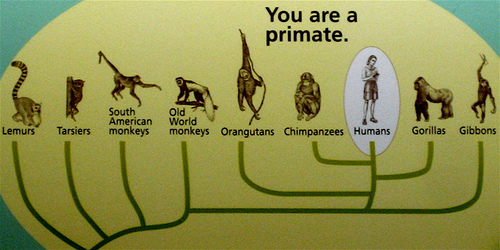
The major evolutionary change which passed Madagascar by was the arrival of the monkeys. These were descended from the same ancestors as the lemurs, but they had bigger brains, and were aggressive competitors for the same habitat. Where the lemurs had been content to hang around in trees having a good time, the monkeys were ambitious, and interested in all sorts of things, especially twigs, with which they found they could do all kinds of things that they couldn't do by themselves - digging for things, probing things, hitting things. The monkeys took over the world and the lemur branch of the primate family died out everywhere - other than Madagascar, which for millions of years the monkeys never reached. 
Then fifteen hundred years ago, the monkeys finally arrived, or at least, the monkey's descendants - us. Thanks to astounding advances in twig technology we arrived in canoes, then boats and finally aeroplanes, and once again started to compete for use of the same habitat, only this time with fire and machetes and domesticated animals, with asphalt and concrete. The lemurs are once again fighting for survival. 

In just these three paragraphs, we found at least five different concepts to unpack and discuss. Later, after reading the entire chapter, we watched the episode of the 2009 BBC series that followed up their visit. 

If you're interested, you can view it here: 


While planning the book, Douglas Adams was able to tell Mark Carwardine where on the planet that he would like to visit, and Carwardine was easily able to find species there that were endangered and in dire need of publicity and help. Taking this as inspiration, we took stock of our own corner of the globe. 

Each student read though this list of threatened or endangered species in the state of Michigan. Then, they selected one to learn about its situation. What is it? Why is it endangered? What is being done about it? 

Having done research on their particular organism, each student is preparing a short (5-10 minute) presentation on what they learned. Some students gave their presentations to the assembled 5/6 classes over the week. The remaining presentations are forthcoming. 


Kaz discusses the Copperbelly water snake

Henry teaches us about the Eastern Massasauga rattlesnake

Oliver presenting on the Piping Plover

Niko tells us about the Northern Long-Eared Bat

After sharing what we've learned about this sampling of endangered species, we'll look toward what active steps we can take to preserve these (and many other) species in our own communities. 

The highly-specialized hand of the aye-aye.