
 |
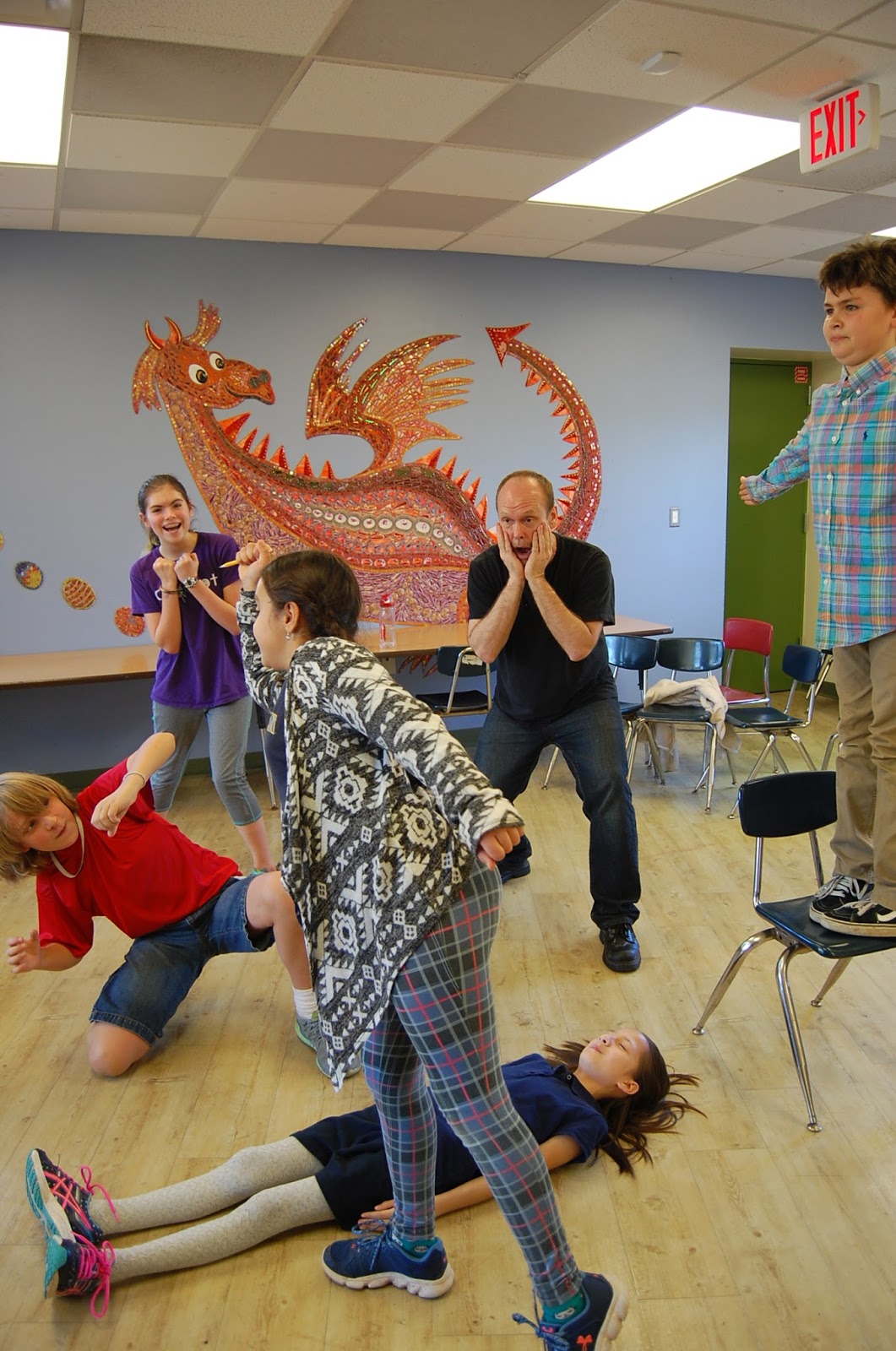
| Scenes from the Stratford workshop |
The week of the school play is almost always wholly consumed by rehearsal and prep, and this year is no different. We’ve spent much of our homeroom time running our lines, practicing the staging, and trying to hone our performances to make sure that we put on a good show. Meanwhile, the students who don’t have roles in the play have been working to design and construct the props needed for the show. We hope to see you at one of the performances of the show!
 | |
|
When not working on the play, we’ve been doing group peer review of our Summers-Knoll myths. Our protocol for this is as follows: First, each student reads a piece of writing to the group twice. Both times, students are actively listening for things that they find interesting and enjoyable, as well as making note of where they were confused, or where the author might want to go into more detail on something. After reading their work, the author takes control of the room and calls on volunteers. For the first few minutes, we ask only for positive thoughts. Kids might point out something that they thought was clever, an interesting turn of phrase, or praise a plot twist. Then, we switch into constructive criticism. The audience shares what they were confused by, where the author might go into more detail, etc. The author’s role during this time is exclusively to listen to their audience. Questions about the work are deliberately not answered, and points are not argued. The point is that the author knows that their audience had those thoughts while hearing the work. The author then processes and considers the feedback, and uses it as they see fit during the revision process later.

For example, an author may have intended for a particular character to be somewhat mysterious in their story. However, if they get feedback from their peers that the character came across as merely underdeveloped, they can then take that information and work to clarify their intent during the revision process.
 | |
|
This method of review requires a community of writers who are all taking the exercise in good faith, and who are actively working to support each other during what can be a somewhat harrowing process. It can be challenging and scary to receive feedback on your writing, and I am happy to report that the conversations have been kind, productive, and supportive.

In math group, we have concluded our survey of multiplication methods, culminating with the standard algorithm, which is the method that most of us were taught during our own schooling. We learned and practiced seven different methods of multiplication, On Thursday, we began an assessment to see how well we could perform each of them, while also evaluating their effectiveness. Which methods are the quickest? What are the strengths and weaknesses of each? Perhaps most importantly, which methods are the most efficient for each individual? Surveying these varied methods has drawn a fine point on the idea that there isn’t one “correct” way to perform this operation, and by examining each method and comparing them to each other, we have developed a deeper understanding of what is actually happening when you multiply.


Henry performs at the Music Cafe


