Showing posts with label Identity. Show all posts

Friday, April 15, 2016

POOT: The Place Out of Time banquet


We began our first week back after Spring Break with a couple of field trips. 


The first was to the University of Michigan School of Education for the annual Place Out of Time banquet. There were a couple hundred students in attendance from Michigan and Ohio, ranging from 5th graders through high school. Check out this video to get a glimpse of the event (apologies in advance for the wobbliness of the camera): 


Chatting with Joanna at our weekly morning assembly


On Tuesday, we took a trip to Hill Auditorium to hear a performance of the Ann Arbor Symphony Orchestra

(I confess that this would be much more effective if there was audio.)


Friday, October 16, 2015

Time for School


Shugufa in 2009


Our Global Village experience has continued to inform our studies. This week, we watched the documentary Time for School. It's a fascinating project that chronicles the journeys of seven children from around the world as they begin their formal educations. The kids come from radically different cultures and backgrounds, and we've been talking about how different factors can help or hinder an education. For example, Ken from Japan lives in one of the wealthiest countries in the world. We watch as he begins school at six years old. He has already learned to read by his first day of class. He has tremendous cultural and family support, as well as a backpack stuffed full of new supplies. 

Neeraj in 2003.
Compare Ken's experience to those of Neeraj. On her first day of schook, she's about 9 or 10 years old (she's not sure), and living in rural India. Her mother takes an extremely dim view of education, arguing that she doesn't have an education, so why would her daughter need one? She also complains that the educated males in their village are unable to find work, and asks why should she bother educating her daughter as well? Neeraj is allowed to go to school only after a full day of hard labor. She attends a night school huddled around a small lantern with other girls from a similar situation. She walks home by herself each night, and arrives in her home after the rest of the household has gone to sleep.

We also meet children from Kenya, Romania, Brazil, and Benin. The first installment aired in 2003, and the filmmakers have followed up with each student twice since. The intention is to check in with each student multiple times over the course a twelve year period. (It's a similar idea to the more famous "Up" series, with a much more diverse set of subjects.)

You can view the original installment here: Time for School (2003). It's about an hour long, and it chronicles all seven children on their first day of school. It's fascinating in its own right. (But we didn't actually watch this in class.) 

Ken in 2003.
The second installment follows up on the kids three years later. It's about an hour and a half long. You can watch it online here: Back to School (2006) (We didn't watch this one in class either, but it's well worth your time.) 

Time for School 3 is available in two parts, and each is about an hour long. They show the students in 2009, and many of them are at crucial points in their educations. It also gives a recap of what we learned about each student and country in the previous installments. We watched these together in class, and you may have noticed your kids revisiting them at home to take notes on each respective student. 

Watch online: 
Time for School 3 (Part 1, featuring Shugufa, Jefferson, Neeraj, and Ken)
Time for School 3 (Part 2, featuring Nanavi, Raluca, and Joab)


There are plans for Time for School 2015, but it has yet to air. We've had discussions in class about where we think each child is by now, and why. 

In the weeks ahead, we'll also be exploring the nonprofits and NGOs that are doing work in these countries and communities to help students succeed. 


Wednesday, September 30, 2015

Science: Building the digestive system


As part of our Identity theme, we're learning about the different human body systems during our Science classes with Lisa. Check out her recent blog entry to see how we're learning about the digestive system!


Measuring and recording the lengths of our innards


If we could stretch our digestive systems out, they'd be about this long (and much bigger and messier).
In addition to the yarn models, we created models of our stomachs using plastic bags, complete with juices to replicate the conditions inside of them. We inserted torn up ("chewed") bread and corn, then spent some time mashing the food up to observe the results. It was both interesting and gross! 


Friday, September 25, 2015

Equality, Justice, Harrison Bergeron, and the Global Village

Nick and Eva spy a visitor to the Howell Nature Center Global Village.

We began our week in the spotlight, as it was the job of the 5/6s to lead our Monday morning assembly. Each Monday morning, all of the students, staff, and faculty (and occasional parents, grandparents, and other family members!) gather in the atrium for a community gathering. A different homeroom leads the meeting each week, often taking the opportunity to share something that's been going on in our classes. 


We chose to spotlight our trip to the Howell Nature Center Global Village, and we adapted the skits that they wrote and performed there for the Summers-Knoll community. While writing them, the kids were very thoughtful about how to best convey what we had learned to the wide age range of our audience. The Global Village trip is a fun and exciting experience, but the underlying message is quite serious. The fifth and sixth graders felt enlightened about the severity of inequity in the world, but they didn't want to disturb, for example, their Kindergarten compatriots while sharing what they had learned. We opted to share our direct experiences, and only briefly touch on the larger issues. It allowed us to introduce some ideas, and hopefully generate some conversation and thought. 

As I narrated, the entire group of fifth and sixth graders acted out brief skits about the challenges and triumphs of the trip: Learning to communicate with each other, bartering for resources, starting a cooking fire, trying to cook with limited ingredients, and eventually trying to fall asleep in cramped and primitive quarters. It was a fun and breezy presentation, that will hopefully generate further conversations.


And since we're talking about equality... 


This image always gets people talking. I'll come back to it in a moment. 


As part of a beginning-of-the-year writing exercise, I was asking the kids about the basic elements of a story. They quickly rattled off "characters, plot, and setting," but when someone said "theme," many had a hard time explaining what it meant. As a result, I did a read aloud of a Harrison Bergeron by Kurt Vonnegut, Jr. Have you read it? If not, you can do so here. Go on! It's a very quick read. I'll wait....

While you do that, here's a photo of Henry, Niko, Kaz, and Eva celebrating their success at keeping their Global Village balloon baby alive through the night. 

Well, what did you think? Vonnegut really yanks the rug out from under you at the end there, doesn't he? 

Harrison Bergeron is a great story to read with 5th and 6th graders. It's funny, brief, and features a big idea that's played out to an almost cartoonish degree. The idea of mandatory equality appeals to them, just as much as the implementation of concept in the story appalls them. (And I've found that the concept of the ear piece broadcasting thought-scattering noises every twenty seconds is a great thing to reference during the times in the year when interrupting each other becomes an issue. Blurting things out when we're having a group conversation causes everyone to have to mentally reset over and over.) (If you haven't read Harrison Bergeron, and you just skimmed past that link earlier, this sentence made no sense to you. For shame.) 

Kids like to talk about the different handicaps mentioned in the story, which gets us into talk about why the characters in the story would willfully submit to them (and why other characters would attempt to subvert them). The discussion eventually turns to the idea of equality not necessarily being an inherently good thing, as exemplified by the Equality Versus Justice cartoon above. 

Of course, Vonnegut's story is satirical, and being very bright kids, they realized that the society represented in the story didn't match either side of the Equality Versus Justice image. In fact, the equality in Harrison Bergeron was best represented by this image:  

Equal!


One can interpret Vonnegut's story a number of ways (and people have! Not always to Vonnegut's satisfaction...), which is another great reason to read it with kids who are expanding their understanding of social justice, while also developing a sense of the power of writing. 

Friday, September 18, 2015

Howell Nature Center Global Village field trip!


Whew! We have successfully completed our once-every-two-years trip to the Howell Nature Center Global Village! There will soon come a day when I will write up a proper post about our experiences, but it is not today, as I am ready for a good, long nap. To tide you over, please check out the page for our class Twitter feed. There, you will find a chronicle of our adventures (tweeted in reverse chronological order). 


Here's a sampling of the photos that you'll find there! (Captions and context to be provided in a proper post later. Better yet, ask your child about them!)


Friday, September 11, 2015

Welcome to the 2015-2016 school year! - Week one in review

Wow! Just like that, we've completed our first week of school! It's only Friday evening, but the first day jitters seem like a distant memory as we've all settled into our new class. Read on for a brief overview of the various threads of study that we began this week!


But first, say hello to the mysterious, affable, two-headed creature that we call Junella.


Identity Theme - Communities

Our first theme for the school year is Identity. One of the ways that we'll be exploring this topic is by taking a closer look at our own identities. There are many ways to think about who we are as individuals, and one particularly useful one is to think about what communities we are members of. After some discussion, we filled out charts listing (some of) our various communities, along with the benefits we receive for being a part of them, and the responsibilities that we have to them. 


For example, everyone listed their immediate families as one such community. The benefits they receive are food, shelter, love, safety, etc. Each person had different responsibilities to their family, such as doing chores, going to school, being kind, and so on. 

Other examples of communities were sports teams, the city of Ypsilanti, the city of Ann Arbor, the Summers-Knoll School community, our classroom community, the State of Michigan, the United States. Some kids thought even more broadly: We are a one species, and we are all citizens of the world. 

Everyone was able to think of several communities, as well as list some benefits that come along with being a part of that community. On one level, this got us all thinking a little more pointedly about the privileges and advantages that we are afforded in our lives. (And our upcoming field trip to Howell Nature Center will reinforce and expand this concept!) 

By also thinking about our responsibilities to these communities, it made us a little more conscious about what we're doing to serve and support them, and perhaps how we might be able to be even more mindful about them. (So feel free to use this weekend to try and encourage your child to pick up a few more household chores.) 


Technology at Summers-Knoll -- Crafting our technology guidelines
Each member of our class will soon be issued a Chromebook laptop for school use. These marvelous machines are remarkably useful tools, and we'll have them out regularly. However, learning to use them properly is fraught with peril. First of all, we all have to agree what "properly" means! Each year, we work with students to help them craft their own set of guidelines for safe, productive use of technology at Summers-Knoll. 


We began with a group brainstorming session with Jason's Class and Sam's Class working together to get our ideas going. What are some things that we shouldn't do with our computers? What are some things that we should do with them? Students then broke off into small groups to come up with guidelines that they felt were reasonable. ("Don't have food or liquid near your computer." "Do good work." "Don't get out your computer unless you've asked or been told to get it." "Use appropriate search terms." "Make sure your computer is plugged in at the end of the day.") 


Then we came back together and shared our drafts of items for our technology agreement. Once we've drafted it (and made sure that we didn't miss anything important), students will read through the rules that they created (and that we approved) and sign an agreement to abide by the guidelines. 


Giving the students an active role in the creation of these guidelines instills a sense of ownership in them that is far more powerful than simply being handed a list of rules to follow. It also gets them thinking about the challenges and issues that they will face over the years as they venture online more frequently. 


Stepping up and helping out
As recess was wrapping up on Thursday, we had an impromptu opportunity to help our our community. Shan had the Kindergarteners out on the playground as part of a science scavenger hunt, and one of her students got cut. As Shan tended to the (very minor, but bleeding and potentially disturbing image for our littlest students) wound, each of the 5th/6th graders quickly paired off and teamed up with a Kindergartener and proceeded to help them out with their task, while Shan took time to clean and bandage the cut. 

Ella takes a photo of her Kindergartener's find.

One of the best ways to bring out the best in older kids is to have them work with their younger schoolmates. It was lovely to see in action. 


Identity Theme: What is an American?
As another way to explore the concept of identity, we began a study of American history. There are many possible points to begin this story, and I've chosen the epic tale of Cabeza de Vaca. 

If you don't know his story, it's worth looking into. Cabeza de Vaca was part of a doomed conquistador expedition to the mainland of North America. Things went... poorly, and eventually only four explorers were left to struggle their way across this new (to them) continent. Along the way, they were attacked, befriended, enslaved, and borderline worshipped, depending on the disposition of the local population. Operating without the benefit of European technology (armor, weapons, horses), the stranded explorers were forced to deal with North America on its own terms, as opposed to acting like conquerors. 

It is for this reason that I've chosen to use this story as our entrance point to American history. It provides context for the strong European heritage of the United States, while still acknowledging the fact that the Americas were first populated by large numbers of complex and distinct societies. Cabeza de Vaca's experiences give us a unique glimpse into these cultures (albeit viewed through a European lens). 

They were eventually "rescued" eight years later, and Cabeza de Vaca prepared a lengthy and surprisingly accurate report for Spain, particularly given the fact that he did it all from memory. He had no way of recording information during this journey. In addition to describing the people and customs of the societies that they encountered, Cabeza de Vaca advocated for more peaceful and humane interactions between the Native Americans and the Spanish, a position that was rejected. 

We're using two books for this part of our studies. One is a translation of the report authored by Cabeza de Vaca himself (vocabulary term: Primary source!), and the other is a book that tells the tale as we understand it today (vocabulary term: Secondary source!). 


These were but a few of the happenings this week. We also visited all of our specialist classes (Math, Latin, French, Mandarin, PE, Music, Art, and Science. Science was particularly cool, and I'll add some photos to the blog soon! 


Thank you to everyone for a wonderful first week! 


Sunday, March 1, 2015

Mars Out of Time (or "MOOT.")

Belgian cartoonist Hergé has recently joined our class. 


Over the next several weeks, you'll be hearing a lot about the planet Mars, and something we call "MOOT." 


"MOOT" stands for Mars Out of Time, which is a new spin on one of our favorite annual projects. For many years, Summers-Knoll students have had the opportunity to participate in Place Out of Time (or "POOT"), a simulation run by the University of Michigan. The idea behind Place Out of Time is brilliant: What if we could bring the great (and lesser) minds of history to ponder a contemporary issue? 


In order to accomplish this, students select a notable character and learn as much about them as possible. They study primary and secondary sources (and learn what "primary" and "secondary" sources are in the process). They comb through books, magazines, websites, documentaries, and beyond in an attempt to learn as much as possible about their character, as well as the time in which they lived. 

Then, each student "becomes" their character, portraying them in the first person in classroom discussions and activities, and also on a web-based messageboard. 

The discussions cover a wide variety of topics, but they always eventually lead to one large, overarching issue. For example, two years ago, students were asked to explore and debate the French law that bans the wearing of conspicuous religious symbols in public. Last year, we debated the morality and legality of the Italian scientists who were held criminally liable for failing to accurately predict a 2009 earthquake

The project requires that students not only examine the intricacies of a contemporary issue, but that they do it from someone else's perspective, which is often radically different from their own. They learn and practice substantial research skills along the way, and by interacting with their classmates, they learn a lot about characters and times other than the ones that they're studying. It's a fantastic project. 

Dame Julie Andrews has also been recently spotted in the halls of Summers-Knoll!  


The University of Michigan masterminds behind the Place Out of Time program have opted to run a simulation about the Italian earthquake trial again this year. Since so many of our students have already examined this case (most of the current 6th graders, and almost all of the 7th and 8th grade class), we have opted to strike out on our own this semester. We'll still be collaborating with the U of M Place Out of Time crew, but our issue this time will be one that ties into our own recent studies: We will be planning and conducting a manned expedition to Mars. 

Kids have already selected their characters, and we've begun the research phase of the project. On Thursday, we took a field trip to the Ann Arbor District Library, where we were given a tour of their collection, with a specific focus on materials that pertain to each student's character. 


A selection of research materials for our cast of characters from a recent trip to the Ann Arbor District Library. 


Place Out of Time/Mars Out of Time is always a fun, highly-rated experience. Excitement runs high!


Tuesday, November 25, 2014

Grandfriends Day!

We had a number of special visitors to our school today! Students invited grandparents (and other grand friends) to spend the morning in our class, getting a taste of what we do in school each day.

We began the day with a warm-up, as is our custom, and our guests and students worked together to puzzle through it. A little later, a few kids performed portions of their magic acts. We also had a few class discussions to give a sample of what daily life is like here at Summers-Knoll.


Keira finds Evan's card. 

Brainstorming a math puzzle

Welcoming such important people into our classroom was a lovely day to spend the morning before a long, well-deserved holiday break!


Thursday, June 12, 2014

Flashback! Ad project videos


You may recall our studies of the tools of persuasion earlier in the year. For a refresher, visit these two blog entries: 


While sifting through materials for the year, I realized that we hadn't actually posted our commercials online. Here are two for your enjoyment: 


Wednesday, April 23, 2014

STEM: Desktop natural selection


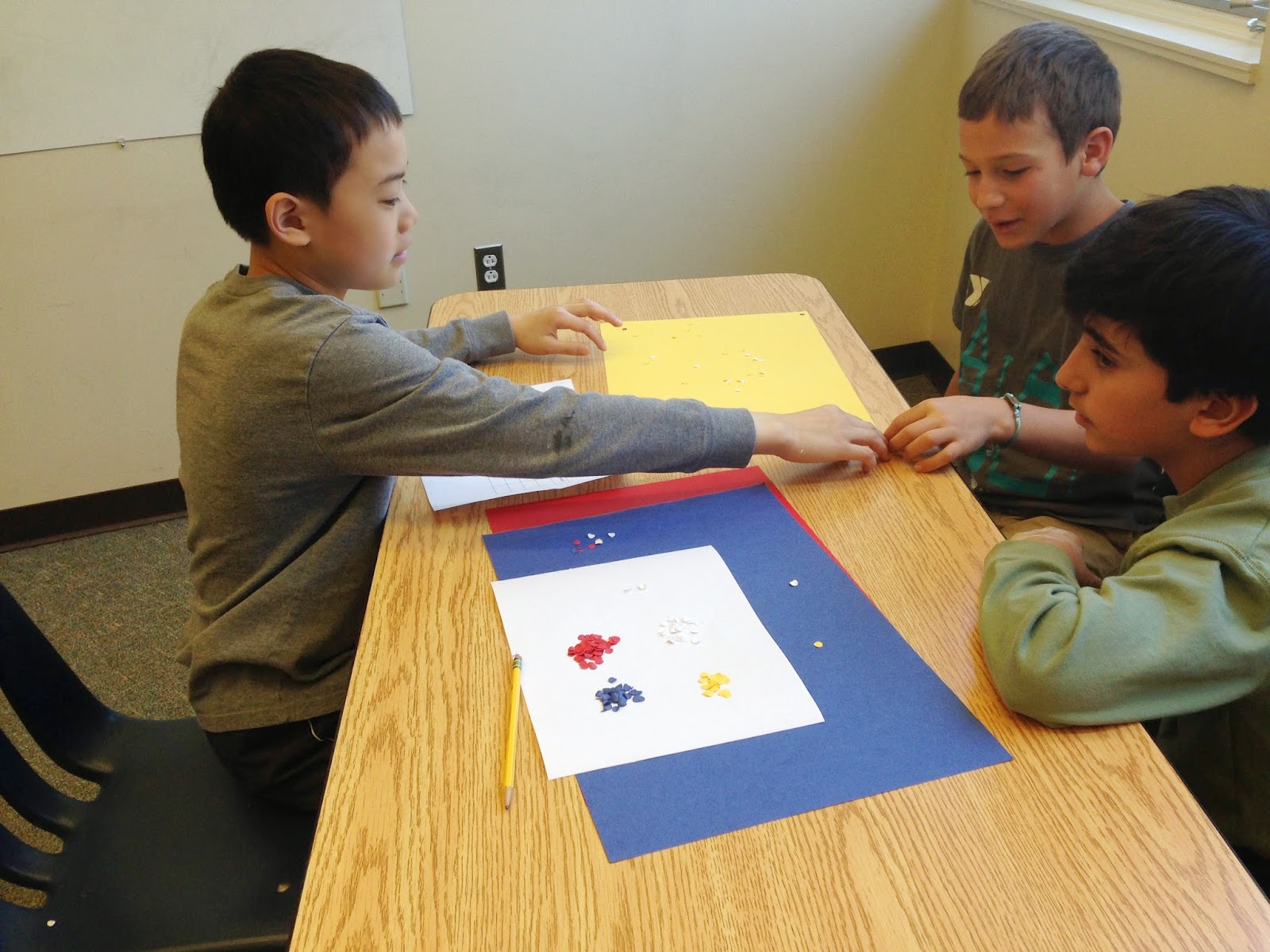
A predator prepares to feed. 
We spent our STEM time today with a simulation that we called "Desktop Natural Selection." We broke into three-person groups, each with a specific role:


1. The predator
2. The data recorder
3. The Benevolent Hand of Nature

We started with a population of colored dots, which all represent specimens of some species of organism. They are the prey for our predators. The phenotype of these organisms causes them to appear as either red, blue, yellow, or white. To begin with, these organisms were living in an environment (represented by a large sheet of paper) that was yellow.

First, the Benevolent Hand of Nature placed a specific number of dots into the environment. Then, the data recorder took stock of the numbers. When signaled, the person in the role of the predator was to look at the paper and then immediately grab ("eat") the first dot that they saw. Then they'd look away until they were signaled to pick another one.


This simulated a situation in which a predator was hunting, spotting, and eating prey. After each "feeding," the surviving dots would reproduce a new generation of offspring. Blue dots spawned more blue dots, yellow dots spawned more yellow dots, and so on. Then we began a new round of feedings. The data recorder kept track of the changing population numbers, while the Benevolent Hand of Nature made sure to make sure that the dots were stocked in the environment appropriately.

After several rounds, trends emerged. The yellow dots seemed to be quite prolific in this environment, and they went on to have many offspring after each round. The blue and red dots were less successful.

Then, their fortunes changed.

We simulated a change in the environment by switching from a yellow background to a red one. This could have represented any number of changes in nature; cloudy water, deforestation, industrial pollution, etc. With this change, suddenly the yellow dots became much more visible to our hungry predators. We saw their population growth level off accordingly.

We also revisited the idea of recessive traits, first discussed a few months ago during our Identity theme. Red dots, which had largely disappeared from the environments of most groups, spontaneously reappeared when we declared that a certain number of the white dots had been carrying a recessive gene for red. Though there were only a few that were reintroduced, the fact that they were now living in an environment that effectively camouflaged their presence buoyed our optimism about their chances to rebound.

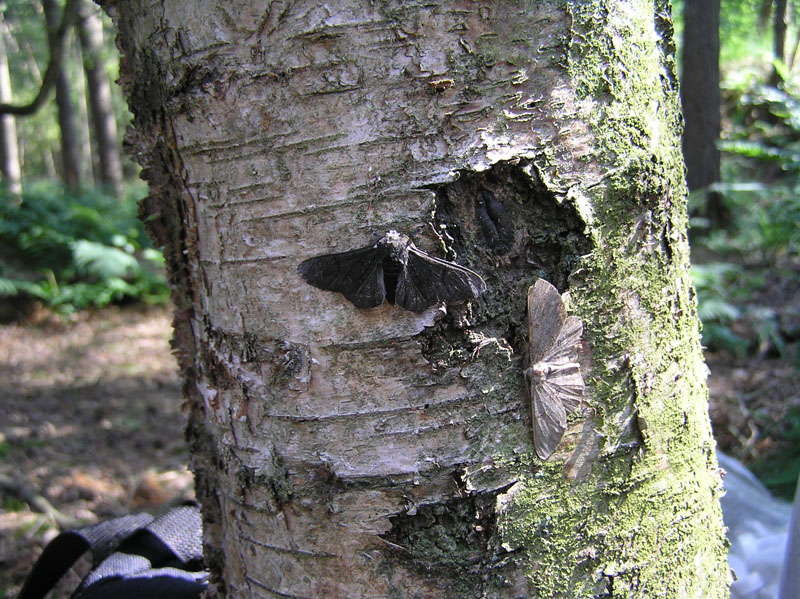
After a class discussion spent sharing observations and theories about what we had seen, we concluded with the famous story of the Peppered Moth. It's a great example to help conceptualize natural selection, both as an idea, and the occasional controversies that surround it. Ask your student to tell you about the story of the changing appearance of the Peppered Moths!

Having laid this groundwork, we'll be wrapping it into our study of Big Foot. What traits might he/she/it possess that would make it successful (or unsuccessful) in the environments in which it is supposed to exist? What about other cryptids and mythological beasts?