Showing posts with label ecology. Show all posts

Friday, October 7, 2016

Week 5 -- Monarch release!


This week saw a grand finale of sorts as we assembled the combined 5/6 classes on the playground to do a mass release of the many monarchs that we have shepherded from caterpillar to butterfly. This is the generation of monarchs who will work their way all the way down to Northern Mexico, where they will spend the winter. When spring arrives, their offspring will begin working their way north again. All of the monarchs released from Summers-Knoll have been tagged by students, so our fingers are crossed that we may one day get word of where they end up.


These are the tags that we put on the wing of each butterfly released from Summers-Knoll. Keen-eyed butterfly observers along the migration route sometimes come across tagged butterflies, and report the sighting to Monarch Watch. 

As we conclude this phase of the project, we are turning our eyes toward the future, participating in a brainstorming session to envision where we’d like the project go from here. What do we want to accomplish with it by the end of the school year? What might it look like one year after that? What should it look like in five year’s time? The ideas that we generate and agree upon will inform what our next steps will be with this exciting endeavor.


Feeding a monarch before release

Meanwhile, we are rapidly approaching the climax of The Tiger Rising, a novel that we’re reading together as a class. We generally have a brief discussion at the end of each chapter, discussing the text and making observations and connections. On Monday, one such discussion ballooned to a remarkable degree as kids started debating the ethics and morality of zoos. This led to Tuesday’s journal writing prompt, “How do you feel about zoos?” Many kids filled pages with their thoughts, and the conversation is clearly far from over.

Our math group met only three times this week, on account of our Professional Development day, so Monday was devoted to a group problem solving activity focused on creating an organized list and using it to analyze data (ask your kids about glass fish, gouramis, and neon tetras), while Tuesday and Friday were both spent working independently in math books for some, and continuing assessments for others.


Friday, May 13, 2016

Monarchs & monarchs


The last several weeks have been informed by learning about two types of monarch, both of which have been cast aside by Americans. One was intentional (King George III, during the American Revolution), the other has been an unintended consequence of the rise of industrialized farming in the United States (the migrating monarch butterfly). 
You may recall some of our work earlier in the year inspired by Last Chance to See, a powerful and entertaining book by Douglas Adams. In it, Adams and naturalist Mark Carwardine travel the world in search of some of the most endangered animals on the planet. 

It is a sad truth that there are endangered species in every region of the world, including our own. Rather than view this as an immutable fact beyond our control, our class has opted to actively work to reverse the fortunes of a familiar, but threatened species: the migratory monarch butterfly. 


The monarch is striking and iconic. If asked to picture a butterfly, most people will likely conjure a monarch in their mind. It is a widespread species, but the insects that we see in Michigan are part of a remarkable annual migration that becomes more miraculous and mysterious the more you learn about it. 

There is (of course) a Wikipedia article about this migration, but in brief: Monarch butterflies take part in a migration that begins in the mountains of Mexico, passes through the continental United States, and concludes in Canada, where they reverse course and head back South. The remarkable thing about this is that the annual migration takes five generations of monarchs to complete. The butterflies that start out in Mexico are not the ones that arrive in our state months later, but their grandchildren. How these butterflies know to consistently follow these paths of their ancestors is a mystery to science.  


It's also a phenomenon that is in danger of disappearing. 


Monarchs are wholly dependent on milkweed, on which they lay their eggs during this long journey. Familiar caterpillars soon hatch, feast on the leaves, create a chrysalis, and emerge in their adult stage two weeks later. 

Milkweed, formerly quite plentiful, is being wiped out en masse as an unintended side effect of the proliferation of industrial farming. Pesticides meant to protect crops have eradicated milkweed populations, significantly fragmenting and reducing a vital resource for the monarchs. 


Happily, there are simple things that people can do to help. 


The most passive is to learn what milkweed looks like, and take care not to remove or poison it if you happen to have it on your property. Milkweed has a bit of a public relations problem. It has the word "weed" right in its name, and it tends to grow in unpredictable places from year to year, confounding gardeners of a more controlling nature. One of the many things we hope to do is to work to rehabilitate the reputation of this important plant. 

A screenshot of recently spotted monarchs.
Visit this link for an interactive version. 

Our class has opted to take a more proactive approach. We have spent the last several weeks researching and planning a monarch waystation, which we're developing on the campus of Summers-Knoll. It is taking shape just outside of the windows of the 5/6 classrooms. As of today, there are two raised beds (constructed by Chris Swinko and his 3/4 class) that will eventually be stocked with native flowering plants that will bloom throughout the spring and summer, and milkweed that has been cultivated from local sources. 


It has been quite a project. This is an interdisciplinary affair, born in Science class, but taking significant portions of our homeroom time. Science Teacher Lisa has a certified monarch waystation at her home, and she has served as an inspiration, mentor, and guide in this endeavor. 

Our grand plan goes beyond simply creating a waystation at school. We also hope to cultivate and distribute milkweed to all who are willing to grow it at their homes. This means that we've been trying to grow our own milkweed from seed. Teams of students have been attempting to cultivate seeds in our classroom and in the greenhouse, experimenting in order to determine the most effective ways to grow milkweed from seed. 


We've also been tracking existing monarchs. Studying monarchs is an excellent way to engage as citizen scientists, with enthusiastic hobbyists and naturalists collecting and sharing data about milkweed and monarch sightings. Kids can be found checking this site daily. (Ask your child about it!) 

The project has offered many authentic opportunities for genuine science. For example, rather than simply buying topsoil from a retailer, we are trying to "mine" our own campus for material. One day found all of our students working in teams to collect soil samples from various places on the Summers-Knoll grounds to determine the best site to take soil. 

When it was determined that the most fertile soil seemed to be in our woods just beyond the playground, we decided that we needed to do a mini-environmental impact study. What would it mean for us to move into a previously undisturbed area to remove several dozen cubic feet of soil? To find out, we trekked carefully into the woods to see what was living back there. 


What we found surprised us all. 


We are currently attempting to identify the source of a clutch of eggs found beneath a log near our vernal pool. Our initial suspicion is that our small woods may be home to a population of reclusive salamanders. We are trying to verify this through online research and reaching out to herpetologists. Stay tuned for updates! 


I also mentioned that other monarch earlier in this post. As part of our background preparation for our upcoming Spring trip to Philadelphia, we have been studying colonial America and the American Revolution. We've been using a number of sources in order to get a well-rounded look at this period of history. We have read selections from Joy Hakim's A History of US series, watched selections from the HBO series John Adams, and listened to selections from the recent Broadway phenomenon Hamilton. We've also done a close reading and discussion of the United States Declaration of Independence, and we've been barreling through our current read aloud book, Chains by Laurie Halse Anderson


Taking stock of the greenhouse inventory


Researching milkweed, native plants, and monarchs


Attempting to grow milkweed from seed, attempt #1


Moving the raised beds to their new homes


Searching for ideal sources of soil


Soil samples settling for close observation and study


Friday, March 11, 2016

Fragmentation


In homeroom, we've continued looking into the complicated consequences of human beings affecting the fates of other species. This week, we looked at habitat fragmentation. 
Here's a snake in its preferred environment. It has a decent size range that allows it food and shelter. 


Then, humans move in.


The habitat changes over time. A road bisects part of its range, and a couple of subdivisions have been built. (You've probably realized that this is not to scale. That's not a gigantic snake.) 

A road may seem like a relatively harmless addition, but it means the snake is now forced to cross an unnatural border in order to access its full range. While on that road, it is more vulnerable to predators (and more likely to be run over). 

Even if the road poses little issue for the snake, it might have a dramatic effect on the environment that it had previously occupied. Roads make water drain differently. The vegetation along the roadway changes. The animals that the snake previously hunted may not be as common. These small changes can add up to make a habitat unlivable for animals that had previously thrived here. 

We talked in class about this example, then broke into groups to explore a similar scenario. 

Heere is Wood Thrush Creek. It's a secluded forested area with a stream running through it. It may not look like much on your screen, but it's lovely in person. 
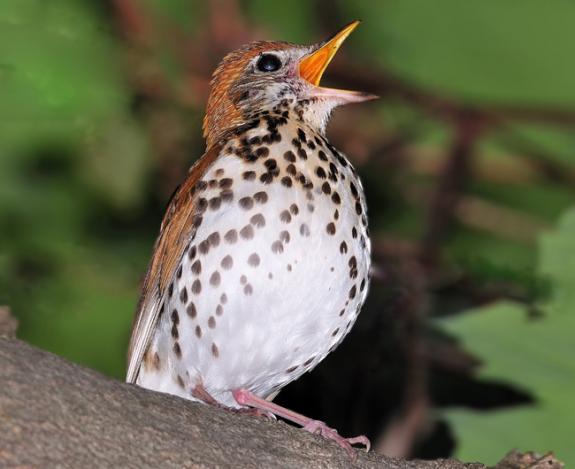
Each group of students was given a print out of this, along with a bunch of one-inch circles, which represent the nesting territories required for the wood thrush (the adorable bird pictured above) to successfully breed. 


The ranges can't overlap, so careful manipulation is required to see how many will fit in this unspoiled version of Wood Thrush Creek.

After seeing how many birds can fit in the area before development, some challenges are introduced:

In this scenario, the owner of the land quite reasonably decides to develop some of it. Over the course of ten years, a couple of roads are built, as well as some houses. The shaded box at the bottom represents an area that has been logged. 

In person, it still looks serene and beautiful, and now it's easier to get to, thanks to the roads. The houses are nestled back in the woods, and to the untrained eye, it looks much as it did before. 

Unfortunately, things look much different to the wood thrush. As far as it's concerned, the habitat has been drastically changed. Many birds are quite sensitive to manmade activity, and can't nest in areas that have structures or activity. Some animals simply won't tolerate it and move on. But others are subject to other factors, such as increased predation. (Imagine, a nesting wood thrush is startled by a lawn mower and flies from the nest. Meanwhile, another animal finds the eggs unguarded and has a filling meal.) 

Twenty years later, things are even busier, with the addition of more roads and houses, as well as a snow mobile/ATV trail. 

Keeping in mind that the Wood Thrush cannot successfully nest near these manmade creations, how many can fit in each area now? Students worked together to try to fit in as many nesting areas as possible in all of these scenarios. 


Finally, we talked about the reality of the situation. Not all land can be completely protected and left in an untouched state. Land (and other resources) have to be managed, ideally in ways that are sustainable to wildlife and humans. 

(We even took a brief detour into the relationship between shape and interior area. Both areas above have a perimeter of 40 miles, but the rectangle has an area of 75 squire miles, while the square has a full 100.)

Students were tasked with creating plans that included all of the features of the previous scenarios (including the trail, the same number of homes, and a logged area), but managed those changes in a less impactful way. 


Friday, January 22, 2016

Last Chance to See

The Aye-Aye. Not all lemurs are adorable. 


Douglas Adams is best known as the author of the Hitchhiker's Guide to the Galaxy, which is a series of books (and many other media) that had a profound influence on my developing sense of humor as a goofy sixth grader. The idea that you could blend science fiction with Monty Python-esque humor blew my mind, particularly because I realized that a lot of it was clearly going right over my head. For example, as a twelve year old, I had no idea what bureaucracy was, nor how absurd and maddening it can be to navigate. But because it was a favorite topic of satire for Adams, it gave me an intriguing glimpse of my own future of tax returns, mortgage applications, and endless visits to the DMV. 


Mark Carwardine and Douglas Adams

As much as I loved the fictional universe that Douglas Adams created, it is his writing about our own world that has continued to resonate with me. In 1985, a magazine editor had the bright idea of teaming Adams up with a photographer and a naturalist to attempt to spot an extremely rare and endangered lemur in the wild. I'll let Mr. Adams introduce the trip:

This isn't at all what I expected. In 1985, by some sort of journalistic accident, I was sent to Madagascar with Mark Carwardine to look for an almost extinct form of lemur called the aye-aye. None of the three of us had met before. I had never met Mark, Mark had never met me, and no one, apparently, had seen an aye-aye in years. 
This was the idea of the Observer Colour Magazine, to throw us all in at the deep end. Mark is an extremely experienced and knowledgeable zoologist, working at that time for the World Wildlife Fund, and his role, essentially, was to be the one who knew what he was talking about. My role, and one for which I was entirely qualified, was to be an extremely ignorant non-zoologist to whom everything that happened would come as a complete surprise. All the aye-aye had to do was do what aye-ayes have been doing for millions of years - sit in a tree and hide.

The aye-aye. 
The experience was transformative. Adams and Carwardine decided to continue their partnership, and spent the better part of a year traveling the globe in an attempt to see (and draw attention to) a collection of animals who were teetering on the edge of extinction. The book that emerged from these travels is called Last Chance to See. The book is both entertaining and sobering. In the time since its publication in 1990, one of the species they searched for (the Yangtze River Dolphin) is now believed to be extinct. 

Sadly, Douglas Adams died in 2001. However, his passion and advocacy inspired many, including his friend Stephen Fry. In 2009, the BBC aired a six part documentary series, in which Fry and Mark Carwardine retraced their journey, checking in to see how each species had fared over the decades. 

By now, you're perhaps wondering if I'm ever going mention the fine students of Summers-Knoll, and what any of this has to do with them. I am, indeed! 
We read the first chapter of Last Chance to See in class, which is a fun and useful primer for evolutionary biology, plate tectonics, ecology, conservation, and more. It's titled "Twig Technology," and I essentially want to quote the entire thing. Instead, here are three paragraphs that I have found delightfully concise and informative. 


Like virtually everything that lives on Madagascar, [the aye aye] does not exist anywhere else on earth. Its origins date back to a period in earth's history when Madagascar was still part of mainland Africa (which itself had been part of the gigantic supercontinent of Gondwanaland), at which time the ancestors of the Madagascan lemurs were the dominant primate in all the world. When Madagascar sheered off into the Indian Ocean it became entirely isolated from all the evolutionary changes that took place in the rest of the world. It is a life raft from a different time. It is now almost like a tiny, fragile, separate planet.  
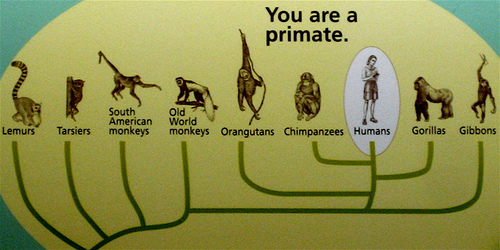
The major evolutionary change which passed Madagascar by was the arrival of the monkeys. These were descended from the same ancestors as the lemurs, but they had bigger brains, and were aggressive competitors for the same habitat. Where the lemurs had been content to hang around in trees having a good time, the monkeys were ambitious, and interested in all sorts of things, especially twigs, with which they found they could do all kinds of things that they couldn't do by themselves - digging for things, probing things, hitting things. The monkeys took over the world and the lemur branch of the primate family died out everywhere - other than Madagascar, which for millions of years the monkeys never reached. 
Then fifteen hundred years ago, the monkeys finally arrived, or at least, the monkey's descendants - us. Thanks to astounding advances in twig technology we arrived in canoes, then boats and finally aeroplanes, and once again started to compete for use of the same habitat, only this time with fire and machetes and domesticated animals, with asphalt and concrete. The lemurs are once again fighting for survival. 

In just these three paragraphs, we found at least five different concepts to unpack and discuss. Later, after reading the entire chapter, we watched the episode of the 2009 BBC series that followed up their visit. 

If you're interested, you can view it here: 


While planning the book, Douglas Adams was able to tell Mark Carwardine where on the planet that he would like to visit, and Carwardine was easily able to find species there that were endangered and in dire need of publicity and help. Taking this as inspiration, we took stock of our own corner of the globe. 

Each student read though this list of threatened or endangered species in the state of Michigan. Then, they selected one to learn about its situation. What is it? Why is it endangered? What is being done about it? 

Having done research on their particular organism, each student is preparing a short (5-10 minute) presentation on what they learned. Some students gave their presentations to the assembled 5/6 classes over the week. The remaining presentations are forthcoming. 


Kaz discusses the Copperbelly water snake

Henry teaches us about the Eastern Massasauga rattlesnake

Oliver presenting on the Piping Plover

Niko tells us about the Northern Long-Eared Bat

After sharing what we've learned about this sampling of endangered species, we'll look toward what active steps we can take to preserve these (and many other) species in our own communities. 

The highly-specialized hand of the aye-aye. 

Wednesday, December 10, 2014

Our class lately. . .


It's been difficult to adequately sum up what's been happening at school lately, as we've been very busy! 


First and foremost, our upcoming school play looms over everything. Rehearsals for Alice have taken over this week, and things have been coming together nicely! 
A full dress rehearsal underway in the atrium
Meanwhile, the students who aren't in the play are working on a variety of other projects. 
Gabe and David are working on a tessellation presentation. Marcellin and Keira are working on creating a fraction game. 
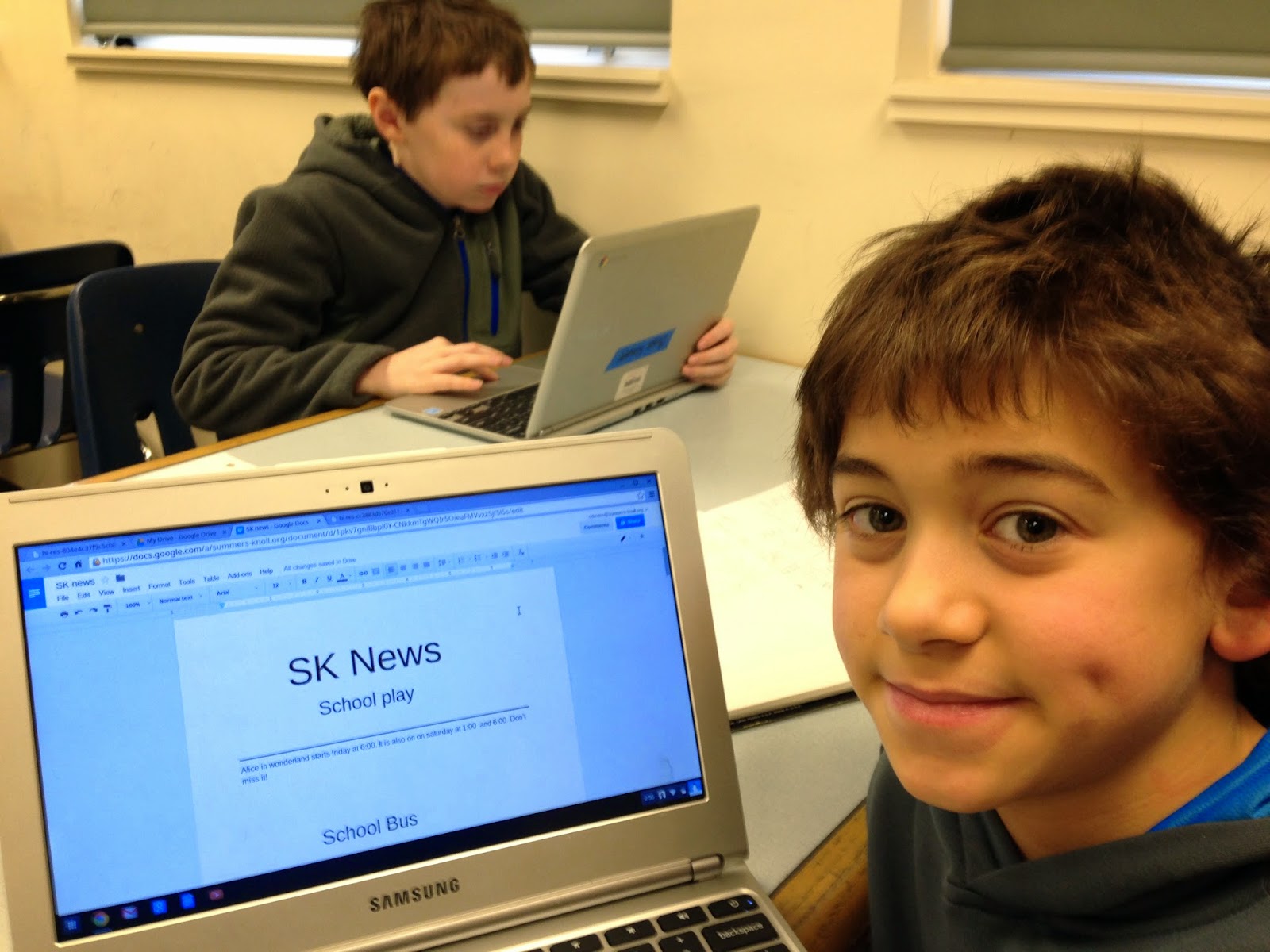
Owen began working on an S-K themed newspaper, and Oliver has started contributing as well. 

Meanwhile, our entire class continues our investigation into water, water purity, and filtration. Here, Sam uses a student-built filter to see if it can remove green food coloring from a cup of water. (It can't! Why not?)

Nick shows off a jar of water that has been driving a lot of our investigations. It was pulled from the standing water just behind the S-K playground. We've been watching as it settles and changes, and learning about the processes that cause the jar to re-pressurize every time we open it and re-seal it. 

We've also been conducting an experiment in evaporation. We placed the same amount of water into differently shaped containers. At what rate will each evaporate? (If they're different rates, why might that be?) Not only is it an exercise in surface area, evaporation, and filtration, but also one involving experimental design and good data collection. (Students are also writing a set of procedures that are precise enough that someone else could replicate the experiment.) 


On top of this, we're also continuing with our book groups. Some groups are finished with their books and have moved onto preparing presentations to share with the rest of the class. It's a busy time!