Showing posts with label work spaces. Show all posts

Tuesday, December 16, 2014

Scenes from the final week of 2014


Now that the energy and excitement of the play has crested, we have a week left before a well-earned break. The final week in December can often be a tricky one, as people are starting to burst at the seams, but we're still getting a lot done! 


On Monday, the first of our book groups presented to the class, telling us a bit about the characters and themes of Mockingbird, the book they had read. 


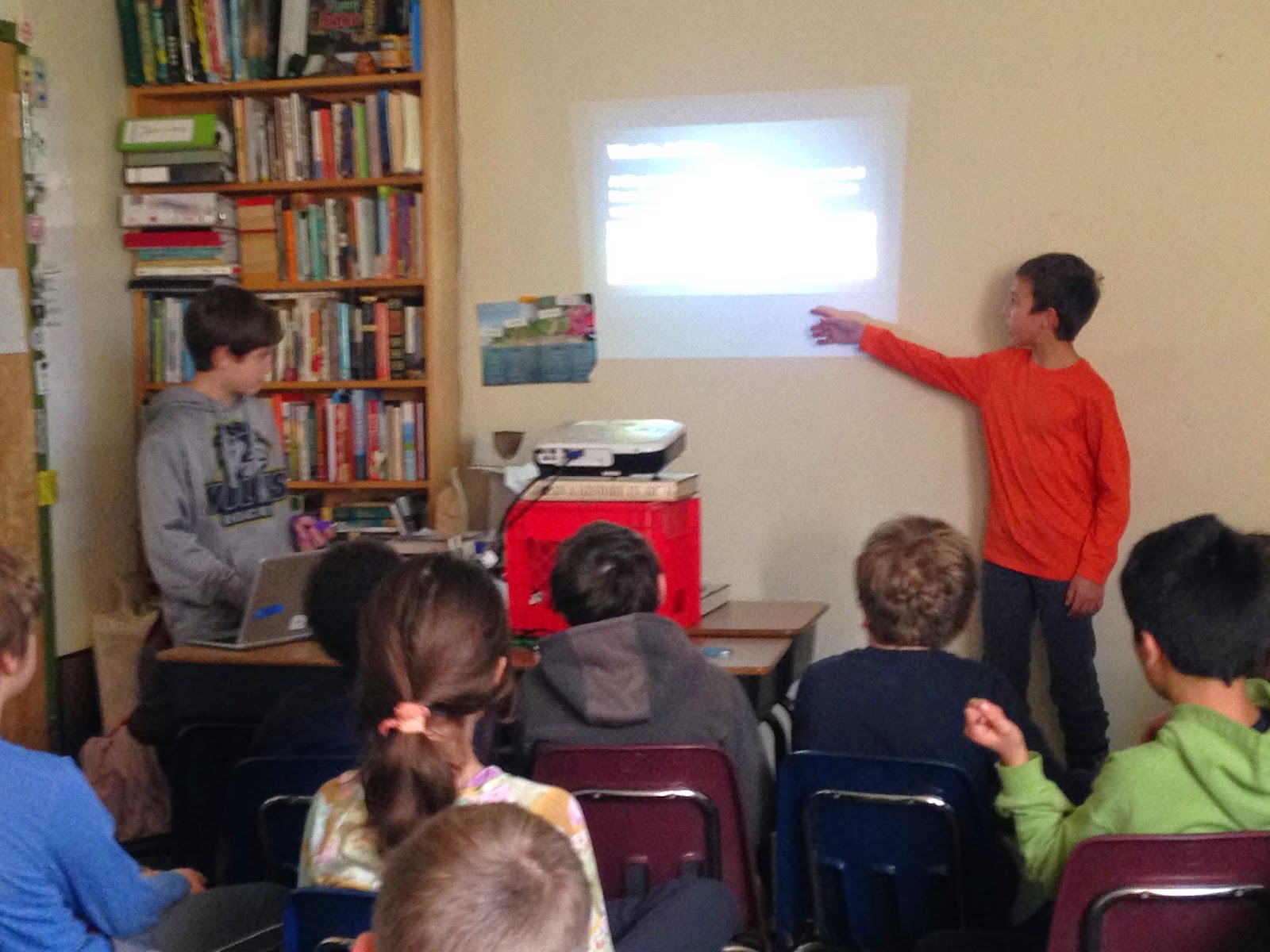
Later in the day, Gabe and David gave a presentation teaching us about tiling and tessellation, which included a group activity designed to illustrate what shapes are able to tessellate. (It's difficult to photograph a slideshow in low light, so please know that David is actually pointing out a detail of a tiling, as opposed to just a blob of white light.) 


In Math today, what was meant as a warm-up exercise wound up taking over much of the morning, as kids worked together (using manipulatives, drawings, paper, and white boards) to solve a logic puzzle involving checkers on a board. 

Today was also one of our days for PE, so after working through the morning, they were ready to run off some energy in the afternoon. 


Tuesday, February 25, 2014

Warm-Up activities

We opened and closed our day with a math problem involving triangles. First, kids worked on it this morning on their own or in small groups. In time, everyone got to the correct answer. The really interesting part was later in the afternoon, when a sampling of kids took turns explaining how they had solved it. Of the kids who shared their processes, we saw at least three different methods (and a few variations) on how to approach the problem.

Wednesday, January 29, 2014

Warm-ups and work spaces


We often begin our school day with a Warm-Up exercise. Today, this problem was part of it: 


"Divide up the grid into four equally sized, equally shaped parts, each containing numbers that add up to 36." 

This task requires an understanding of addition, subtraction, and rotational symmetry, none of which are particularly complicated concepts for a fifth or sixth grader, but applying them to this puzzle becomes quite a challenge! The kids took to the task this morning, each in their own way. 


One of my favorite things about our classroom set up is the number of options that students have when tackling a task like this. Our home base consists of three large work spaces: "Jason's Room," "Sam's Room," and "The Middle School Commons." In general, we're able to allow kids to move to the space in which they feel the most productive. For some kids, that might mean sitting in a silent room at a desk. For others, the ability to collaborate, talk things through, and move around is vital. Having those options available to a student is wonderful. 

A large focus of the fifth and sixth grade years is encouraging increased autonomy and self-discipline. Having a silent room available to a student is great, but the really gratifying part is when a kid starts to take ownership of their own productivity by opting into the space that works best for them. At the beginning of the year, kids will generally sit with their friends when given the choice, regardless of how much they actually get accomplished. Over time (and with occasional guidance), kids start to figure out what environment works best for them, and under what circumstances. 

Some examples from this morning:


Sydney and Kaeli opted to work together on the whiteboard in the middle school commons. They eventually drew a version of the problem on the board with wet erase markers, allowing them to try several different possible solutions  

Chris and David paired up and began working through possibilities on paper. 

Lee opted into the silent room for part of the assignment, venturing out to collaborate with others when he felt it was useful. Eventually, several kids opted into this room. 

This group was particularly social, though not necessarily as immediately productive as they might have liked. After some nudging, they all made choices to move to areas that were a little more in line with their individual working style.