Showing posts with label presentations. Show all posts

Friday, April 21, 2017

Week 29 -- Reflections, presentation, and 20 words


This was quite a varied week. As Place Out of Time draws to a close, we are taking time to look back on the experience with a reflection assignment. Our first Into the Biome project group placed the order for their game cards, which we are all eager to see in person. Sana shared a presentation on her recent trip to India, complete with an assortment of snacks brought back from the other side of the globe. One writing prompt asked students what items they would save if their house burned down (assuming all family and pets were already safe), and another asked them to imagine a world in which they could only use 20 words for the rest of their lives. (Making a list of 20 essential words is challenging, to say the least.) Perhaps the most animated discussions this week surrounded the first hints of our annual Spring trip, the details of which are currently being nailed down. (Families, expect an email about this soon.)


In Math group, we continued learning some of the rules of the Roman numeral system, while also devoting a fair amount of time to our Singapore books.

Thursday, January 28, 2016

Week 19: Hodge Podge


We kicked off the week with some highly anticipated news: We received our Place Out of Time character assignments from our friends at the University of Michigan. In our class, we'll be spending the next couple of months getting to know Pelé, Millard Fillmore, Rachel Carson, Henry Clay Frick, Raina Telgemeier, Mustafa Kemal Atatürk, Elon Musk, Richard Nixon, and Manfred con Richthofen (also known as "the Red Baron"). 
We're just dipping our toes into the research phase of the project this week, but things will progress quickly moving forward. Everyone is using a fairly comprehensive research log to help guide their inquiry into the life and time of their character. To take a look at the template, click here. Each child has their own copy on Google Drive, so be sure to chat with your child about what they're learning. (They can share their actual research log with you, if you like!) We'll be doing online research at school, as well as attempting to find books at the library, but feel free to help your child seek out material outside of school as well! In addition to the learning about each character, we'll all be learning research skills and strategies, the difference between primary and secondary sources, and the importance of citing sources of information. 


We're also continuing with a much smaller scale research and presentation project this week. As mentioned in a previous blog entry, each student was tasked with researching and presenting on a species that is threatened or endangered in Michigan.
Eva presents on the Canadian Lynx. 

Ella presents on the Karner blue butterfly. 

Nick tells us about the plight of the Indiana bat. 

Bora lectures on the rufa red knot. 
This project has dovetailed with a project in science class, in which each student has been tasked with creating a new species, drawn from both their imaginations and a real-world understanding of body systems and ecosystems. (And in Latin, the kids have been working to give their animals realistic scientific names for the genus and species of their creation.) 

Ask your child about their animal! 


We also watched Sticky, which is a dreamy and lovely animated documentary that tells the remarkable story of a species categorized as extinct many decades ago. The first third of the twenty minute film is wordless. It's well worth a viewing: 

Friday, January 22, 2016

Last Chance to See

The Aye-Aye. Not all lemurs are adorable. 


Douglas Adams is best known as the author of the Hitchhiker's Guide to the Galaxy, which is a series of books (and many other media) that had a profound influence on my developing sense of humor as a goofy sixth grader. The idea that you could blend science fiction with Monty Python-esque humor blew my mind, particularly because I realized that a lot of it was clearly going right over my head. For example, as a twelve year old, I had no idea what bureaucracy was, nor how absurd and maddening it can be to navigate. But because it was a favorite topic of satire for Adams, it gave me an intriguing glimpse of my own future of tax returns, mortgage applications, and endless visits to the DMV. 


Mark Carwardine and Douglas Adams

As much as I loved the fictional universe that Douglas Adams created, it is his writing about our own world that has continued to resonate with me. In 1985, a magazine editor had the bright idea of teaming Adams up with a photographer and a naturalist to attempt to spot an extremely rare and endangered lemur in the wild. I'll let Mr. Adams introduce the trip:

This isn't at all what I expected. In 1985, by some sort of journalistic accident, I was sent to Madagascar with Mark Carwardine to look for an almost extinct form of lemur called the aye-aye. None of the three of us had met before. I had never met Mark, Mark had never met me, and no one, apparently, had seen an aye-aye in years. 
This was the idea of the Observer Colour Magazine, to throw us all in at the deep end. Mark is an extremely experienced and knowledgeable zoologist, working at that time for the World Wildlife Fund, and his role, essentially, was to be the one who knew what he was talking about. My role, and one for which I was entirely qualified, was to be an extremely ignorant non-zoologist to whom everything that happened would come as a complete surprise. All the aye-aye had to do was do what aye-ayes have been doing for millions of years - sit in a tree and hide.

The aye-aye. 
The experience was transformative. Adams and Carwardine decided to continue their partnership, and spent the better part of a year traveling the globe in an attempt to see (and draw attention to) a collection of animals who were teetering on the edge of extinction. The book that emerged from these travels is called Last Chance to See. The book is both entertaining and sobering. In the time since its publication in 1990, one of the species they searched for (the Yangtze River Dolphin) is now believed to be extinct. 

Sadly, Douglas Adams died in 2001. However, his passion and advocacy inspired many, including his friend Stephen Fry. In 2009, the BBC aired a six part documentary series, in which Fry and Mark Carwardine retraced their journey, checking in to see how each species had fared over the decades. 

By now, you're perhaps wondering if I'm ever going mention the fine students of Summers-Knoll, and what any of this has to do with them. I am, indeed! 

We read the first chapter of Last Chance to See in class, which is a fun and useful primer for evolutionary biology, plate tectonics, ecology, conservation, and more. It's titled "Twig Technology," and I essentially want to quote the entire thing. Instead, here are three paragraphs that I have found delightfully concise and informative. 


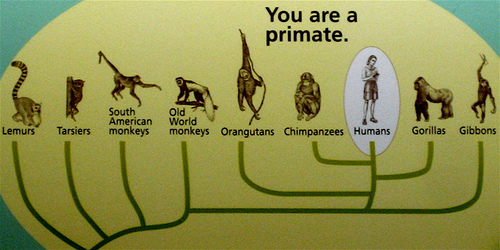
Like virtually everything that lives on Madagascar, [the aye aye] does not exist anywhere else on earth. Its origins date back to a period in earth's history when Madagascar was still part of mainland Africa (which itself had been part of the gigantic supercontinent of Gondwanaland), at which time the ancestors of the Madagascan lemurs were the dominant primate in all the world. When Madagascar sheered off into the Indian Ocean it became entirely isolated from all the evolutionary changes that took place in the rest of the world. It is a life raft from a different time. It is now almost like a tiny, fragile, separate planet.  
The major evolutionary change which passed Madagascar by was the arrival of the monkeys. These were descended from the same ancestors as the lemurs, but they had bigger brains, and were aggressive competitors for the same habitat. Where the lemurs had been content to hang around in trees having a good time, the monkeys were ambitious, and interested in all sorts of things, especially twigs, with which they found they could do all kinds of things that they couldn't do by themselves - digging for things, probing things, hitting things. The monkeys took over the world and the lemur branch of the primate family died out everywhere - other than Madagascar, which for millions of years the monkeys never reached. 
Then fifteen hundred years ago, the monkeys finally arrived, or at least, the monkey's descendants - us. Thanks to astounding advances in twig technology we arrived in canoes, then boats and finally aeroplanes, and once again started to compete for use of the same habitat, only this time with fire and machetes and domesticated animals, with asphalt and concrete. The lemurs are once again fighting for survival. 

In just these three paragraphs, we found at least five different concepts to unpack and discuss. Later, after reading the entire chapter, we watched the episode of the 2009 BBC series that followed up their visit. 

If you're interested, you can view it here: 


While planning the book, Douglas Adams was able to tell Mark Carwardine where on the planet that he would like to visit, and Carwardine was easily able to find species there that were endangered and in dire need of publicity and help. Taking this as inspiration, we took stock of our own corner of the globe. 

Each student read though this list of threatened or endangered species in the state of Michigan. Then, they selected one to learn about its situation. What is it? Why is it endangered? What is being done about it? 

Having done research on their particular organism, each student is preparing a short (5-10 minute) presentation on what they learned. Some students gave their presentations to the assembled 5/6 classes over the week. The remaining presentations are forthcoming. 


Kaz discusses the Copperbelly water snake

Henry teaches us about the Eastern Massasauga rattlesnake

Oliver presenting on the Piping Plover

Niko tells us about the Northern Long-Eared Bat

After sharing what we've learned about this sampling of endangered species, we'll look toward what active steps we can take to preserve these (and many other) species in our own communities. 

The highly-specialized hand of the aye-aye. 

Friday, September 25, 2015

Equality, Justice, Harrison Bergeron, and the Global Village

Nick and Eva spy a visitor to the Howell Nature Center Global Village.

We began our week in the spotlight, as it was the job of the 5/6s to lead our Monday morning assembly. Each Monday morning, all of the students, staff, and faculty (and occasional parents, grandparents, and other family members!) gather in the atrium for a community gathering. A different homeroom leads the meeting each week, often taking the opportunity to share something that's been going on in our classes. 


We chose to spotlight our trip to the Howell Nature Center Global Village, and we adapted the skits that they wrote and performed there for the Summers-Knoll community. While writing them, the kids were very thoughtful about how to best convey what we had learned to the wide age range of our audience. The Global Village trip is a fun and exciting experience, but the underlying message is quite serious. The fifth and sixth graders felt enlightened about the severity of inequity in the world, but they didn't want to disturb, for example, their Kindergarten compatriots while sharing what they had learned. We opted to share our direct experiences, and only briefly touch on the larger issues. It allowed us to introduce some ideas, and hopefully generate some conversation and thought. 

As I narrated, the entire group of fifth and sixth graders acted out brief skits about the challenges and triumphs of the trip: Learning to communicate with each other, bartering for resources, starting a cooking fire, trying to cook with limited ingredients, and eventually trying to fall asleep in cramped and primitive quarters. It was a fun and breezy presentation, that will hopefully generate further conversations.


And since we're talking about equality... 


This image always gets people talking. I'll come back to it in a moment. 


As part of a beginning-of-the-year writing exercise, I was asking the kids about the basic elements of a story. They quickly rattled off "characters, plot, and setting," but when someone said "theme," many had a hard time explaining what it meant. As a result, I did a read aloud of a Harrison Bergeron by Kurt Vonnegut, Jr. Have you read it? If not, you can do so here. Go on! It's a very quick read. I'll wait....

While you do that, here's a photo of Henry, Niko, Kaz, and Eva celebrating their success at keeping their Global Village balloon baby alive through the night. 

Well, what did you think? Vonnegut really yanks the rug out from under you at the end there, doesn't he? 

Harrison Bergeron is a great story to read with 5th and 6th graders. It's funny, brief, and features a big idea that's played out to an almost cartoonish degree. The idea of mandatory equality appeals to them, just as much as the implementation of concept in the story appalls them. (And I've found that the concept of the ear piece broadcasting thought-scattering noises every twenty seconds is a great thing to reference during the times in the year when interrupting each other becomes an issue. Blurting things out when we're having a group conversation causes everyone to have to mentally reset over and over.) (If you haven't read Harrison Bergeron, and you just skimmed past that link earlier, this sentence made no sense to you. For shame.) 

Kids like to talk about the different handicaps mentioned in the story, which gets us into talk about why the characters in the story would willfully submit to them (and why other characters would attempt to subvert them). The discussion eventually turns to the idea of equality not necessarily being an inherently good thing, as exemplified by the Equality Versus Justice cartoon above. 

Of course, Vonnegut's story is satirical, and being very bright kids, they realized that the society represented in the story didn't match either side of the Equality Versus Justice image. In fact, the equality in Harrison Bergeron was best represented by this image:  

Equal!


One can interpret Vonnegut's story a number of ways (and people have! Not always to Vonnegut's satisfaction...), which is another great reason to read it with kids who are expanding their understanding of social justice, while also developing a sense of the power of writing. 

Thursday, January 15, 2015

January So Far...

January is off to a rollicking good start in the 5/6. (Snow Days excluded, or perhaps enjoyed.) Here's a long, rambling recap of some of the things we've done with these first eight days of January.
A quiet work period in the middle of a very busy two weeks. 


Evan explains the ideas supporting the exploration of Near Earth Asteroids (NEAs).

This month has a strong science and social studies focus. Our new school theme is Journeys, and we're exploring that by beginning a unit on manned exploration of space.

Last week, the students split up into small groups to learn about a possible destination for a human habitat outside of the atmosphere. The groups each read an article about the logistics of putting people in one of the following places: Low-Earth Orbit, Near-Earth Asteroids,  Luna (Earth's moon), Venus, or Mars. (Ask your student about the destination that they researched!)

Marcellin and a guest student explain a proposed mission to Venus. 

Prior to presenting, each student had a specific role in their group: The Data Specialist was responsible for making notes on the key points in the document. The Mission Commander was responsible for presenting the groups report to the whole class. The other students in the group were given mini-rubrics to help the Mission Commander prepare the short presentation, as well as being responsible for the initial reporting.

Each group then presented a summary of what they learned to the rest of the class.

This week, science has been focused on the wide variety of technologies that have been developed or enhanced as a result of Space Exploration (Insulin pumps! Whale tracking technology! Helmet padding!) . Each student is investigating two specific NASA created (or developed) technologies.


In math, we are doing a small project on data collection, display, and analysis. So far the students have crafted questions suitable for analysis ("What month were you born in?" "How tall are you in inches?").

Today we talked about how to collect and organize the data as it's being collected, and then moved on to actual data collection. A few students have begun to transfer their data to a Google Sheet (the spreadsheet program in Google Drive). Next week, we'll be working on analyzing and presenting the data and making conclusions.

Owen collects data about student's favorite sport to play.

We've also wrapped up our book group presentations. As mentioned in a previous post, we've been reading novels in small groups. Each group has completed their book and prepared a presentation for the rest of the class to share about the book and their experiences. Some groups spoke in the first person as characters from the book, some read excerpts, and everyone gave enticing summaries about what was valuable and interesting about each book that they read.
Eleanor, Emma, and Adri talk about Out of My Mind

Jonah, Evan, Gabe, Ben, and Oliver discuss First Light

Niko reads a selection from A Wizard of Earthsea, as Marcellin, Luke, David, and Owen await their turns to share. 

We've also been having some group discussions about the media, society, and how we interact with each other. On Monday, we wanted to gauge how kids were processing anything that they may have heard in the news about various terrorist acts. Students' awareness of the news stories varied widely, which lead to a productive discussion about how we consume media, and why certain stories stick out in our minds. For example, of all the current events that were mentioned, the only one that almost every student had heard of was the semi truck full of fireworks that was involved in an accident on I-94. We talked a little about why that story has stuck out in their minds. ("It's sort of scary." "It's exciting.") We eventually hit on the idea of personal relevance and/proximity: Something happened that feels close to you. Car accidents on I-94 feel much more relevant than car accidents in Nevada.


We eventually also talked a little bit about the incidents in France recently, trying parse through the rationale for such a senseless act. We talked about the concept of satire, fundamentalism, freedom of the press, and the challenges (and strengths) of living in blended, multicultural societies.

Finally, we had a long sprawling conversation yesterday about our personal interactions at school. We frequently have these kinds of discussions on a small scale, sometimes in response to a specific conversation, and other times preemptively, but yesterday's chat was particularly in depth.

We talked a lot about how to navigate the constantly shifting power dynamics of the middle school world. We talked about "being your best self" as often as possible, with the understanding that no one can always achieve that. However, if one of us happens to fall short on a given day or in a particular moment, as long as the rest of us hold ourselves together, things will be okay. We also talked about how to prevent situations from spiraling out control, not carrying the grudges of other people, and strategies to help things run smoothly during these occasionally turbulent pre-teen years.


This is a spotty snapshot of some of the things that were discussed. We'll be revisiting this conversation regularly in the weeks and months ahead.


Oh, one more item worthy of note:

In writing last week, we went over the rules of using quotation marks when writing dialogue in stories. As practice in this, kids were required to write a dialogue between three or four characters using proper punctuation. The dialogue did not have to be a self-contained story, but it did have to give some sense of what the larger plot was, where the setting was, and a bit about the personalities of the characters involved. They are still trickling in, as they're not formally due until tomorrow (Friday), but on the whole, they've been both excellent and hilarious. Since the assignment only asked for a scene, many kids seemed content to come up with some bizarre and creative ideas. Nearly everyone of them is a cliffhanger begging for the larger context of the unwritten story. They're great.

On a whim, we staged a few of them as impromptu mini-plays in class the other day, much to the delight of everyone.


Tuesday, December 16, 2014

Scenes from the final week of 2014


Now that the energy and excitement of the play has crested, we have a week left before a well-earned break. The final week in December can often be a tricky one, as people are starting to burst at the seams, but we're still getting a lot done! 


On Monday, the first of our book groups presented to the class, telling us a bit about the characters and themes of Mockingbird, the book they had read. 


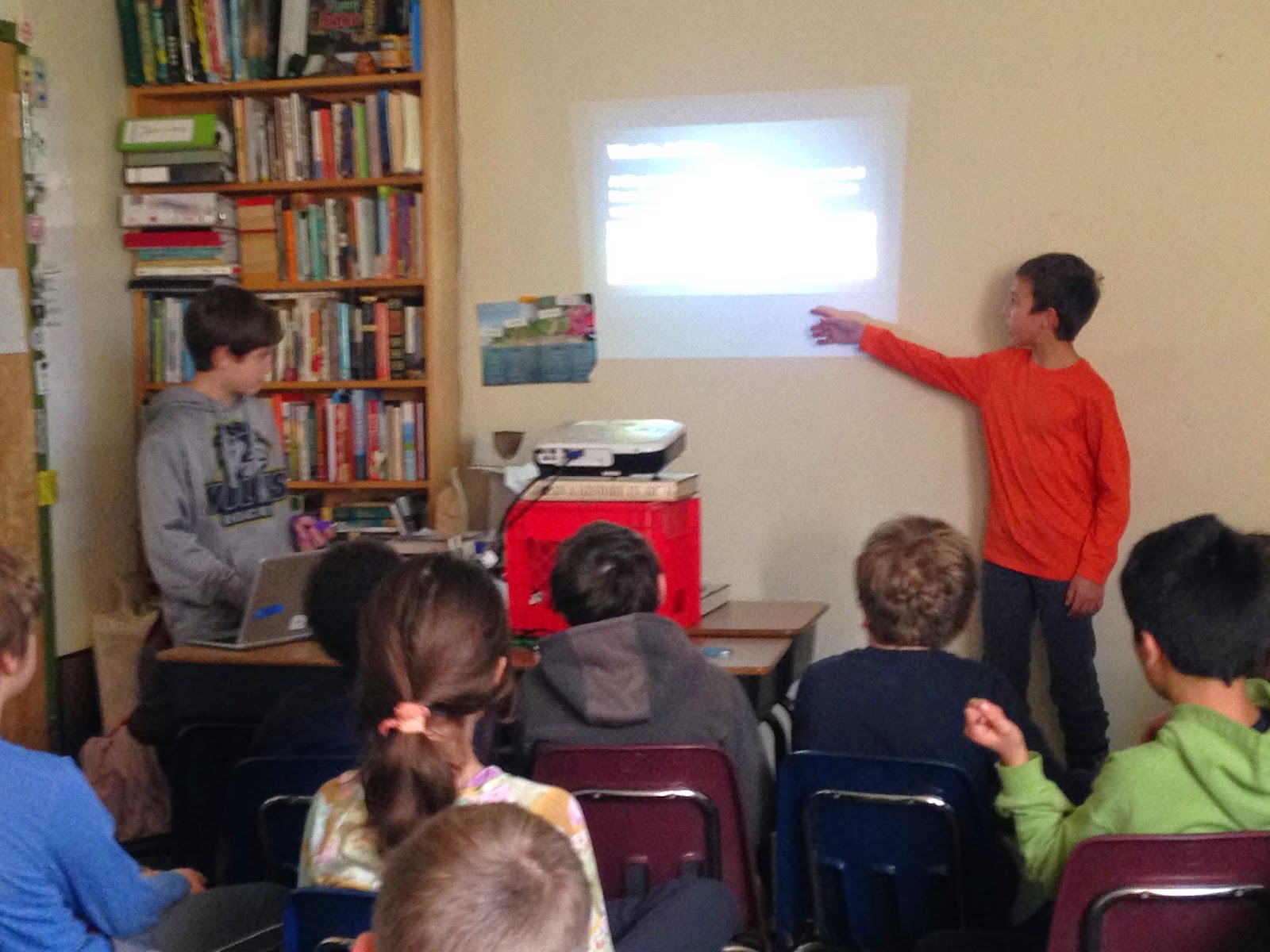
Later in the day, Gabe and David gave a presentation teaching us about tiling and tessellation, which included a group activity designed to illustrate what shapes are able to tessellate. (It's difficult to photograph a slideshow in low light, so please know that David is actually pointing out a detail of a tiling, as opposed to just a blob of white light.) 


In Math today, what was meant as a warm-up exercise wound up taking over much of the morning, as kids worked together (using manipulatives, drawings, paper, and white boards) to solve a logic puzzle involving checkers on a board. 

Today was also one of our days for PE, so after working through the morning, they were ready to run off some energy in the afternoon. 


Wednesday, December 10, 2014

Our class lately. . .


It's been difficult to adequately sum up what's been happening at school lately, as we've been very busy! 


First and foremost, our upcoming school play looms over everything. Rehearsals for Alice have taken over this week, and things have been coming together nicely! 
A full dress rehearsal underway in the atrium
Meanwhile, the students who aren't in the play are working on a variety of other projects. 
Gabe and David are working on a tessellation presentation. Marcellin and Keira are working on creating a fraction game. 
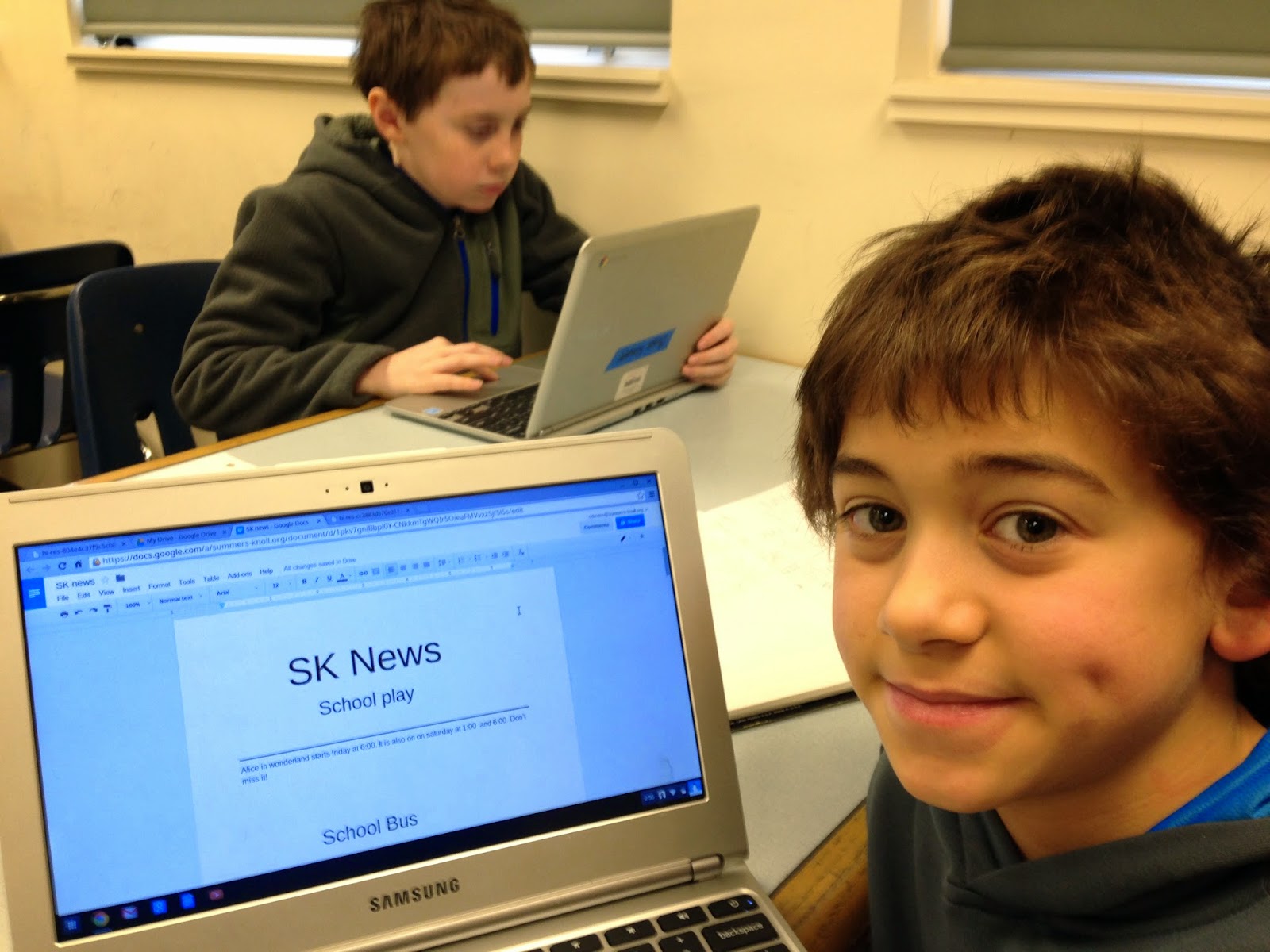
Owen began working on an S-K themed newspaper, and Oliver has started contributing as well. 

Meanwhile, our entire class continues our investigation into water, water purity, and filtration. Here, Sam uses a student-built filter to see if it can remove green food coloring from a cup of water. (It can't! Why not?)

Nick shows off a jar of water that has been driving a lot of our investigations. It was pulled from the standing water just behind the S-K playground. We've been watching as it settles and changes, and learning about the processes that cause the jar to re-pressurize every time we open it and re-seal it. 

We've also been conducting an experiment in evaporation. We placed the same amount of water into differently shaped containers. At what rate will each evaporate? (If they're different rates, why might that be?) Not only is it an exercise in surface area, evaporation, and filtration, but also one involving experimental design and good data collection. (Students are also writing a set of procedures that are precise enough that someone else could replicate the experiment.) 


On top of this, we're also continuing with our book groups. Some groups are finished with their books and have moved onto preparing presentations to share with the rest of the class. It's a busy time! 


Tuesday, November 25, 2014

Grandfriends Day!

We had a number of special visitors to our school today! Students invited grandparents (and other grand friends) to spend the morning in our class, getting a taste of what we do in school each day.

We began the day with a warm-up, as is our custom, and our guests and students worked together to puzzle through it. A little later, a few kids performed portions of their magic acts. We also had a few class discussions to give a sample of what daily life is like here at Summers-Knoll.


Keira finds Evan's card. 

Brainstorming a math puzzle

Welcoming such important people into our classroom was a lovely day to spend the morning before a long, well-deserved holiday break!


Wednesday, November 19, 2014

Magic act run throughs


As part of our exploration of the theme of Magic, we've been developing acts in small groups. It will culminate with a series of performances this Friday afternoon, when we'll be performing for other a few of the other classes (and any family members who would like to drop in!). 

We've spent this week putting the finishing touches on our acts, and performing them for each other for peer review. They're really coming together! Ask your child about how their act is going!