Showing posts with label stuff we watched in class. Show all posts

Friday, March 17, 2017

Week 25 -- Pi, pi, shoplifting, and justice

Recording our gravity car trials in science 

The Place Out of Time trial has begun in earnest, and we spent part of this week unpacking the opening arguments of the plaintiff and the defense. As mentioned previously, our case involves the true story of the Italian Supreme Court of Cassation overturning the conviction of a homeless man who shoplifted approximately $4.70 worth of food because he was in “a state of need.” It’s a very interesting story, and it’s well worth reading a little about it. It captures a lot of what’s in the political climate of our country at the moment, while being far enough removed to allow some perspective.

Our trial in the Place Out of Time courtroom is a fictional extension of the story. The plaintiff in our case is the shopkeeper whose merchandise was stolen in the first place. She asserts that human need and dignity are obviously important matters for a society to address, but the fact remains that it was her store and property that were affected. A law was broken, and she was directly impacted. Doesn’t this ruling send a message that anyone can come in and take her property? She makes a compelling argument, and the defense has the job of convincing us that the court’s ruling should stand. Everyone is wrestling with this issue, both in-character and as themselves.


Winter came back for a bit this week:


Henry pits readers against each other. 
Meanwhile, a conversation that began during our weekly library time with Rachel led to this week’s journal prompt: “Novels versus Graphic Novels!” Students were encouraged to explore the pros and cons of each as a storytelling medium, and to write about how they interact with each. It was a unique prompt, in that kids were given the option of responding in prose, text, or some hybrid of both. Some kids who enthusiastically leapt to respond in a comic format realized that it can take a lot longer to write and draw a story than they realized. Many of the responses were playful and clever. Ask your child how they responded!
Joey had the books themselves fight it out. 

In math group, we spent some time working in our Singapore books, but as with every March 14, pi was front and center. On Tuesday, 3/14 (Pi Day), we watched some videos about pi, including one of Vi Hart’s infamous anti-pi rants.

One of the points of her video led us down a bit of a rabbit hole, as we started talking about scales of magnitude and the spaces in between things. This was vividly illustrated by playing with the very illuminating internet tool/toy The Scale of the Universe. Please do yourself a favor and spend several minutes playing with it right now. We also watched the classic Eames film Powers of Ten.


Of course, we are essentially obligated to bring in some sort of actual pie as part of all of this, a task that Sam dutifully took on as our school’s foremost expert on pi, pie, and homophones.


Friday, February 10, 2017

Week 21 -- Writing resumes and eating cake


The focus of our homeroom time remains learning about our Place Out of Time characters. Over the course of the week, the timelines of our lives have been completed and posted in the Middle School Commons, allowing us to see how our characters relate to one another in time. We also began speaking in character with one another, having first learned a little about the rules of improvisational acting.


Ella and company fixing our class decor

We’re also wrapping up the composition of our character “resumes,” which are brief (about 3-4 paragraph) introductions written in the first person. These will be posted on each character’s profile page on the Place Out of Time website.

One of the many ways that we’re learning about these figures is by seeking out documentaries and docudramas that feature them. Since we happen to have both Bill Gates and Steve Jobs in our class, we watched some key selections from the 1999 film Pirates of Silicon Valley. The entire class learned about the birth of the personal computer (as well as a bit about how stocks work), and we got to see how actors dramatize people who actually exist.

Scenes from our weekly cleaning of the lunchroom 

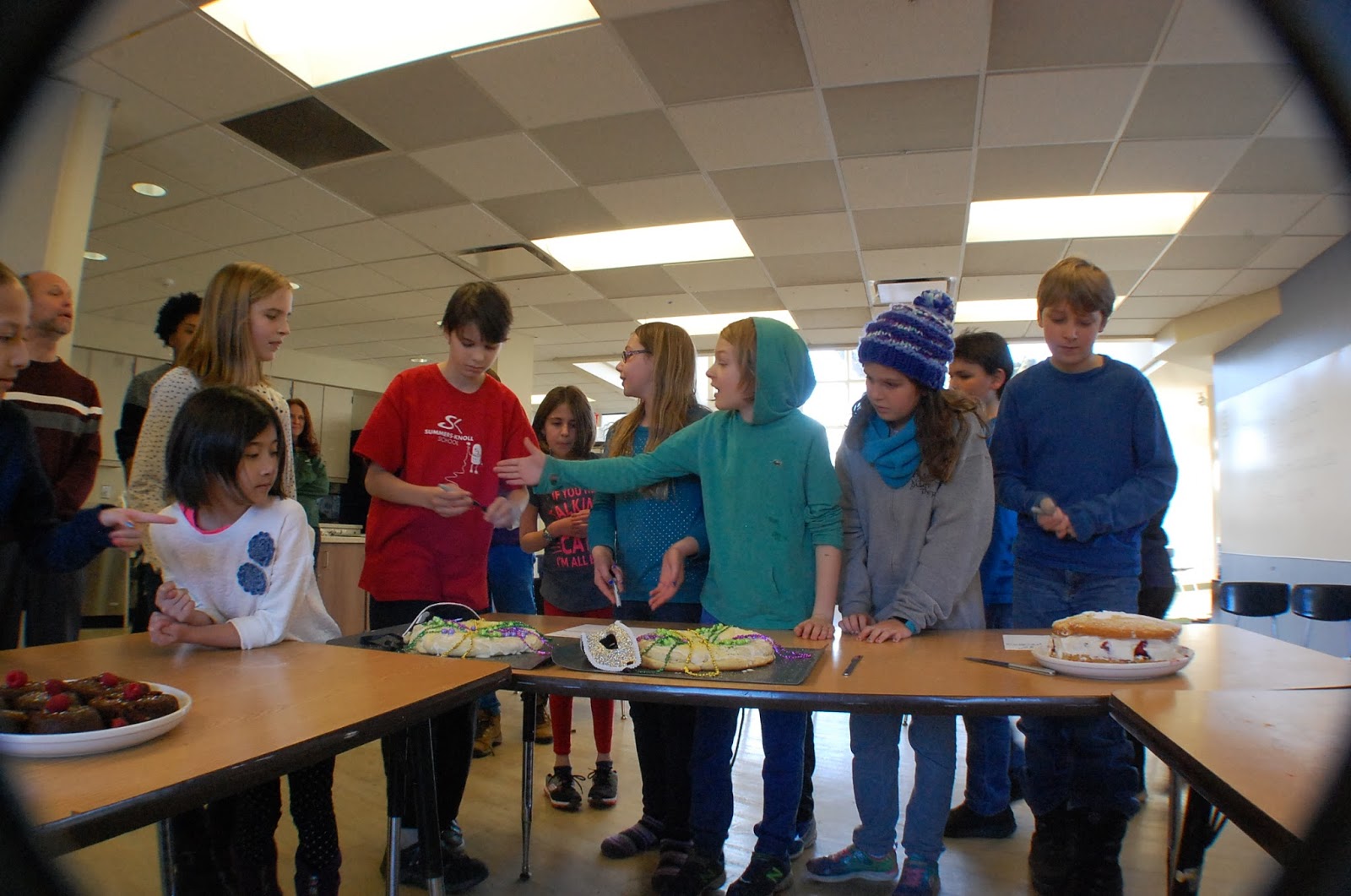
We also got to spend some time with the 7/8s this week. They’re engaged in a unit about food, and they baked a variety of cakes from historic recipes. They were kind enough to invite us to sample their efforts, while telling us a bit about what they had learned.


In math, we continued exploring the concept of Flatland, this week moving to an adaptation that hews a little more closely to the original novel, including aspects that parody social conventions and stereotypes. We also spent two days this week working in our Singapore books.
The daily lunch session of Magic: The Gathering 

Friday, December 2, 2016

Weeks 12 & 13 -- Time for school, biomes, and grandfriends


We only had two days of school before the Thanksgiving break last week, and we used part of them to begin watching the documentary Time for School. This fascinating film is a longitudinal look at five children from around the world as they progress through some form of schooling system. The filmmakers first visited them in 2003, and have followed up with films every few years ever since. We made note of many things as we watched, such as the amount of family and/or cultural support for school each student experienced. We compared and contrasted the experiences of these kids with each other and with ourselves.


We experienced a potent display of support from family and community on Grand Friends day, during which we welcomed several family and friends into our classroom and shared some of what we’ve been doing at school this year.


Much of the rest of our homeroom time has been spent working on our Into the Biome projects, in which students are working in teams to create a food web game based on different biomes of the planet.

In math group, we’ve been continuing our exploration of various ways to multiply numbers. Ask to see the Ethiopian method, or the one where you draw intersecting lines. They’re like magic tricks, but looking closely at them reveals hints of how they work, and also firms up the conceptual understanding of multiplication.

Friday, November 11, 2016

Week 10 -- The votes are in


Our warm-up for Wednesday morning. There was a lot of stress in the air.  


A few minutes before school began on Wednesday, one of the students in our class said, “I have a feeling that today is going to be a very odd day…” It was indeed. One thing that I think most people of all political leanings can agree on is that this has been a notably odd presidential cycle. 5th and 6th graders, even the ones that seem savvy and sophisticated about such things, can have a difficult time processing it all.
Leading up to the election, we talked a bit about political parties and how they work. The general idea was that not every Democrat believes the same thing as every other Democrat, nor does every Republican believe the same thing as every other Republican (and the same is true, of course, for other political parties). This drawing illustrates the way different platforms are created, and how coalitions are built. 

Rather than doing a post mortem on the late night results of the election while emotions were still so high, I opted to address the matter in a more roundabout way. We spent most of our homeroom time on Wednesday watching the 1957 classic 12 Angry Men. It’s an excellent film, and it was a soothing balm for anyone who was feeling unease about people in general, and the United States specifically. It portrays unconscious prejudice, overt bigotry, and casual indifference to others, then counters them with a passionate rebuttal of reason, logic, and decency. The trajectory of the story shows that one person of principle can stand up against a crowd and truly make a difference. It happens through reason, patience (along with some anger, which is right in the title), and consensus-building. People find that they are able to work together as they start listening to one another, and ultimately, everyone in the room has valuable things to say. The film is timeless in some ways, and dated in others. The stuff that’s out of sync with us today are things that are useful for driving conversation. Most glaringly, it’s called 12 Angry Men, and indeed, the entire cast is white and male. Were one to imagine casting this story in 2016, it would be a stark reminder of how far we’ve come.
The film also allowed us to get at some very basic aspects of our judicial system, such as “innocent until proven guilty,” “a jury of one’s peers,” and “burden of proof,” and we spent part of Thursday reflecting on it through a written assignment.
Our journal writing prompt for the week 

We balanced out the week with some less intense stuff, such as a journal prompt (“In what ways is writing a more effective communication tool than speaking?”), play rehearsal, and good old Scholastic News.

We only had two days of Math this week. One day was devoted to Singapore work, and the other was spent practicing some problem-solving strategies that we’ve learned this year. Some students are opting to take the AMC-8 next week, so part of Thursday was spent registering for them for the test next Tuesday.


Friday, May 13, 2016

Monarchs & monarchs


The last several weeks have been informed by learning about two types of monarch, both of which have been cast aside by Americans. One was intentional (King George III, during the American Revolution), the other has been an unintended consequence of the rise of industrialized farming in the United States (the migrating monarch butterfly). 
You may recall some of our work earlier in the year inspired by Last Chance to See, a powerful and entertaining book by Douglas Adams. In it, Adams and naturalist Mark Carwardine travel the world in search of some of the most endangered animals on the planet. 

It is a sad truth that there are endangered species in every region of the world, including our own. Rather than view this as an immutable fact beyond our control, our class has opted to actively work to reverse the fortunes of a familiar, but threatened species: the migratory monarch butterfly. 


The monarch is striking and iconic. If asked to picture a butterfly, most people will likely conjure a monarch in their mind. It is a widespread species, but the insects that we see in Michigan are part of a remarkable annual migration that becomes more miraculous and mysterious the more you learn about it. 

There is (of course) a Wikipedia article about this migration, but in brief: Monarch butterflies take part in a migration that begins in the mountains of Mexico, passes through the continental United States, and concludes in Canada, where they reverse course and head back South. The remarkable thing about this is that the annual migration takes five generations of monarchs to complete. The butterflies that start out in Mexico are not the ones that arrive in our state months later, but their grandchildren. How these butterflies know to consistently follow these paths of their ancestors is a mystery to science.  


It's also a phenomenon that is in danger of disappearing. 


Monarchs are wholly dependent on milkweed, on which they lay their eggs during this long journey. Familiar caterpillars soon hatch, feast on the leaves, create a chrysalis, and emerge in their adult stage two weeks later. 

Milkweed, formerly quite plentiful, is being wiped out en masse as an unintended side effect of the proliferation of industrial farming. Pesticides meant to protect crops have eradicated milkweed populations, significantly fragmenting and reducing a vital resource for the monarchs. 


Happily, there are simple things that people can do to help. 


The most passive is to learn what milkweed looks like, and take care not to remove or poison it if you happen to have it on your property. Milkweed has a bit of a public relations problem. It has the word "weed" right in its name, and it tends to grow in unpredictable places from year to year, confounding gardeners of a more controlling nature. One of the many things we hope to do is to work to rehabilitate the reputation of this important plant. 

A screenshot of recently spotted monarchs.
Visit this link for an interactive version. 

Our class has opted to take a more proactive approach. We have spent the last several weeks researching and planning a monarch waystation, which we're developing on the campus of Summers-Knoll. It is taking shape just outside of the windows of the 5/6 classrooms. As of today, there are two raised beds (constructed by Chris Swinko and his 3/4 class) that will eventually be stocked with native flowering plants that will bloom throughout the spring and summer, and milkweed that has been cultivated from local sources. 


It has been quite a project. This is an interdisciplinary affair, born in Science class, but taking significant portions of our homeroom time. Science Teacher Lisa has a certified monarch waystation at her home, and she has served as an inspiration, mentor, and guide in this endeavor. 

Our grand plan goes beyond simply creating a waystation at school. We also hope to cultivate and distribute milkweed to all who are willing to grow it at their homes. This means that we've been trying to grow our own milkweed from seed. Teams of students have been attempting to cultivate seeds in our classroom and in the greenhouse, experimenting in order to determine the most effective ways to grow milkweed from seed. 


We've also been tracking existing monarchs. Studying monarchs is an excellent way to engage as citizen scientists, with enthusiastic hobbyists and naturalists collecting and sharing data about milkweed and monarch sightings. Kids can be found checking this site daily. (Ask your child about it!) 

The project has offered many authentic opportunities for genuine science. For example, rather than simply buying topsoil from a retailer, we are trying to "mine" our own campus for material. One day found all of our students working in teams to collect soil samples from various places on the Summers-Knoll grounds to determine the best site to take soil. 

When it was determined that the most fertile soil seemed to be in our woods just beyond the playground, we decided that we needed to do a mini-environmental impact study. What would it mean for us to move into a previously undisturbed area to remove several dozen cubic feet of soil? To find out, we trekked carefully into the woods to see what was living back there. 


What we found surprised us all. 


We are currently attempting to identify the source of a clutch of eggs found beneath a log near our vernal pool. Our initial suspicion is that our small woods may be home to a population of reclusive salamanders. We are trying to verify this through online research and reaching out to herpetologists. Stay tuned for updates! 


I also mentioned that other monarch earlier in this post. As part of our background preparation for our upcoming Spring trip to Philadelphia, we have been studying colonial America and the American Revolution. We've been using a number of sources in order to get a well-rounded look at this period of history. We have read selections from Joy Hakim's A History of US series, watched selections from the HBO series John Adams, and listened to selections from the recent Broadway phenomenon Hamilton. We've also done a close reading and discussion of the United States Declaration of Independence, and we've been barreling through our current read aloud book, Chains by Laurie Halse Anderson


Taking stock of the greenhouse inventory


Researching milkweed, native plants, and monarchs


Attempting to grow milkweed from seed, attempt #1


Moving the raised beds to their new homes


Searching for ideal sources of soil


Soil samples settling for close observation and study


Thursday, January 28, 2016

Week 19: Hodge Podge


We kicked off the week with some highly anticipated news: We received our Place Out of Time character assignments from our friends at the University of Michigan. In our class, we'll be spending the next couple of months getting to know Pelé, Millard Fillmore, Rachel Carson, Henry Clay Frick, Raina Telgemeier, Mustafa Kemal Atatürk, Elon Musk, Richard Nixon, and Manfred con Richthofen (also known as "the Red Baron"). 
We're just dipping our toes into the research phase of the project this week, but things will progress quickly moving forward. Everyone is using a fairly comprehensive research log to help guide their inquiry into the life and time of their character. To take a look at the template, click here. Each child has their own copy on Google Drive, so be sure to chat with your child about what they're learning. (They can share their actual research log with you, if you like!) We'll be doing online research at school, as well as attempting to find books at the library, but feel free to help your child seek out material outside of school as well! In addition to the learning about each character, we'll all be learning research skills and strategies, the difference between primary and secondary sources, and the importance of citing sources of information. 


We're also continuing with a much smaller scale research and presentation project this week. As mentioned in a previous blog entry, each student was tasked with researching and presenting on a species that is threatened or endangered in Michigan.
Eva presents on the Canadian Lynx. 

Ella presents on the Karner blue butterfly. 

Nick tells us about the plight of the Indiana bat. 

Bora lectures on the rufa red knot. 
This project has dovetailed with a project in science class, in which each student has been tasked with creating a new species, drawn from both their imaginations and a real-world understanding of body systems and ecosystems. (And in Latin, the kids have been working to give their animals realistic scientific names for the genus and species of their creation.) 

Ask your child about their animal! 


We also watched Sticky, which is a dreamy and lovely animated documentary that tells the remarkable story of a species categorized as extinct many decades ago. The first third of the twenty minute film is wordless. It's well worth a viewing: 

Friday, January 22, 2016

Last Chance to See

The Aye-Aye. Not all lemurs are adorable. 


Douglas Adams is best known as the author of the Hitchhiker's Guide to the Galaxy, which is a series of books (and many other media) that had a profound influence on my developing sense of humor as a goofy sixth grader. The idea that you could blend science fiction with Monty Python-esque humor blew my mind, particularly because I realized that a lot of it was clearly going right over my head. For example, as a twelve year old, I had no idea what bureaucracy was, nor how absurd and maddening it can be to navigate. But because it was a favorite topic of satire for Adams, it gave me an intriguing glimpse of my own future of tax returns, mortgage applications, and endless visits to the DMV. 


Mark Carwardine and Douglas Adams

As much as I loved the fictional universe that Douglas Adams created, it is his writing about our own world that has continued to resonate with me. In 1985, a magazine editor had the bright idea of teaming Adams up with a photographer and a naturalist to attempt to spot an extremely rare and endangered lemur in the wild. I'll let Mr. Adams introduce the trip:

This isn't at all what I expected. In 1985, by some sort of journalistic accident, I was sent to Madagascar with Mark Carwardine to look for an almost extinct form of lemur called the aye-aye. None of the three of us had met before. I had never met Mark, Mark had never met me, and no one, apparently, had seen an aye-aye in years. 
This was the idea of the Observer Colour Magazine, to throw us all in at the deep end. Mark is an extremely experienced and knowledgeable zoologist, working at that time for the World Wildlife Fund, and his role, essentially, was to be the one who knew what he was talking about. My role, and one for which I was entirely qualified, was to be an extremely ignorant non-zoologist to whom everything that happened would come as a complete surprise. All the aye-aye had to do was do what aye-ayes have been doing for millions of years - sit in a tree and hide.

The aye-aye. 
The experience was transformative. Adams and Carwardine decided to continue their partnership, and spent the better part of a year traveling the globe in an attempt to see (and draw attention to) a collection of animals who were teetering on the edge of extinction. The book that emerged from these travels is called Last Chance to See. The book is both entertaining and sobering. In the time since its publication in 1990, one of the species they searched for (the Yangtze River Dolphin) is now believed to be extinct. 

Sadly, Douglas Adams died in 2001. However, his passion and advocacy inspired many, including his friend Stephen Fry. In 2009, the BBC aired a six part documentary series, in which Fry and Mark Carwardine retraced their journey, checking in to see how each species had fared over the decades. 

By now, you're perhaps wondering if I'm ever going mention the fine students of Summers-Knoll, and what any of this has to do with them. I am, indeed! 

We read the first chapter of Last Chance to See in class, which is a fun and useful primer for evolutionary biology, plate tectonics, ecology, conservation, and more. It's titled "Twig Technology," and I essentially want to quote the entire thing. Instead, here are three paragraphs that I have found delightfully concise and informative. 


Like virtually everything that lives on Madagascar, [the aye aye] does not exist anywhere else on earth. Its origins date back to a period in earth's history when Madagascar was still part of mainland Africa (which itself had been part of the gigantic supercontinent of Gondwanaland), at which time the ancestors of the Madagascan lemurs were the dominant primate in all the world. When Madagascar sheered off into the Indian Ocean it became entirely isolated from all the evolutionary changes that took place in the rest of the world. It is a life raft from a different time. It is now almost like a tiny, fragile, separate planet.  
The major evolutionary change which passed Madagascar by was the arrival of the monkeys. These were descended from the same ancestors as the lemurs, but they had bigger brains, and were aggressive competitors for the same habitat. Where the lemurs had been content to hang around in trees having a good time, the monkeys were ambitious, and interested in all sorts of things, especially twigs, with which they found they could do all kinds of things that they couldn't do by themselves - digging for things, probing things, hitting things. The monkeys took over the world and the lemur branch of the primate family died out everywhere - other than Madagascar, which for millions of years the monkeys never reached. 
Then fifteen hundred years ago, the monkeys finally arrived, or at least, the monkey's descendants - us. Thanks to astounding advances in twig technology we arrived in canoes, then boats and finally aeroplanes, and once again started to compete for use of the same habitat, only this time with fire and machetes and domesticated animals, with asphalt and concrete. The lemurs are once again fighting for survival. 

In just these three paragraphs, we found at least five different concepts to unpack and discuss. Later, after reading the entire chapter, we watched the episode of the 2009 BBC series that followed up their visit. 

If you're interested, you can view it here: 


While planning the book, Douglas Adams was able to tell Mark Carwardine where on the planet that he would like to visit, and Carwardine was easily able to find species there that were endangered and in dire need of publicity and help. Taking this as inspiration, we took stock of our own corner of the globe. 

Each student read though this list of threatened or endangered species in the state of Michigan. Then, they selected one to learn about its situation. What is it? Why is it endangered? What is being done about it? 

Having done research on their particular organism, each student is preparing a short (5-10 minute) presentation on what they learned. Some students gave their presentations to the assembled 5/6 classes over the week. The remaining presentations are forthcoming. 


Kaz discusses the Copperbelly water snake

Henry teaches us about the Eastern Massasauga rattlesnake

Oliver presenting on the Piping Plover

Niko tells us about the Northern Long-Eared Bat

After sharing what we've learned about this sampling of endangered species, we'll look toward what active steps we can take to preserve these (and many other) species in our own communities. 

The highly-specialized hand of the aye-aye.