Showing posts with label group work. Show all posts

Friday, March 11, 2016

Fragmentation


In homeroom, we've continued looking into the complicated consequences of human beings affecting the fates of other species. This week, we looked at habitat fragmentation. 
Here's a snake in its preferred environment. It has a decent size range that allows it food and shelter. 


Then, humans move in.


The habitat changes over time. A road bisects part of its range, and a couple of subdivisions have been built. (You've probably realized that this is not to scale. That's not a gigantic snake.) 

A road may seem like a relatively harmless addition, but it means the snake is now forced to cross an unnatural border in order to access its full range. While on that road, it is more vulnerable to predators (and more likely to be run over). 

Even if the road poses little issue for the snake, it might have a dramatic effect on the environment that it had previously occupied. Roads make water drain differently. The vegetation along the roadway changes. The animals that the snake previously hunted may not be as common. These small changes can add up to make a habitat unlivable for animals that had previously thrived here. 

We talked in class about this example, then broke into groups to explore a similar scenario. 

Heere is Wood Thrush Creek. It's a secluded forested area with a stream running through it. It may not look like much on your screen, but it's lovely in person. 
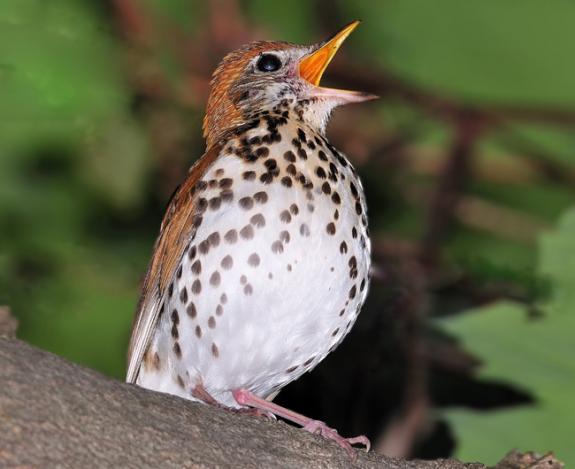
Each group of students was given a print out of this, along with a bunch of one-inch circles, which represent the nesting territories required for the wood thrush (the adorable bird pictured above) to successfully breed. 


The ranges can't overlap, so careful manipulation is required to see how many will fit in this unspoiled version of Wood Thrush Creek.

After seeing how many birds can fit in the area before development, some challenges are introduced:

In this scenario, the owner of the land quite reasonably decides to develop some of it. Over the course of ten years, a couple of roads are built, as well as some houses. The shaded box at the bottom represents an area that has been logged. 

In person, it still looks serene and beautiful, and now it's easier to get to, thanks to the roads. The houses are nestled back in the woods, and to the untrained eye, it looks much as it did before. 

Unfortunately, things look much different to the wood thrush. As far as it's concerned, the habitat has been drastically changed. Many birds are quite sensitive to manmade activity, and can't nest in areas that have structures or activity. Some animals simply won't tolerate it and move on. But others are subject to other factors, such as increased predation. (Imagine, a nesting wood thrush is startled by a lawn mower and flies from the nest. Meanwhile, another animal finds the eggs unguarded and has a filling meal.) 

Twenty years later, things are even busier, with the addition of more roads and houses, as well as a snow mobile/ATV trail. 

Keeping in mind that the Wood Thrush cannot successfully nest near these manmade creations, how many can fit in each area now? Students worked together to try to fit in as many nesting areas as possible in all of these scenarios. 


Finally, we talked about the reality of the situation. Not all land can be completely protected and left in an untouched state. Land (and other resources) have to be managed, ideally in ways that are sustainable to wildlife and humans. 

(We even took a brief detour into the relationship between shape and interior area. Both areas above have a perimeter of 40 miles, but the rectangle has an area of 75 squire miles, while the square has a full 100.)

Students were tasked with creating plans that included all of the features of the previous scenarios (including the trail, the same number of homes, and a logged area), but managed those changes in a less impactful way. 


Friday, December 4, 2015

Weeks 9 - 13: Miscellany


I take a lot of photos over the course of a week. Here's a smattering of odds and ends from recent weeks. 


Juna is camera shy. 

Her classmates are not.


Henry!


Guest artist Leslie Sobel came to share her work with us several weeks ago. The middle school recently visited an exhibition of her work at the Village Theater in Canton. Monica has an entry up on her Middle School Art Blog as well.


Touring the theater


Nick!


We've been studying body systems in Science. Here are some photos of our class constructing a device to simulate the lung. 


And here we see kids puzzling through the muscular-skeletal system. They are attempting to construct a "muscle" that mimics the hinge joint of the human elbow.


Silent reading time:


Each Monday morning, the whole school gathers for an assembly. Here, the student government representatives articulate and demonstrate the rights and responsibilities that they have come up with.


Using the windows as a giant light box for tracing.


Bora!


As part of our exploration of the various body systems, we've been constructing paper models of ourselves with each system taped inside. It's yielded some odd photo opportunities.


We led the school assembly on Monday, November 23rd. We opted to talk about our three class values, demonstrated by brief skits.


Grandfriends Day!


Here we are playing 'Jenkins Says' with our Grandfriends. (Ask your kids/Grandfriends about the rules. It's fun!)


Giving the Grandfriends a tour of the school. "The Cove" is always a popular stop. 


Preparing scenery for the school play:


Winter is coming. 


Tuesday, September 15, 2015

Science: "Enigma Cylinders" (and banana phones)


As you may know, Lisa Johnson (famous and beloved for bringing Fish Lab to Summers-Knoll) has joined our faculty as a science teacher. We'll be co-teaching science this year, and we ran a fantastic activity on class on Monday. I'll tell you all about it, just as soon as Bora finishes this phone call. 

Bora blatantly violating our "no phones during the school day" rule


We wanted the kids to get the kids "doing science" early and often this year, but many people have differing ideas about what that actually means. To get us all thinking about what science really is, we introduced the class to some mysterious objects that we call "Enigma Cylinders." 


As an educator, this activity was incredibly easy to run: We simply passed out a few of the cylinders to the kids. Before we had a chance to bore them with directions, they all instantly snapped into the mindset of scientists. They furrowed their brows, tugged at strings, and started talking. 


First they made observations, then they started offering possible explanations for what they were seeing. Before long, they were sketching. By the time Lisa and I actually told them that they'd be attempting to make their own models of this contraption, most of them were already well on their way to sketching potential designs. All of this was pure inquiry. It required so little direction from us that I was able to film them in action. Check out the following video, which picks up immediately after handing kids the cylinders. None of what you hear them saying is in response to questions that we've posed to them. If you've ever wanted to be a fly on the wall during a Summers-Knoll class, this is the video for you:


As mentioned in the video, all three groups eventually constructed models that seemed to be reasonable facsimiles of the cylinders that they examined. However, Lisa and I have vowed to never reveal the inner workings of our actual cylinders, as that's part of true science! There are many things in this universe that we will never truly know. 


Lisa gave a great example: We will never know for certain what caused the extinction of the dinosaurs. Never! We do, however, have a very good hypothesis or two about what happened to them. And as we collectively learn more about the world, we can revise our hypothesis (or throw it out entirely if compelling evidence demands it). In many ways, science demands failure and revision. We will encourage both over the course of this school year (and beyond)!


But enough about Science. Let's check in with Bora. How's that phone call going, Bora? 


See? This is why we make kids keep them in their backpacks.