Friday, September 30, 2016

Week Four: POP X, magical items, masters and beginners, and hand feeding butterflies


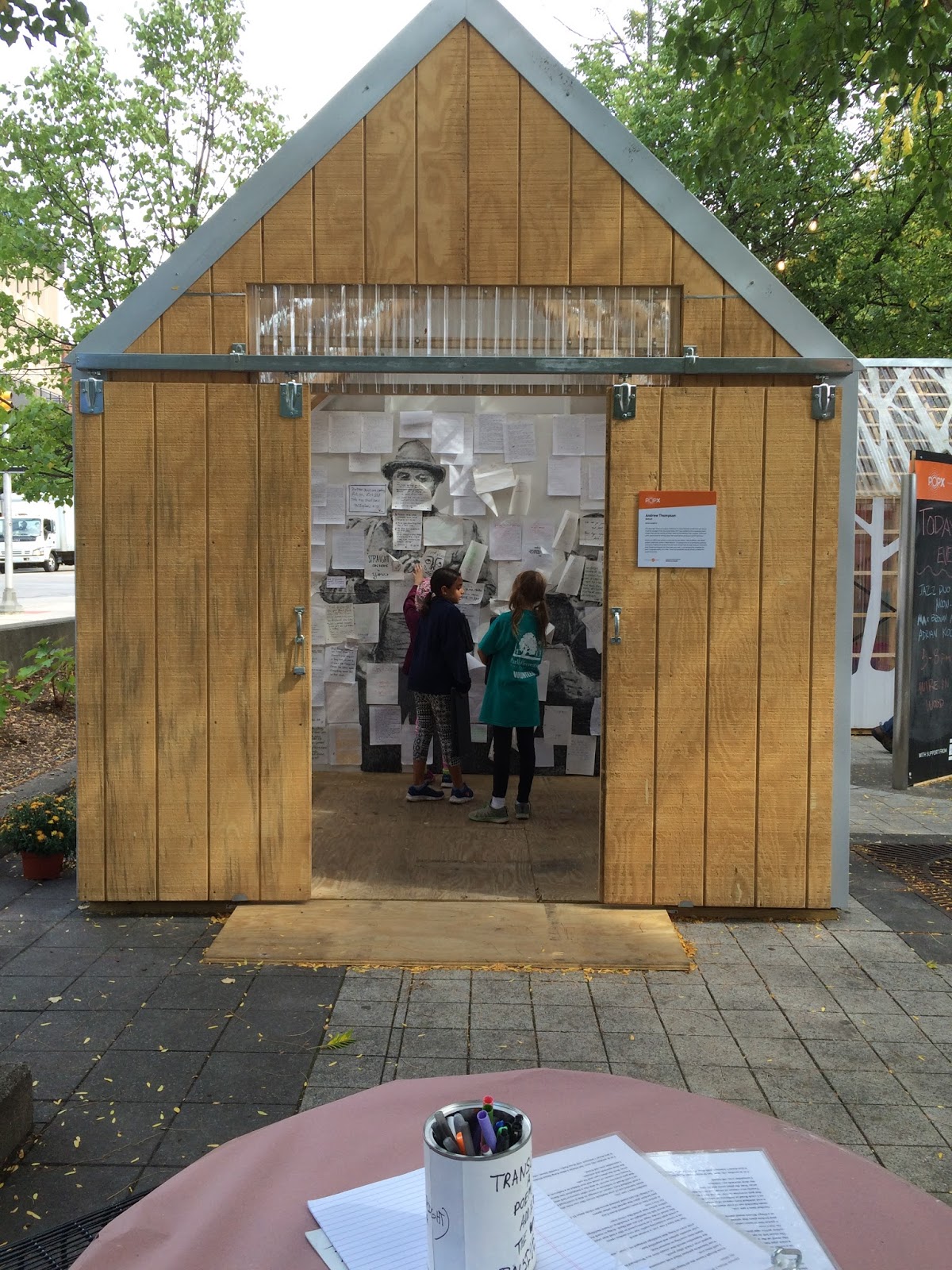
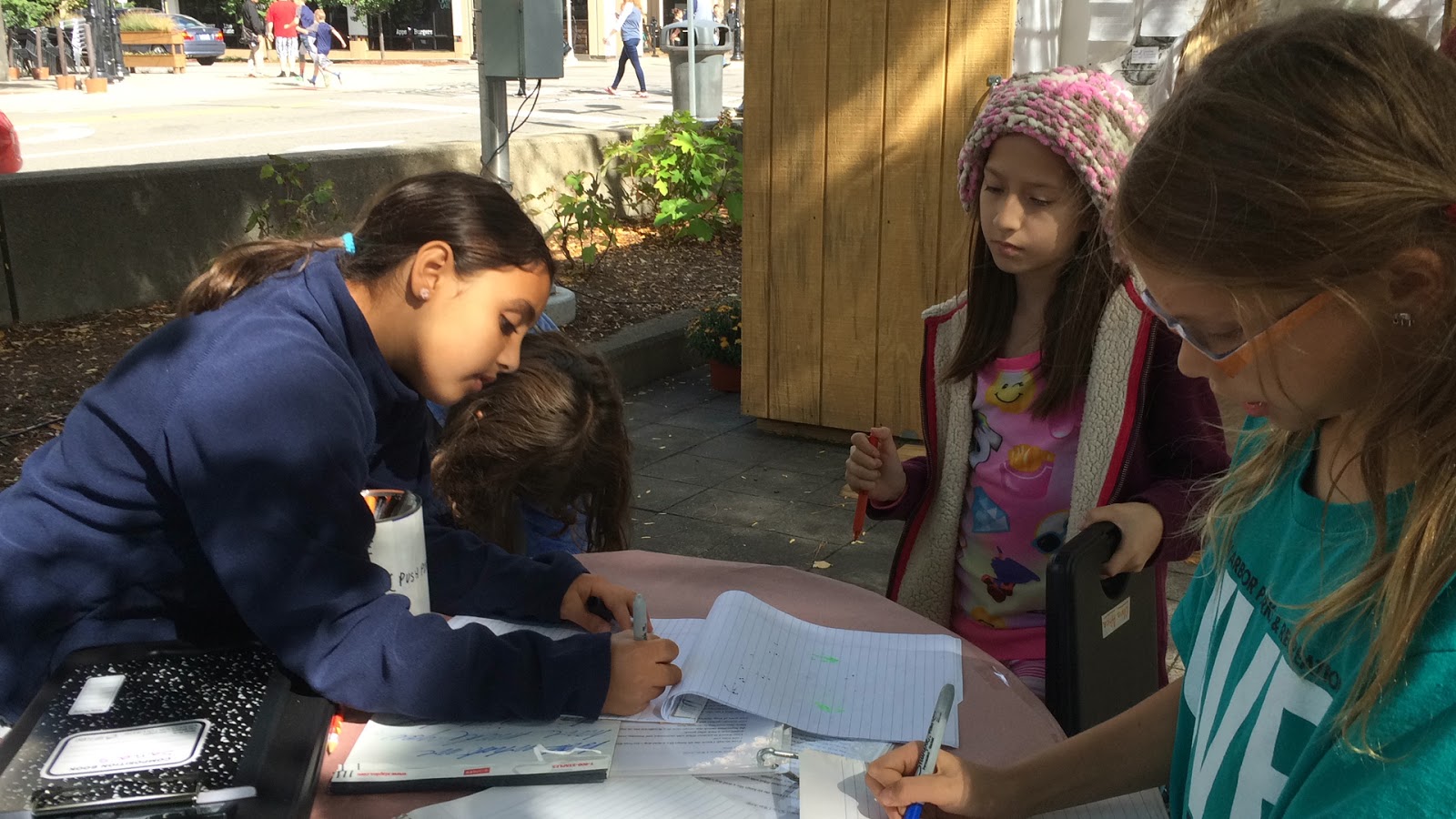
This week we took an impromptu field trip this week, traveling to downtown Ann Arbor’s Liberty Plaza to visit POP X, an art installation. Students explored the exhibits in trios, making note of what intrigued them, then returned to school and designed their own exhibits in the spirit of what they saw.




In homeroom, we discussed the elements of a story, focusing on what makes writing compelling. We then wrote a couple of lackluster stories together, then worked individually to make them more engaging. We also had a writing prompt about taking ordinary items (flashlights, paintbrushes, etc) and making them magical, and a journal prompt that asked students to consider the quote “the master has failed more times than the beginner has even tried.”


We also continued our close reading of The Tiger Rising as a group, analyzing the writing to discern the author’s intent.

On top of all of that, we also had a talk with Rachel about banned books, and toured a project gallery of a recent project by the 7/8 classroom.
We're committed to getting outside as often as possible, which sometimes makes for rainy recesses. 

The muddiest kick line ever 

In math group, we spent two days working in our Singapore books, and spent the other two days playing an assortment of math games, identifying what mathematical concepts were involved in each (pattern recognition, symmetry, arithmetic, etc.)


On Friday morning, we partnered with Sam's class to lead the all school assembly, where we talked about our ongoing work with Lisa and monarch butterflies. 

Lisa hand feeds one of our monarchs. 
Learning to wrangle monarch butterflies safely 


Friday, September 23, 2016

Week Three -- Tigers, monarchs, ethnography, and Farkle

A monarch emerges during Math class. 


Our third week of school has been regularly punctuated by excited cries as caterpillars began pupating (ask your child), and later as butterflies emerged. With Lisa’s guidance, we’ve begun tagging our monarchs with tracking stickers, then releasing them back into the wild. If all goes well, we should be releasing several more in the next week or two. We also began reading a book together as a class called The Tiger Rising by Kate DiCamillo. We’re doing a close read of this novel, taking time to think and talk about the craft of the writing and the intent of the author. We’ve also continued learning about the Yanomami tribe of South America, and got to have a lively conversation with an actual ethnographer who came to speak to the entire 5/6 about her work. In our writing journals, we explored the question, "What is the best way to talk to someone with different political beliefs?” It’s a question that I’m sure we’ll be coming back to regularly in the weeks leading up to Election Day.

Chatting with the ethnographer


Henry leads us through a "Perplexor," one the logic puzzles we do in class. 
Tagging a monarch for release 


Monarchs emerging 

Taking measurements of very hungry caterpillars 


Picture day was also this week! 

Behind the scenes


In our math group, Monday was devoted to practicing the strategy of making a table to organize information when solving certain types of problems. We did one as a group, then another individually. Tuesday was spent working in our Singapore math books, and Thursday and Friday were an introduction to the basics of probability, as experienced through the dice game ‘Farkle.’


Friday, September 16, 2016

Week Two -- Monarchs and the adventure park


This week, we continued a project set in motion by last year’s class. Last spring, we began construction of a milkweed garden, hoping to attract the increasingly endangered monarch butterfly to our school. Our work is is paying off, and we have found several monarch caterpillars among the milkweed. With Lisa’s guidance, we have taken them indoors, where we’ve been taking measurements, making observations, tending to their needs, and doing all that we can to increase their likelihood of survival.

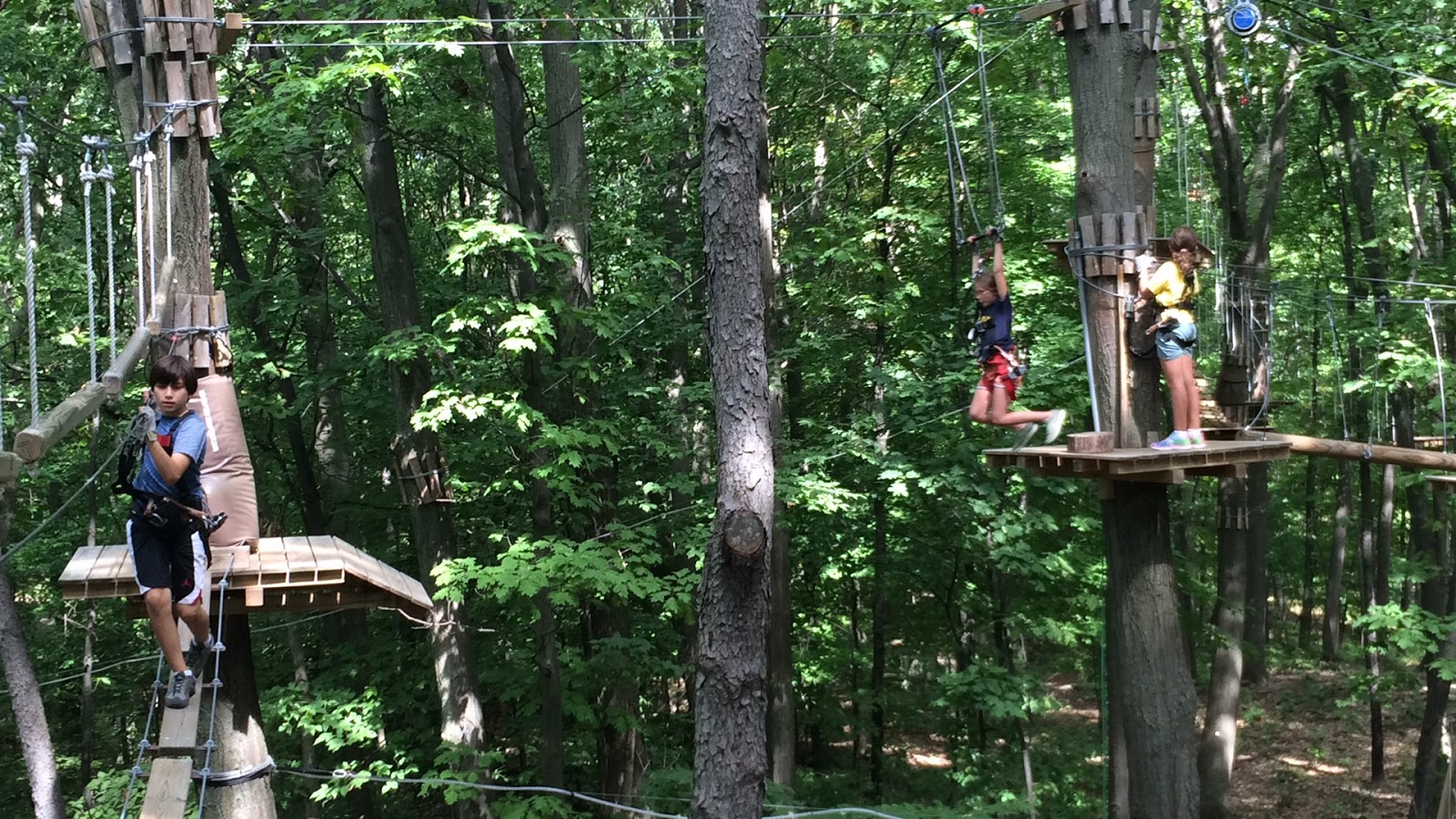
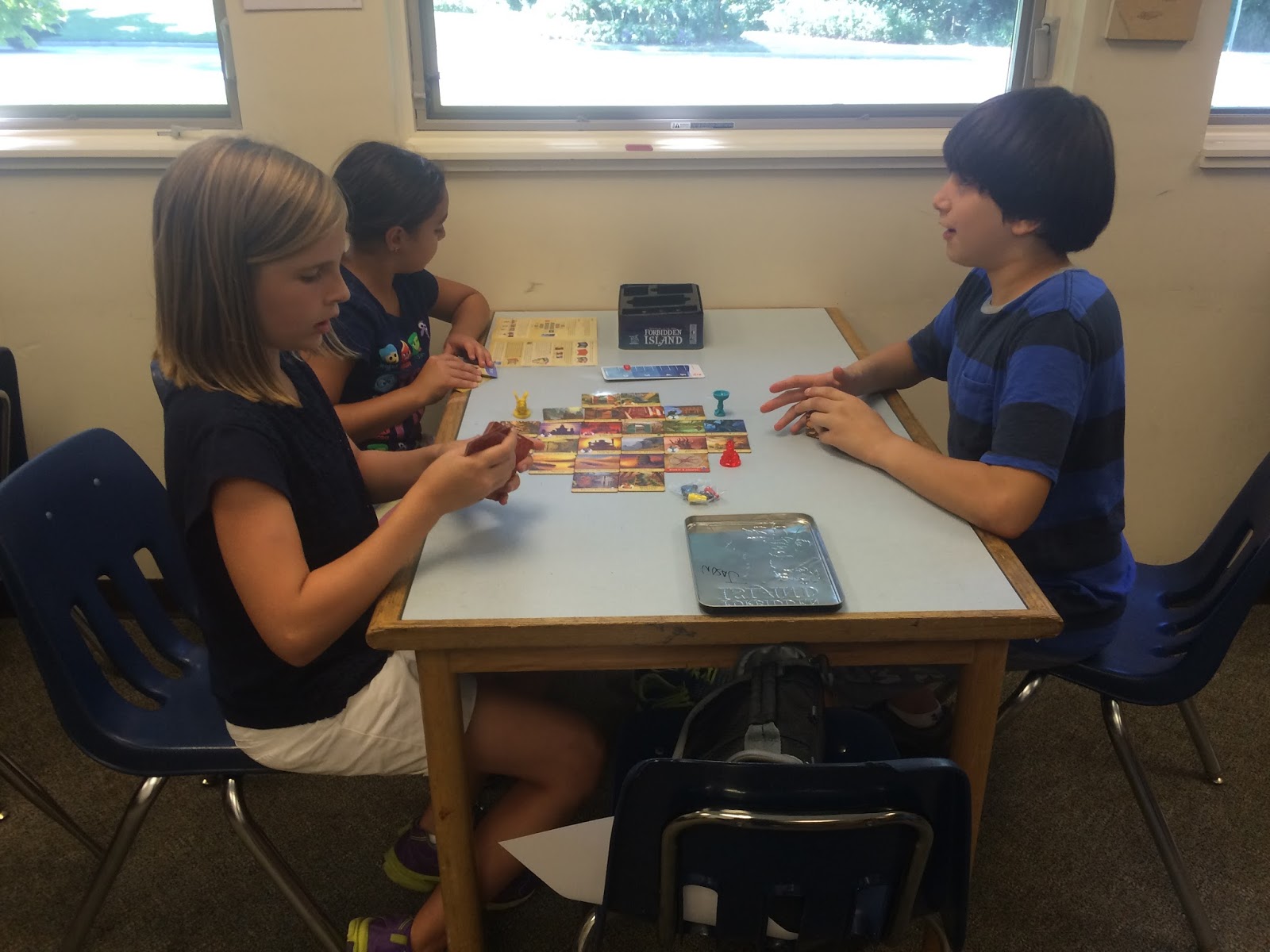
We also began using our writing journals (first prompt: “Why do people write?”), learned more about the Yanomami, played some board games, and spent all of Thursday climbing, balancing, and zip lining through the Adventure Park at West Bloomfield.

(Click through for photos)


Tagging and releasing a monarch! 


Tracking the monarch through the sky


Mark puts a lot of faith in the harness. 


In math group, we spent some time discussing what we liked and disliked about math, establishing that there’s more to mathematics than just arithmetic. We also began individual work in our Singapore books.


Thursday, September 8, 2016

Week One -- Yanomami, magic, milkweed, and monarchs


We began our year by exploring the difficulty in remaining objective when learning about something new. To illustrate this, we delved into Napoleon Chagnon’s infamous field work with the Yanomami tribes of the Amazon rainforest. How can one accurately study a culture that is entirely different than the one that they were raised in? Was his study ethical? Are his findings biased? Closer to home, what biases do we bring to our current political debate?


We also began writing stories based on the Arthur C. Clark assertion that “any sufficiently advanced technology is indistinguishable from magic.” (What would your great-great-great grandparent think of an iPad? What would someone from the stone age think of a flamethrower?)

We’re also writing and performing short skits for each other illustrating our three classroom guidelines: Awareness, Communication, and Everything Gets Respect.

Playing Factor Tag in Math class. 

Playing Factor Tag in Math class. 
Meanwhile, in our math group, we began talking about polling, and exploring how a sample of a population doesn’t necessarily provide an accurate picture of the whole group.


Our week concluded with an exciting find in the milkweed garden created by our class last year: A monarch caterpillar in "hanging j" position, which we watched transition into a chrysalis: 


We also found other caterpillars, which we took collected to raise in the protective environment of our classroom.