Friday, December 23, 2016

Week 16 -- Writing stories, making art, bowling, and sledding


The week before a big break is one that always threatens to descend into chaos. Happily, we have a few projects that have kept us busy and engaged in these last days of 2016.


The artwork for our biome games is coming along marvelously, but it’s a lot of work. Each team needs to make a total of 41 cards, each with unique artwork, and each student has taken responsibility for some portion of that. We’re also in the process of assigning point values to each card, which need to accurately represent the organism’s place in the trophic level of the biome, while also being a functional card in the mechanics of the game.
Artwork for Into the Great Barrier Reef 
Artwork for Into the Great Barrier Reef 


Everyone also started a new story from their choice of one of the following writing prompts; “Write a story in which a young superhero gets a part-time job to support his/her secret identity. Unfortunately, s/he is hired by a super villain.” “Write a story about a magician who has a terrible act… until s/he discovers a mysterious portal to another dimension.” “While digging in the woods, a child stumbles across five ancient dragon eggs…”


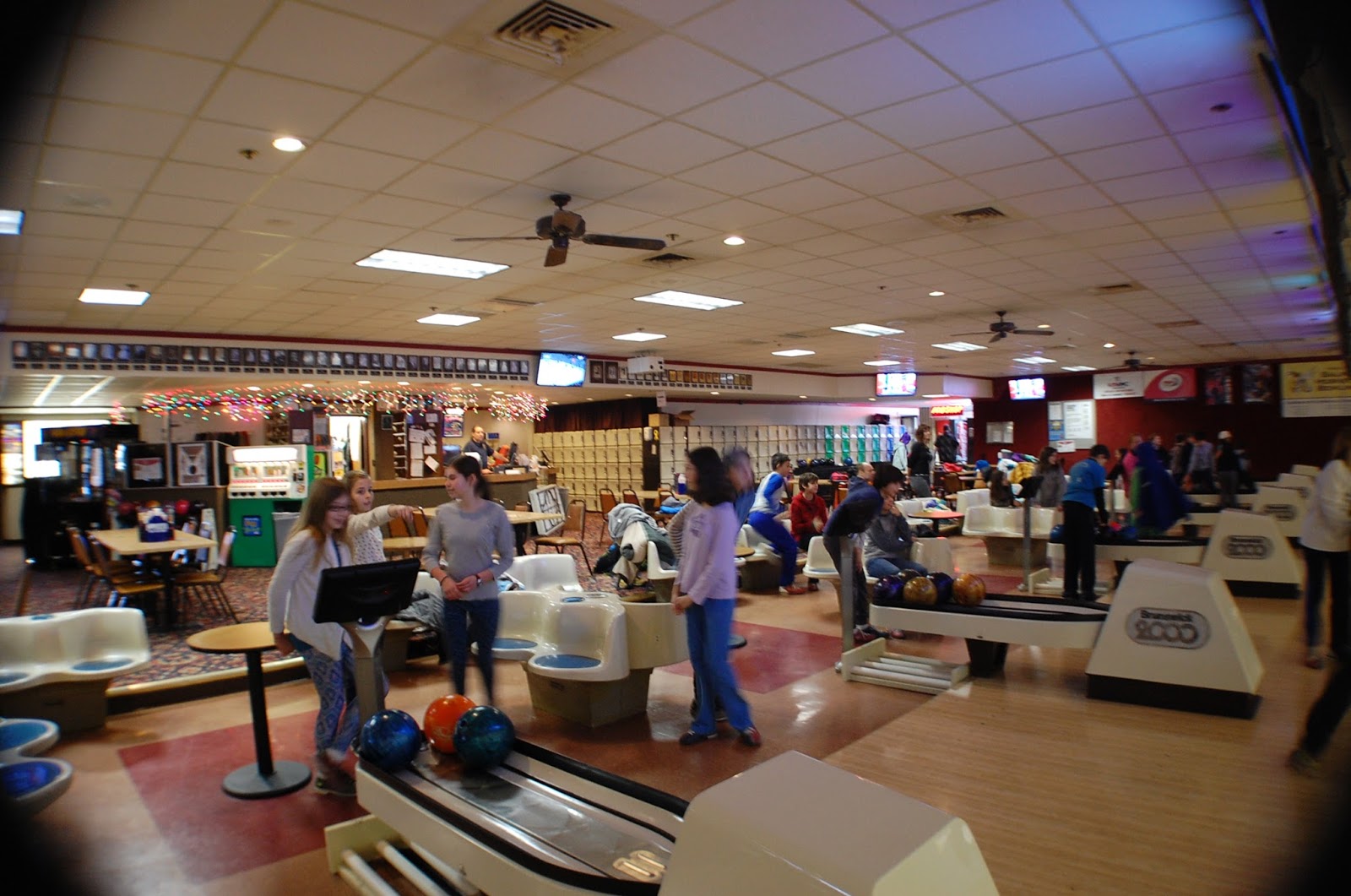
The rest of the week was peppered with other activities. We made more progress in When You Reach Me, which is our current read aloud book. The highlights of the week, however, are both the work of PE superstar Shan Cook, who arranged an all-middle school bowling trip on Wednesday morning, and a sledding trip for us on Friday. Here are 45,000 photos for you to peruse (it's difficult to shoot photos in a bowling alley):


Finally, we kept things simple in our math group, devoting one day to Singapore work, and the other to a spirited session of math games. Have a lovely break!

Friday, December 16, 2016

Week 15 -- The Nutcracker and fiascos


It’s difficult to top the excitement of an unexpected snow day, but we did our best with the rest of our week. On Tuesday, we began reading When You Reach Me, by Rebecca Stead. It’s a difficult book to talk about without giving away its secrets, so suffice to say that it begins in the late 1970s in New York City, and a mystery quickly develops. We also continued group peer review sessions of our Summers-Knoll myths, practicing active listening and giving constructive feedback to one another.


On Wednesday, we entered into a fun new phase of our Into the Biome project, which was born in science class. Kids are working in teams to create their own versions of a game we enjoyed called Into the Forest, and we began creating the artwork for the games. Our room is quickly filling with renderings of wolverines, blue jays, raspberries, sea cucumbers, and more.  


On Thursday, we traveled to the Power Center in Ann Arbor to see a production of The Nutcracker (and to cheer on our classmate Rebecca, who was one of the sugar plums!). Between that and our work on the school play last week, theatrical productions have loomed large in our minds, so when we returned to school, we listened to act 1 of the Fiasco episode of This American Life while working on artwork for our games. It’s a very entertaining story that certainly puts some of the minor mistakes that we may have made in our own performances into stark perspective.

Math group was quite abbreviated this week, as we missed two sessions (one from the snow day, the other to go see The Nutcracker). The remaining two days were spent working in our Singapore books, and doing a self-audit of progress. I had each student make note of what page they were on in their books, then told them what page they had been on at the beginning of the school year. Some students were pleasantly surprised by how much progress they had made in 15 weeks of school, while others have a renewed sense of purpose in making good use of their time and energy in class. On Friday, our work period was punctuated by a fun visit from Mrs. Carpenter’s math students, who came and performed some math magic for the group.

Friday, December 9, 2016

Week 14 -- Peer review, myth, and multiplication

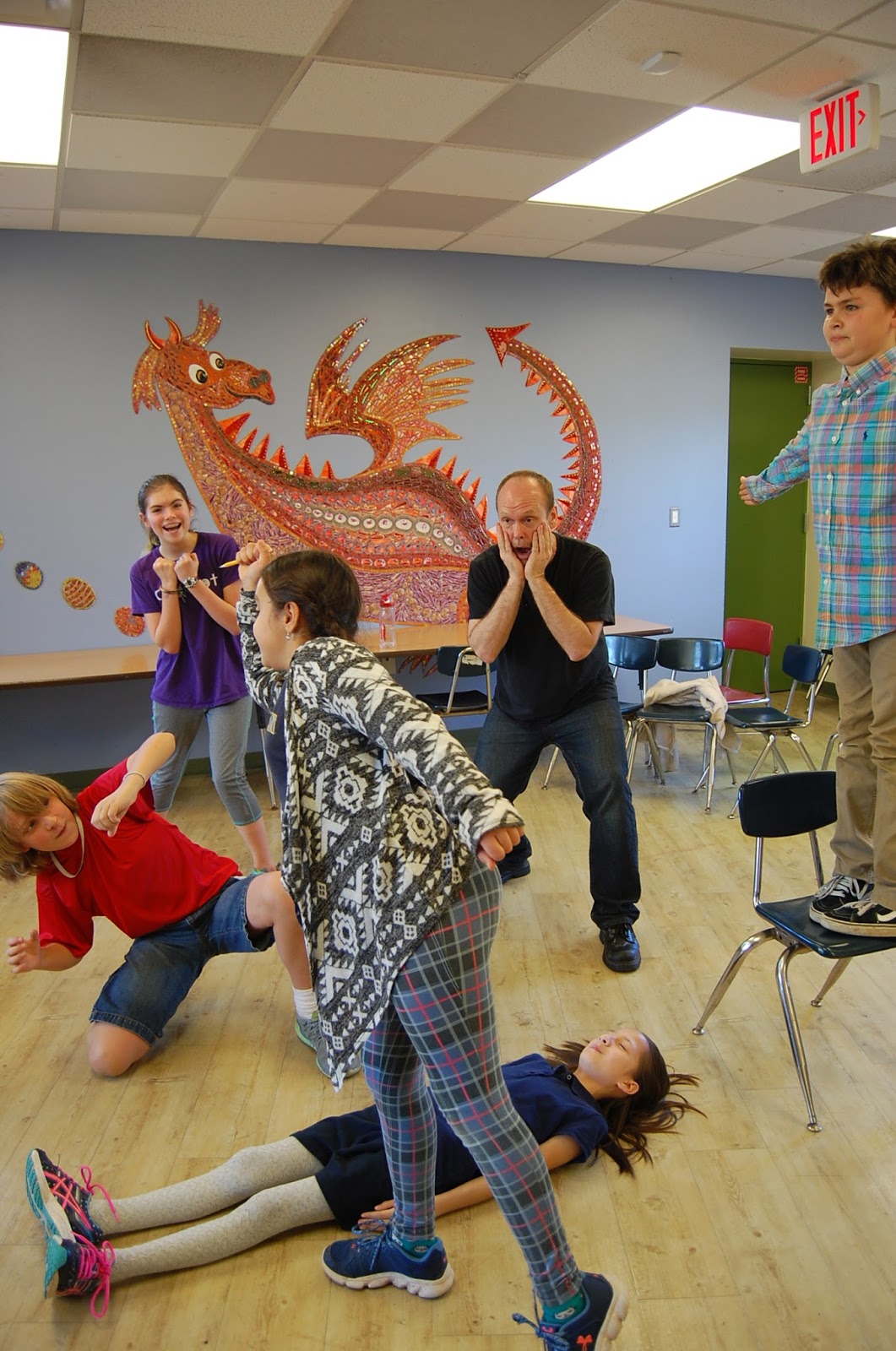
Scenes from the Stratford workshop
The week of the school play is almost always wholly consumed by rehearsal and prep, and this year is no different. We’ve spent much of our homeroom time running our lines, practicing the staging, and trying to hone our performances to make sure that we put on a good show. Meanwhile, the students who don’t have roles in the play have been working to design and construct the props needed for the show. We hope to see you at one of the performances of the show!
Scenes from the Stratford workshop
When not working on the play, we’ve been doing group peer review of our Summers-Knoll myths. Our protocol for this is as follows: First, each student reads a piece of writing to the group twice. Both times, students are actively listening for things that they find interesting and enjoyable, as well as making note of where they were confused, or where the author might want to go into more detail on something. After reading their work, the author takes control of the room and calls on volunteers. For the first few minutes, we ask only for positive thoughts. Kids might point out something that they thought was clever, an interesting turn of phrase, or praise a plot twist. Then, we switch into constructive criticism. The audience shares what they were confused by, where the author might go into more detail, etc. The author’s role during this time is exclusively to listen to their audience. Questions about the work are deliberately not answered, and points are not argued. The point is that the author knows that their audience had those thoughts while hearing the work. The author then processes and considers the feedback, and uses it as they see fit during the revision process later.


For example, an author may have intended for a particular character to be somewhat mysterious in their story. However, if they get feedback from their peers that the character came across as merely underdeveloped, they can then take that information and work to clarify their intent during the revision process.
Scenes from the Stratford workshop

This method of review requires a community of writers who are all taking the exercise in good faith, and who are actively working to support each other during what can be a somewhat harrowing process. It can be challenging and scary to receive feedback on your writing, and I am happy to report that the conversations have been kind, productive, and supportive.

In math group, we have concluded our survey of multiplication methods, culminating with the standard algorithm, which is the method that most of us were taught during our own schooling. We learned and practiced seven different methods of multiplication, On Thursday, we began an assessment to see how well we could perform each of them, while also evaluating their effectiveness. Which methods are the quickest? What are the strengths and weaknesses of each? Perhaps most importantly, which methods are the most efficient for each individual? Surveying these varied methods has drawn a fine point on the idea that there isn’t one “correct” way to perform this operation, and by examining each method and comparing them to each other, we have developed a deeper understanding of what is actually happening when you multiply.
Henry performs at the Music Cafe


Friday, December 2, 2016

Weeks 12 & 13 -- Time for school, biomes, and grandfriends


We only had two days of school before the Thanksgiving break last week, and we used part of them to begin watching the documentary Time for School. This fascinating film is a longitudinal look at five children from around the world as they progress through some form of schooling system. The filmmakers first visited them in 2003, and have followed up with films every few years ever since. We made note of many things as we watched, such as the amount of family and/or cultural support for school each student experienced. We compared and contrasted the experiences of these kids with each other and with ourselves.


We experienced a potent display of support from family and community on Grand Friends day, during which we welcomed several family and friends into our classroom and shared some of what we’ve been doing at school this year.


Much of the rest of our homeroom time has been spent working on our Into the Biome projects, in which students are working in teams to create a food web game based on different biomes of the planet.

In math group, we’ve been continuing our exploration of various ways to multiply numbers. Ask to see the Ethiopian method, or the one where you draw intersecting lines. They’re like magic tricks, but looking closely at them reveals hints of how they work, and also firms up the conceptual understanding of multiplication.

Friday, November 18, 2016

Week 11 -- Myth, music, and math


There was a big focus on performance this week. The most public example of that was a substantial amount of preparation for the Friday night’s Music Cafe. Keyboards, drum sets, music stands, and the occasional harp were dragged to and fro as kids found places to practice their pieces for the show. We also received our parts for the school play, and we began our first proper run throughs of the script. We also began reciting our Summers-Knoll myths to each other. You may recall that we’ve been writing stories that convey some aspect of the culture of Summers-Knoll. Now, we’re telling them to each other and seeing what aspects resonate with people and survive later retellings. In addition to being audiences for each other, we were able to spend part of Wednesday morning attending the poetry exhibitions of the 7/8s to see what they’ve been studying. Finally, some we were visited by some actors from the Stratford Festival, who engaged the entire middle school in some acting exercises. 

Our journal writing prompt this week was, “A ship in harbor is safe, but that is not what ships are built for.” It’s a thought that speaks to the spirit of risk-taking and courage that emboldens these kids to stand up in front of each other and our community to tell stories, sing songs, and share themselves so openly and publicly with the world.


In math, some students took a risk of another sort by participating in the AMC-8 math competition on Tuesday. Math competitions aren’t exactly a common occurrence at Summers-Knoll, but they are certainly an interesting thing to opt into for a unique experience. Meanwhile, our class began investigating the concept of multiplication, discovering that there are actually dozens of ways to perform this seemingly mundane mathematical operation. It’s an investigation that we’ll be continuing in the weeks ahead, learning different methods and then evaluating them for precision and speed.


There was some time after Science class for some fall fun on Friday:


Friday, November 11, 2016

Week 10 -- The votes are in


Our warm-up for Wednesday morning. There was a lot of stress in the air.  


A few minutes before school began on Wednesday, one of the students in our class said, “I have a feeling that today is going to be a very odd day…” It was indeed. One thing that I think most people of all political leanings can agree on is that this has been a notably odd presidential cycle. 5th and 6th graders, even the ones that seem savvy and sophisticated about such things, can have a difficult time processing it all.
Leading up to the election, we talked a bit about political parties and how they work. The general idea was that not every Democrat believes the same thing as every other Democrat, nor does every Republican believe the same thing as every other Republican (and the same is true, of course, for other political parties). This drawing illustrates the way different platforms are created, and how coalitions are built. 

Rather than doing a post mortem on the late night results of the election while emotions were still so high, I opted to address the matter in a more roundabout way. We spent most of our homeroom time on Wednesday watching the 1957 classic 12 Angry Men. It’s an excellent film, and it was a soothing balm for anyone who was feeling unease about people in general, and the United States specifically. It portrays unconscious prejudice, overt bigotry, and casual indifference to others, then counters them with a passionate rebuttal of reason, logic, and decency. The trajectory of the story shows that one person of principle can stand up against a crowd and truly make a difference. It happens through reason, patience (along with some anger, which is right in the title), and consensus-building. People find that they are able to work together as they start listening to one another, and ultimately, everyone in the room has valuable things to say. The film is timeless in some ways, and dated in others. The stuff that’s out of sync with us today are things that are useful for driving conversation. Most glaringly, it’s called 12 Angry Men, and indeed, the entire cast is white and male. Were one to imagine casting this story in 2016, it would be a stark reminder of how far we’ve come.
The film also allowed us to get at some very basic aspects of our judicial system, such as “innocent until proven guilty,” “a jury of one’s peers,” and “burden of proof,” and we spent part of Thursday reflecting on it through a written assignment.
Our journal writing prompt for the week 

We balanced out the week with some less intense stuff, such as a journal prompt (“In what ways is writing a more effective communication tool than speaking?”), play rehearsal, and good old Scholastic News.

We only had two days of Math this week. One day was devoted to Singapore work, and the other was spent practicing some problem-solving strategies that we’ve learned this year. Some students are opting to take the AMC-8 next week, so part of Thursday was spent registering for them for the test next Tuesday.


Friday, November 4, 2016

Week 9 -- Yanomami mythology


Mythology remains on center stage for us this week. On Tuesday, we got our first look at our section of the annual all-school play. Our section is an adaptation of two Yanomamo myths. One tells the tale of humans stealing the secret of fire from the mouth of a great caiman, the other explains the concept of Moon’s blood. We read through the script as a class, then spent the next day making note of striking imagery in the tales (there’s plenty), as well as the clues that reveal aspects of the values of the Yanomamo culture.

We also did this exercise after a birthday-inspired viewing of the Twilight Zone episode “After Hours.” There’s plenty of striking imagery in that as well, and we examined what messages we could discern from from what we found funny and/or unnerving.
These studies are all culminating with an examination of our own culture here at Summers-Knoll. What values do we share? What customs do we have? What are useful lessons that our community passes on? We brainstormed a giant list of these along with a list of striking, Summers-Knoll related imagery. Students are now working on creating myths that incorporate some sort of S-K cultural belief or story, punctuated with striking imagery that will help reinforce the tale. If we start hearing strange stories trickling through the various homerooms in the weeks ahead, we’ll know that we’ve been successful.
We created a huge list of striking imagery and cultural values related to Summers-Knoll. This is part of it. 


Bora choosing how we will celebrate his birthday. 
Our journal prompt for the week

Math got off to an exciting start this week with our annual school Halloween parade. By the time we had marched to County Farm Park and back while admiring and showing off our costumes, there wasn’t much time for math. Instead, we watched a brief episode of the “educational” series Look Around You. Ask your child about “Maths,” and at what point they realized their math teacher was pulling their leg. The remaining days this week were devoted to Singapore work.